
Why You Should Try Structuring Your Articles Before Writing Them
What started as an experiment turned out to be my most useful tool

Countless times I’ve been sitting in front of my computer, ready to roll and eager to create my next viral article (or at least a decent one), and almost all those times my head would struggle to calm the whirlwind of thoughts I held inside it.
I don’t say it’s a bad thing to have a lot of ideas you can transpose into great stories. That is the ideal part. What is tough, though, is to have an endless source of inspiration, yet to be unable to lay anything on paper.
Some call it writer’s block. I wouldn’t call it like that, because I’m not lacking ideas and for sure I’m not blocked. I could write down everything that’s going through my mind, but chances are it won’t make much sense to the reader. There lies my real problem.
Given my situation, my mind started wandering in so many directions, trying to find the underlying cause.
- Is it my non-native English speaker status?
- Is it that I’m not as good at writing as I presumed I’d be?
- Am I that chaotic in thinking?
Even though all these questions were valid ones and there was some trace of truth there, they didn’t satisfy my curiosity, as I couldn’t completely agree with them. I felt there was a bigger issue I couldn’t figure out right away.
Thankfully, the uncertainty didn’t last forever. When I was trying to summarise a lecture for an exam at med school, writing down only the titles, subtitles, and main ideas, it hit me.
I should be doing this with my articles, too!
Human attention and appreciation are two very ‘pricey’ things nowadays. The world we live in is so agitated, fast-paced, and full of distractions, it’s harder and harder to be an outstanding character.
If you feel like you’re falling into the same category as I am, it shouldn’t, however, make you lose motivation and give up your work. It should only come as a disclaimer so that you can better adapt to this context and thrive. I learned that only through experience.
With these being said, I will walk you through the steps I took that really made a difference for my content, and hope it will do the same for you, too.
Firstly, a switch of angle
Imagine you are the reader. You are scrolling down on Medium and you click on a title you find catchy or in your area of interest. You start going through the story. It’s not too long, not too short, it takes just the perfect amount of effort you’d want to put into reading it. However, when you reach the end, you realize you kind of enjoyed your read, but you forgot the main idea.
Well, isn’t that unsatisfying?
I know that because I’ve tried putting myself in the shoes of a reader. To be a writer, you have to enjoy others’ work, too, if not to prioritize it.
Readers are pretty busy people. We all are in this century. Given so, they sure want to maximize the free time they have here and there. Wouldn’t you, too?
Furthermore, they would most certainly want an article to be as clear and concise as possible, with an introduction, a conclusion, and all the constituent parts in between well organized, so that they can mentally summarise the read easier and feel like they’ve actually learned something new.
I know what I’m saying so far can come as nothing new under the sky. But what if I tell you that we can make our articles much easier to read if we just reverse the steps a reader has to take?
Let me explain…
Where is all this coming from?
As I have mentioned before, I am a medical student. That means I have tons of lectures to study and exams to pass. With that much information to process, I can’t possibly learn any other way than trying to extract the main points out of every lecture.
Every time I had to memorize a course, I would read it and then try to draw sort of a mind map. I would write down the title of a chapter, the subtitles, and under every subtitle, I would try to summarize tens of sentences into two or three that will offer me a general view.
Doing this has enormously helped me during my exams, as it’s way easier to access the information when needed. I wouldn’t have to think of a whole course or book, as I would just think of my mind map, access a certain subtitle and its main idea, then remember what’s it all about.
What does it have to do with the readers?
Everything. As I’ve said, they want an article to be clear and concise as possible. The more organized, well divided, and with a clear takeaway yours will be, the less will people struggle to understand what you wanted to say.
A reader can sense if your story doesn’t make much sense. They can feel when there’s a mixture of ideas that don’t add up or aren’t supposed to be there.
The good news is that it’s not the end of the world. Not at all. You already are in possession of your ideas. You just need to rearrange them in a way that makes it easier for the readers to digest the information.
What does it have to do with the authors?
How to get to the desired level of logic and clarity without first experiencing it yourself? It’s way easier for the readers to discover the main points of your story when you already know them yourself.
Wouldn’t it be easier to imagine that ‘structure’ or ‘mind map’ I am telling you about and write it down so that you roughly know how the article will look like and only then let your inspiration do its thing in a more directed way?
I sure know it helped me. This process has pretty much reminded me of how I usually take my notes in med school, and how they come in handy every time, easing my otherwise desperate search for information.
My first attempt — a sample to share
Now, I will start by telling you about my first time trying this technique. This way, you can picture what I’m talking about. Afterward, I’ll show you how you can adapt it to better suit yourself.
Even as kind of a new writer on Medium, I wanted to get into the big publications. Considering that I’m as stubborn as an Aries can get, I wanted it to happen as fast as possible. Even the next day would have been nice. However, we all know it isn’t that simple, and practice has its own purpose.
For quite a long time, I didn’t consider any of my articles to be worthy of a big audience. My optimism started to lose its breadth. I’ve even tried submitting a couple of times to a well-known publication and got rejected, obviously. Well, I got rejected… until I didn’t anymore.
What changed?
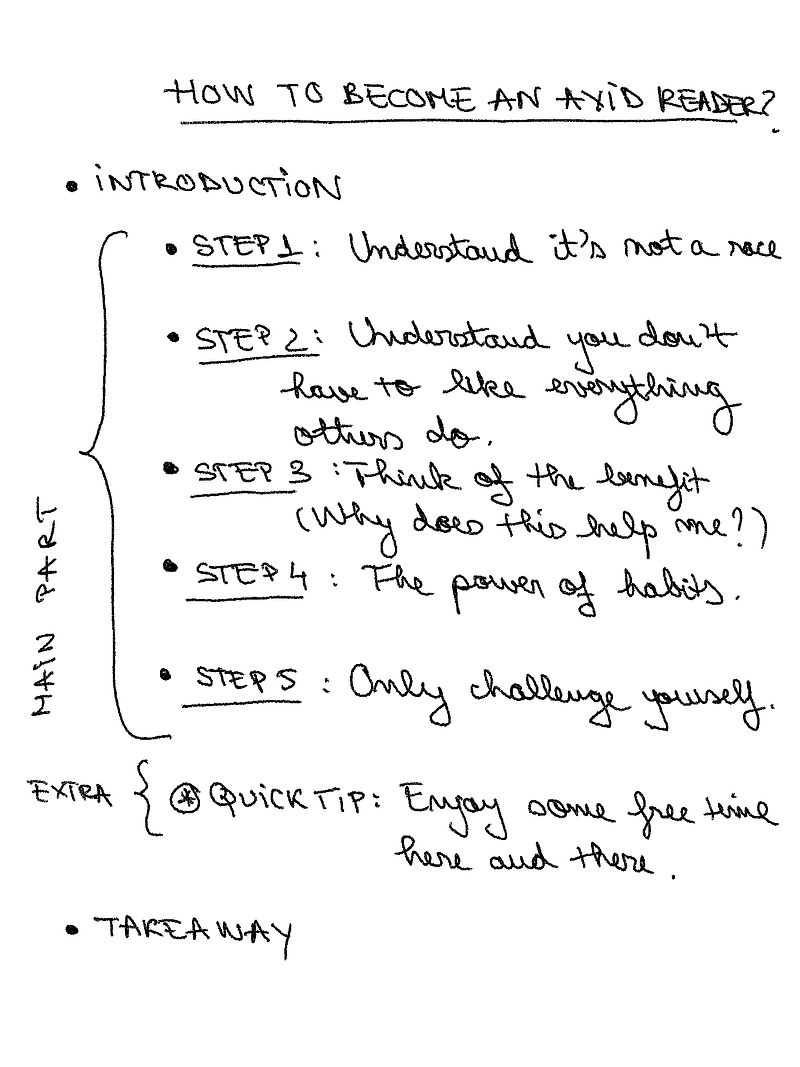
The sketch
As you can see in the image, this is a sketch of an article. It was my first attempt at approaching the way I write differently. It was also my first time getting accepted into a big publication.
Instead of opening the editor, choosing the headline, and getting it started, I closed my laptop and grabbed my paper tablet.
Then, I asked myself:
- ‘What do I want to write about?’
- ‘What are the main points I want to cover?’
- ‘What’s the message I want the World to receive?’
While asking all those questions, I started laying the answers I could come up with on paper (better said, on my paper tablet). This brainstorming process summed up into developing my ‘structure’, consisting of a title, an introduction, the main part, and a takeaway.
Here’s a summary of the steps I took:
- Firstly, the title was my guide to building this structure. I imagined something I wanted to share, transformed it into a killer headline, then expanded that headline into all I could think of related to it and relevant to the readers.
- Regarding the introduction, I wanted it to be something I spontaneously created. Given so, you can only see the word ‘Introduction’ pinned right under my title. It’s a reminder for myself that this is what I have to start my story with.
- After the introduction, comes my main part. As you can see, I divided it into five steps. I have named them ‘steps’ and not ‘main points’ because it somehow helps my mind be aware of the logical course of the story. Maybe it’s just my thing, but I find it helpful. Also, you can notice that every step is followed by a sentence. You can also see me call them subtitles.
- That ‘quick tip’ is just a little extra to my main part. It is not a takeaway, but rather my personal touch. A piece of advice you may call it.
- Finally, the takeaway. This is my favorite part. You can also call it the conclusion. In the end, all that matters is that you make sure you have made yourself understood. Again, this is something I wanted to spontaneously create.
Your (possible) first impression
Looking at my sketch, you can notice it’s pretty short. It doesn’t offer you a precise view of how long my article will be. What it does show you, however, is in which directions it will go.
Every step in the main part is a subtitle, obviously related to the title, and it tells me exactly what I should write about in that section. It helps me work smarter and more efficiently, instead of wasting time trying to remember what was my next paragraph supposed to be about.
My personal impression
I found this technique to be a game-changer. I never would have thought that my uni routine could help me with my content creation. Sometimes, your unfair advantages are right under your nose, but you simply don’t know where and how to apply them. Thankfully, I know better now.
How can you use this technique?
A bit of introspection
First of all, you need to be honest with yourself.
Try to think if you resonate with what I’ve told you about my struggle at the beginning of this article. Maybe you have encountered the same problem from time to time and didn’t even realize it.
If not, at least, consider it an experiment and see if it helps you in any way. It can’t hurt trying to adopt a new perspective and see if it works for you. Maybe you will have even more success with it than I did!
Ready? Set. Go!
Let’s start with something simple. Remember what I was doing with my lectures? You can do it, too. Take one of your already published articles. Read it, and then extract its main ideas. If those main ideas are too generic, break them into a few more specific ones. It should look something like this:
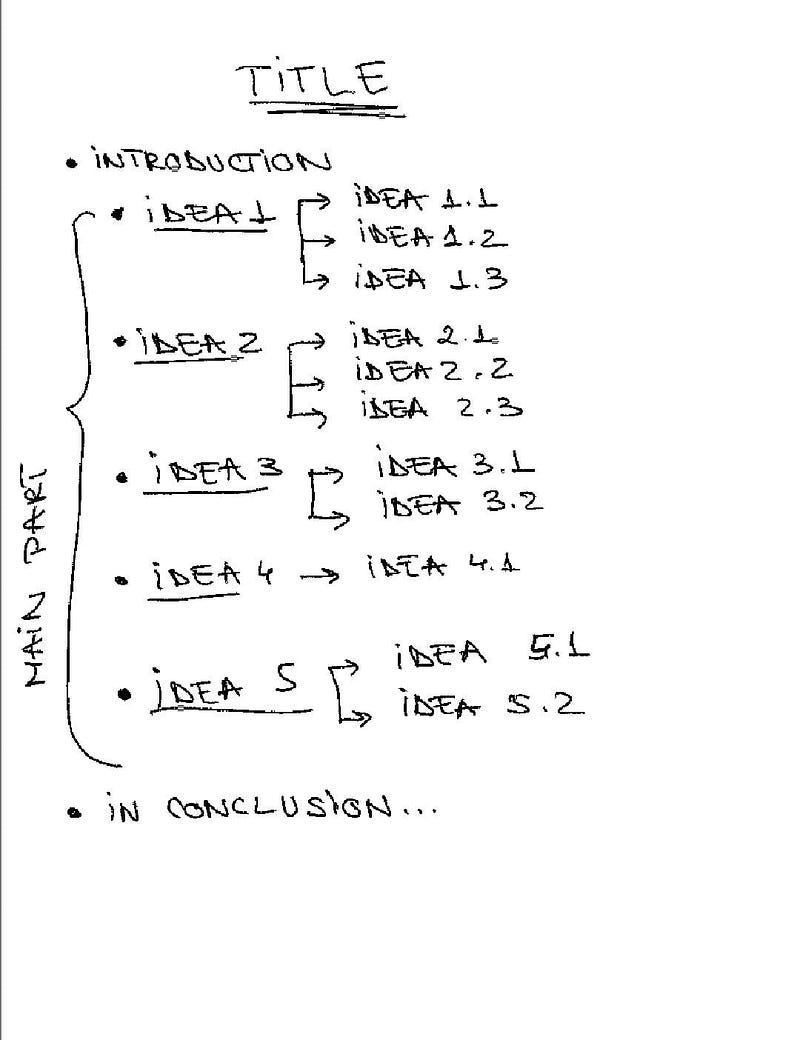
The number of main points really varies, depending on how long and full of information your story is.
This is an exercise to help you visualize how 500, 1000, or even 3000 words can be reduced to a lot less. This is what you want your reader to remember. It’s the least you can shrink up your article to. This condensed form not only contains all the information needed but is also a lead to all the extra parts.
The “do it yourself” part
Here are the steps you need to take:
- Pick a topic. Let’s say you’ve just finished a great book and you want to share its insights with the world. Therefore, your topic would be reading/books.
- Think of a headline. I find this to be the hardest part, as it’s my ticket to winning the audience’s attention. Don’t put that much pressure on yourself, though, as you can always adjust it afterward and make it look more interesting. However, you shouldn’t make radical changes and the general view should remain the same, considering it dictates what you’ll be writing about. For example, I’ve changed my ‘How to Become an Avid Reader’ to ‘These 5 Secrets of Becoming an Avid Reader Lie in Every One of Us’.
- Now that you’ve picked your headline, stare at it for a while. Take your time. If you already know what you want to write about, then it’s great. If you had a passing thought you considered interesting, keep staring at your title until ideas start emerging. Every time they do, write them down. Those are your main points.
- Now that you have identified what’s most important in your article, break those main points into a few more ideas. If the subtitle is already pretty self-explanatory or can’t be divided, keep it like that. As long as what you’ll be writing about in that sequence is clear, you nailed it.
- Don’t forget to add the ‘Introduction’ and ‘Conclusion’ in your structure. Here, you can apply my method of pinning them as reminders, or you can note a thing or two. It’s really up to you.
- Add any extra details here and there if it helps. It’s your sketch after all! You should design it in a way that advantages you.
- Rearrange if necessary. Logic is what you want to achieve through this process. If it doesn’t make any sense, the reader will feel that right away and will simply not bother to continue going through it.
- Wait until the next day. Who knows what you will dream of that might turn out to be a useful extra?
- Take a look at it once more. Are you satisfied? Can you begin expanding all those ideas? If the answer is yes, then great!
- Congrats! You’ve made it this far. Now start writing your story!
Quick tips
- You can see it as a challenge. You can consider it an experiment. Whatever you call it, what’s bad in trying something new? Worst case scenario, you get back to your own style. In the best-case scenario, it can become a tool as useful as it is for me, if not more.
- Take everything a person says (including me, of course) with a grain of salt, yet bear in mind the possibility of it becoming a true asset.
In conclusion
Structuring my articles before writing them was an experiment I firstly attempted not so long ago, but the technique itself was definitely something I’ve used for a long time in my uni life.
I really hope it will come in handy to those of you reading my article. If not entirely, maybe you can at least take some parts of it and use them to ‘craft’ your own method, inspired by mine. Either way, I’m glad to play even the slightest role in the development of future writers and in the bettering of existent ones. As my favorite quote says:
“We rise by lifting others” — Robert Ingersoll