
Why You Should Take Risks When You’re Young
The real danger is not to try.
The doomscroll has never been more alive.
You don’t even need to go online. The notifications will come and find you. Everything that’s wrong with the world and a thousand things that aren’t, splashed across your phone screen whether you want them or not. We hover, they want you to believe, on the brink of societal collapse. If the disease doesn’t get you, the fascists will. Or the communists, if that’s your flavor of despair.
It doesn’t matter what you believe. It only matters that you’re afraid.
Because when you’re afraid, it makes sense to hide. Stay where you are, breathing in the noxious exhalations of the devil you know. Outside your door, there’s a world you can’t control. It could harm you.
Of course, that’s true. But there is no life without risk. While everyone talks about the dangers outside, they don’t mention the risk of staying where you are.
Driving to work carries far more risk than shark attack, yet one makes headlines while the other doesn’t. We’ve become a society of narcissistic narcs, constantly filming one another through gaps in twitching curtains while we sip filtered water around the gaps in our moist masks.
It never used to be like this.
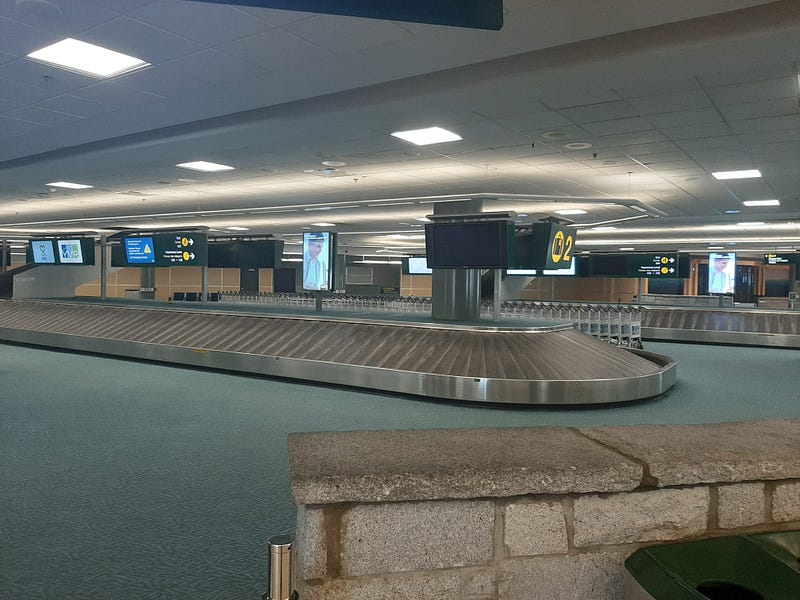
The baggage carousels are still and silent, steel scales overlapping like the peeling skin of some monstrous fish. The stores are closed. The echoing halls are nearly empty. There are more staff than passengers, and they speak through cloth masks that mangle their words almost as badly as the squawking radios they carry.
I’ve been here dozens of times. Late nights and early mornings in the same airport, in sun and snow and the omnipresent rain. I’ve never seen it this empty. This abandoned.
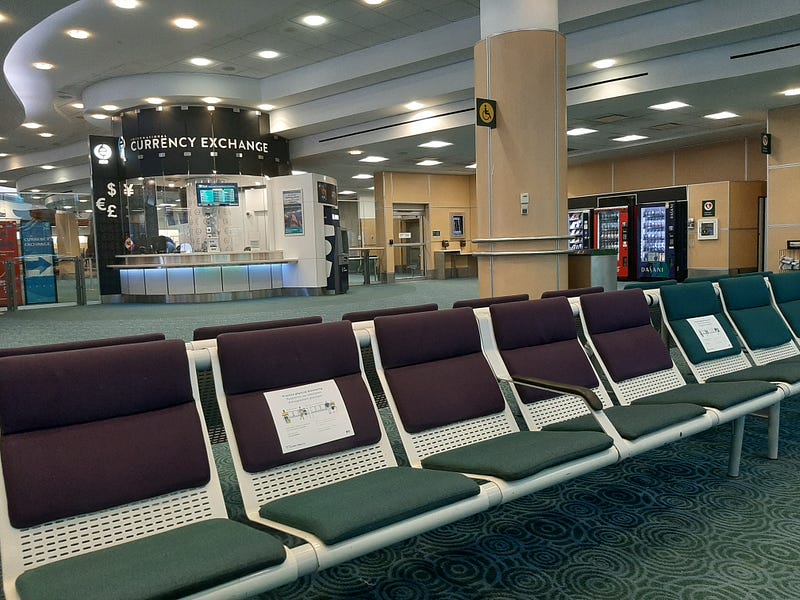
There’s a special silence that exists only in places that are normally loud. School hallways and train stations and, yes, airports. No graveyard is as quiet as this.
This time, I’m not allowed in the arrivals hall. Tinted glass walls keep me out. This time, I don’t have the magic scroll, the barcode and ticket that work like a password on the dull-eyed gatekeepers of the airport. But I remember it. I’ve been there so many times. And like anything important, each time reminds me of the first.
There is a waterfall in Vancouver airport. Between descending flights of stairs, clear tapwater slides in a glittering curtain down the wall and runs over a bed of smooth pebbles like the streams that pierce the mountains outside. The arrivals hall is all wood and stone under its modern steel roof. At the end of the stream, two towering wooden columns carved by Indigenous artist Susan Point mark the entrance to Canada.
And as she passes those columns, her soft eyes wide open despite jetlag and infinitely receptive to the thousand minute miracles of a wholly new environment, I sit in an abandoned lounge and wait for her.
Somewhere, somebody is snoring. It’s so quiet in the airport that I can hear the steady rumble of their breath. And I wait, breathing through cloth and remembering how it felt to start life all over again.
I was 20 years old the first time I made my way through those columns. The tiny world I had known all my life lay on the plane behind me, crumpled up and thrown under the seat. In front of me was the vast unknown, the secret the mountains hide, the blackness at the back of the moon.
Seventeen years later, I still haven’t forgotten the unrepeatable feeling of stepping off the plane and starting a new life in a foreign country. The absolutely limitless freedom of being in a place I had never been before, where nobody knew my name or my past. Where everything I would experience, good or bad, would come to me through my own decisions.
That moment alone was almost worth the journey. To be young and standing alone and staring into nothing without blinking. To taste freedom like blood between my teeth.
All achievement comes from risk.
Take it from a guy who used to gamble for a living. The more you put in, the more you win.
And yes, sometimes you lose. Not all gambles pay off. But although it sometimes seems otherwise, life is not a game of chance. Not completely, anyway. Failure is a virtual guarantee for all of us. But it’s also the path to everything worth having.
The reason why people envy the young isn’t smooth skin, painless joints, and sexual stamina. At least, those aren’t the main reasons. What you will miss as you get older is the boundless possibility that comes with being young. The ability to absorb hardship and recover from it. To bounce back higher.
Because even your successes will rob you of your freedom. Every achievement unlocked is one more bar in your prison, one more gate swinging shut across a path you can no longer take.
When you’re young, you may have nothing. No money. No skills. No connections. But you do have an abundance of time. And it’s time that turns mountains into meadows.
The art of being young is to fail. To make mistakes. To take those risks and chase those dreams. Because as you get older, you’ll start to have some success. And that will trap you more fully than failure ever could.
Every time I go to Vancouver airport, I remember that first day.
It was Halloween. But the sun was shining as though it were July, and the mountains that rose above the ocean have never looked more beautiful than they did the first time I saw them.
The mountains are still there. And oceans last forever. But seventeen years later, the world has changed completely. Now we cower and quake and hide from disease. Now we wear masks in public and wash our hands until our skin splits. The bars are closed and the economy is ruined and society hangs everywhere in tatters.
My niece is a full two years younger than I was when I stepped off the plane. It’s different for her. I’m here to pick her up. And her father is waiting on the other side of the mountains, eager for her quarantine to be over. He came to Canada because I was here, and she came because of him, a spiraling stereoscope of cause-and-effect arcing forward into infinity like mirrors reflecting one another.
We never know, when we step off these planes, where our stories will lead us.
She’s eighteen. She doesn’t fear a pandemic. She doesn’t fear anything. And gray heads may shake and call it naïve. If she knew what they knew, they say. Stay safe. Be careful. Stick with what you know.
But she didn’t listen. Beyond the western horizon, she saw a new world glowing, and as young people should, she reached out to take it.
It’s not the same.
It’s never going to be the same. I wanted for her what I had. That wild and reckless possibility. That limitless potential future that doesn’t last long, that shrinks like a tide pool with every decision you make.
Soon, too soon, you find yourself hemmed in on all sides by responsibilities and obligations and triumphs and fears. Some cages are built from gold bars. That doesn’t stop them from being cages.
My niece can’t have the experience I had in 2003. The world has changed. She has family here and a place to stay and a university to attend, while I had a backpack full of clothes speckled with hot rock burns and a Lonely Planet guidebook. She’s more privileged than I was, and less fortunate. Luckier, and not so lucky.
But her story will be her own. Because even in the teeth of the world showing its fangs like never before, she still had the courage to try.
And I’m sitting here scared.
It’s not about the money. It hasn’t been since I started making some and realized how unhappy it made me. I’m not for this world, or it’s not for me. Not really. I can function the way I do at parties, teeth clenched behind my smile, beer bottle gripped tight in my squeaking fist.
I can endure. I can even rack up a few wins in this pointless status game we’re all forced to play, trading worthless scraps of paper for irreplaceable hours while everything real slips slowly away.
But it’s not who I am. Maybe I was chasing that first feeling of freedom I had in Vancouver airport when I decided more or less on a whim to move to Italy. This time, I had a wife. This time, I had some money in the bank. This time, I was 33, not 20. But I was chasing that same glow I saw when I was young, the strange light that has nothing to do with the sky and everything to do with the eyes that see it.
It worked. The six months we planned to spend abroad turned into two years. I found a new career. Forced into finding a way to make money in a country where I couldn’t work a regular job, I became a writer. Under that ancient sunlight, I felt myself sprouting wings.
Everything good in my life has come from my decision to take a big risk when I was young.
I came back because of money. Because of the things I owned and the demands they made upon me. I came back to sell my house and then got trapped by a virus. And now I huddle in the shadow of unfriendly mountains and wish I was somewhere else.
I worry about making a clumsy step. I worry about making a mistake. I want my old life back, the one I had on the Mediterranean where the sea is always calm and the sun never stops shining. But I don’t dare do it. I watch the graphs climb and the numbers rise and I know that until the sickness runs its course, I’m in the best place I could be.
But when you’re young, it’s different. Where you are now may be the worst place you could possibly be. For all the fear and doubt and uncertainty that comes with being young while everything seems to be changing, one fact remains.
You’ll never be free if you’re not free now. The sky will never be so open, the borders never so porous, the future never again as limitless as it is when you first become an adult. And as dangerous as the world undoubtedly is, the greatest risk is not in trying something new, but in refusing to move at all.


