
Why You Should Stop Multitasking Now
It damages your concentration and makes you behave like prey
It is an ordinary morning for most inhabitants of the Tanzanian savannah. Except for a Lioness and its hungry cubs. The urge to feed her offspring increases the female feline awareness. She fully mobilizes her senses to the approaching herd of antelopes.
Or maybe not.
The lioness, in reality, does not care about the herd. She is laser-focused on a single antelope. One that is slightly behind due to a numb leg, probably a result of sliding in a rock after the recent rains.
The feline focuses all her plans during the next minutes only on the numb antelope. She assesses how fast he can be, his escape routers, even the exact point where she should burst and dash to catch her prey. She is laser-focused, she is surgical. If she worries about the cubs' fighting-games, about the herd, or her tax-returns, she loses the prey.
The entire world for the lioness at this moment is that numb antelope.
The lion does not multitask. Neither should you. Here I will explain to you why.
Multitasking weakens your memory
To multitask with frequency damages our memory. It is even worse when it involves multiple media sources.
According to a published paper from the University of California and Stanford University, people who often engage with many media sources at the same time showed worse results on simple memory assignments.
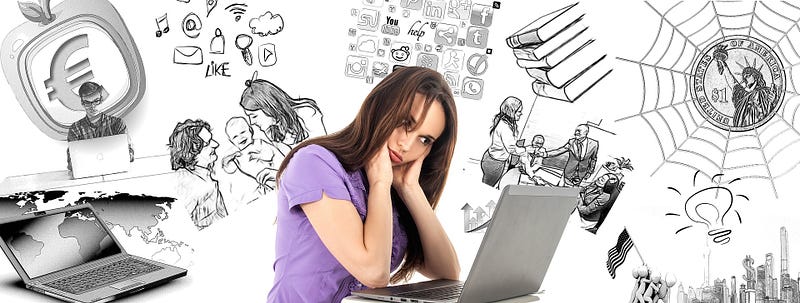
We are talking here about the so-called Heavy media multitaskers. They have multiple media channels open at once, switching between them. A student writing his thesis on a laptop, while occasionally checking the TV, responding to Facebook messages, and then getting back to writing, for example.
People similar to the example given above showed a higher probability of experiencing lapses of attention. The attention lapses then contributed to poor performance on cognitive memory tasks.
One explanation from the researchers is that we never truly multitask, but we task-switch. The constant and frequent task switching reduces efficiency. And this is not the only problem caused by it, which we will cover again later in this article.
Multitasking reduces the ability to mobilize your executive functions
Our brains have a set of tools called executive functions. They manage cognitive processes and decide how, when, and in what order tasks are performed. According to the researchers Joshua Rubinstein, Jeffrey Evans, and David Meyer, this happens in two stages:
Goal shifting: Deciding to do one thing instead of another
Role activation: Changing from the rules for the previous task to rules for the new task
The time between the two stages may be only a second. However, when we are task-switching all the time — remember that in reality, nobody multitasks, but task-switch — these seconds will add up and become minutes, maybe hours of extra-work. According to Meyer, productivity may fall as much as 40% by the mental blocks caused by switching tasks.
Multitasking lowers your IQ
Grey-matter is one of the main parts of your brain. It contains most of the brain’s neuronal cell bodies and includes parts involved in muscle control, sensory perception such as seeing and hearing, memory, emotions, speech, decision making, and self-control.
Explanations made, let’s dive into where it gets interesting:
Scientists at the University of Sussex obtained MRI scans of people spending long periods on various devices, like texting while watching a movie. The scans showed lower grey-matter density. This likely means they had less cognitive control and were prone to suffer from a poor attention span.
Psychologists long believed that cognitive impairment from multitasking was temporary. However, new studies suggest that the effect could be longer. Heavy-multitaskers showed an IQ decline similar to individuals who have stayed up all night. Some male participants had an IQ drop of 15 points. This puts their IQ at a level similar to an eight-year-old child.
In another article, I wrote about the benefits of deep-work. Deep work means deliberate practice, focused on a single activity for longer periods. One of the greatest advantages of it is the increase in cognitive capacity. This is exactly the opposite of the detrimental effect of multitasking.
Multitasking increases stress levels
High heart rates are often a signal of stress — especially when physical activities are not involved and people are healthy.
Researchers from the US Army and the University of California discovered that heart rates of employees with continuous access to email were permanently higher.
While multitasking (or task-switching) between trivial activities like doing the laundry or chatting on the phone may not be stressful, the more important the tasks involved, the higher are the chances of disaster. This may be the reason that successful surgeons have the ability to mono-task during hours, as a Cleveland Clinic article points:
To isolate out of the multitasking world brings many benefits, in all walks of life and in any setting, including the workplace. It certainly has been an essential aspect of our careers.
People assume that the skill of a surgeon is primarily in the steadiness and precision of his or her hands, and there is some truth to that. But the proficiency of surgery is the ability to single-mindedly focus on a single patient and complete a series of tasks, all in the pursuit of a given outcome that may take many hours to finish.
Improving your productivity without Multitasking
The discoveries mentioned above, from some of the greatest universities in the world, point in a single direction: Multitasking during important tasks is detrimental to your performance.
Among the skills negatively affected by the constant task-switching are attentiveness, mindfulness, and learning. While for trivial activities, multitasking is not a problem, during work it may thwart your success.
Media companies, in special social networks, spend colossal amounts of resources to capture your attention. This makes the fight against the constant distraction and task-switching a difficult mission. In other articles, I wrote about how Facebook is using science to capture your eyeballs, and in another piece, I told how too much time on WhatsApp is making us dumb.
But it is still possible to win the fight against distraction and frequent task-switching, and make your performance soar.
If you find yourself task-switching and distracted, take a look at techniques like the Pomodoro, developed by Francesco Cirillo. I also recommend the methods from Cal Newport to practice deep-work.
You do not need to be a Formula 1 pilot, a surgeon, or an air-traffic controller to benefit from a fully focused, mono-tasking practice. In a myriad of fields, we deliver our best one thing at a time.
Levi Borba is the CEO of expatriateconsultancy.com and a best-selling author. You can check his books here and subscribe to his future articles (and receive a free ebook) here.
This article is for informational purposes only. It should not be considered Financial or Legal Advice. Not all information will be accurate. Consult a financial professional before making any major financial decisions.