
Art Appreciation
Visit an Art Gallery and Recharge Your Senses
Wakening awareness and creative impulses
There’s no place quite like being inside an art gallery. Most museums have no windows or clocks, so it becomes easy to lose track of what’s going on outside. The weather, the politics, and the crowded streets all fade away.
Scientific studies have found that interaction with art reduces stress and lowers blood pressure. One significant study of over 50,000 Norwegians concluded that there was a strong correlation between cultural activities and positive life outcomes. Researchers found that participation in cultural events, like trips to art galleries and museums, “was significantly associated with good health, good satisfaction with life, low anxiety and depression.”
Awaken Your Creative Impulses
When you look at a work of art — I mean, truly stand still and observe, permitting the minutes to pass — the object before you reveals itself. Simply by looking and noticing the ways the work is constructed, how the light falls, where the balance sits, the parts of the artwork that are symmetrical and the parts that break the symmetry, and so on, your own creative impulses are stirred.
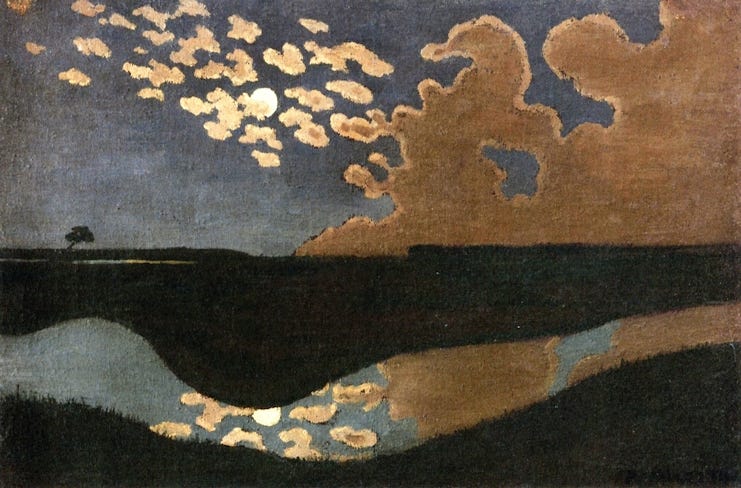
Take this painting Moonlight by Felix Vallotton, who often used unusual composition with strong blocks of colour and silhouette to create visual animation and rhythms.
The painting has symmetry and flow. Notice the prominent band of silhouetted land swelling in black, bulging downwards just at the point where the light of the moon bursts fiercely through the flock of clouds. This repetition of shape is given delicate relief by the appearance of the sky in the water’s reflection.
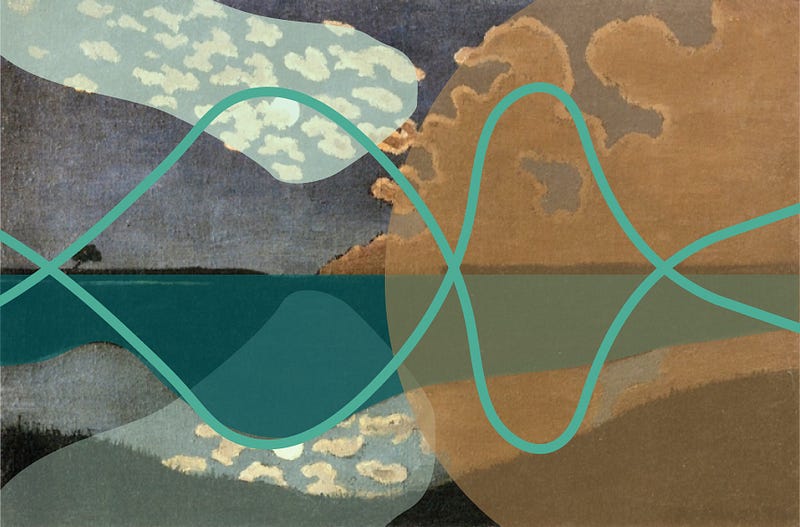
These points of visual interest create zones of focus, combining into an elegant, sweeping movement across the axis of the picture space.
To engage with a work of art in this way takes no training — only a little patience. Yet the rewards are superb: your own imaginative capacity is roused and the sense of appreciation for the artist quickened.
Positive Feelings Through Identification
When we look at a piece of art, we’re often drawn into a rich and complex world of emotions, ideas and associations. The benefit of art is that it allows us to explore these things inside ourselves at the same time.
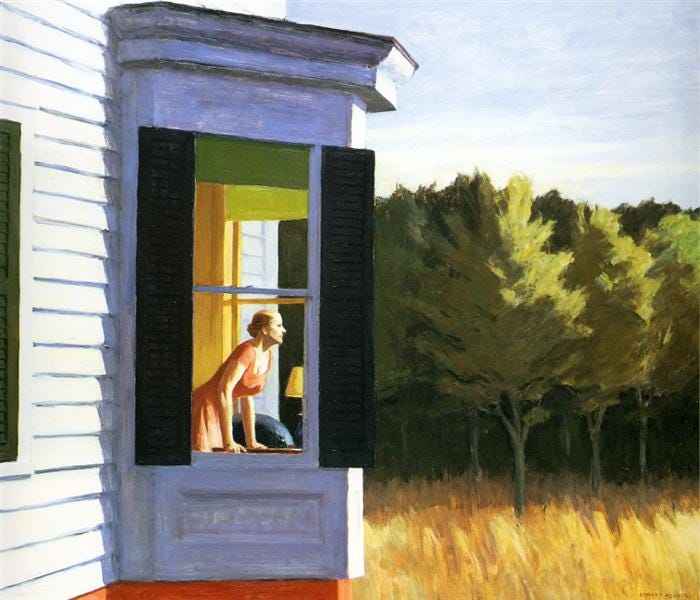
In the painting Cape Cod Morning by Edward Hopper, a woman stands looking out of a bay window. Notice the way Hopper has placed the side of the bay window in complete shadow so that the brilliant light falling on the woman is emphasised.
This subtle device, of using light and shadow to draw out a psychological implication, adds an emotional pitch to the painting.
And what is she doing? She has stopped at this moment, gazing out through her window — at what we don’t know. Is there someone approaching in the distance? Or is she contemplating something unrelated to the world outside?
At the heart of the painting is an absence: an unanswered question. In this space, the fictional possibilities of the image — and the chance for the viewer’s self-reflection — opens up. Have you ever stopped in front of a window like that and gazed off into the world?
One Harvard academic described a series of tests that showed that when we look at something through the lens of “art”, it tends to generate positive feelings — even if the content is challenging or negative. Being able to relate to an idea in a painting can allow us to stand apart from ourselves more objectively and gain perspective and clarity, which in turn can bring feelings of fulfilment.
So we might say that the pleasure and rewards derived from looking at art involves the ability to perceive an emotional stimulus and then regulate our response accordingly, enjoying the aesthetic response under our own imagination.
Heighten Your Senses to the Wider World
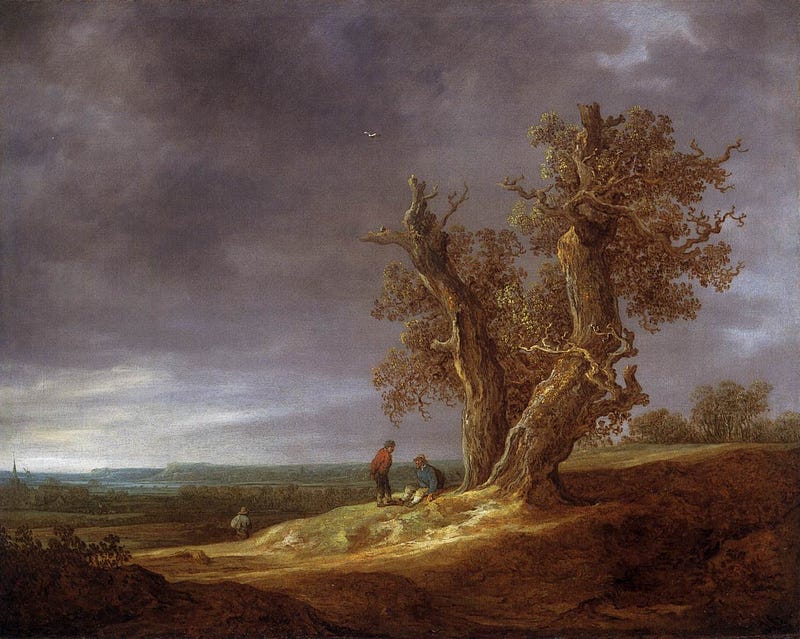

The term “picturesque” was originally used in the 18th century to denote a view, usually of a landscape, that had all the charms and beauty of a painting. In other words, it meant a view that had “the manner of a picture”.
It taught people to look more closely at the natural world and notice how a crooked tree has character or how a ray of sunlight penetrates the grey skies and falls on the land — as in Landscape with Two Oaks by Jan van Goyen (above).
What’s interesting about the Picturesque movement was that it compared aesthetic features of nature with those of art. It looked at images and discovered a new appreciation for nature. It prized variation and texture in colour and light, irregularity of form and infinite variety — both in paintings and natural scenery.
In other words, the sensory experience of looking at art can awaken our senses to the world around us. By paying attention to the details, we can become more attuned to our surroundings and engage our senses more fully, which in turn can feed back into our creative potential. This seems to agree with the science of neurological and psychological processes that point to a tight relationship between the creation and appreciation of visual art.
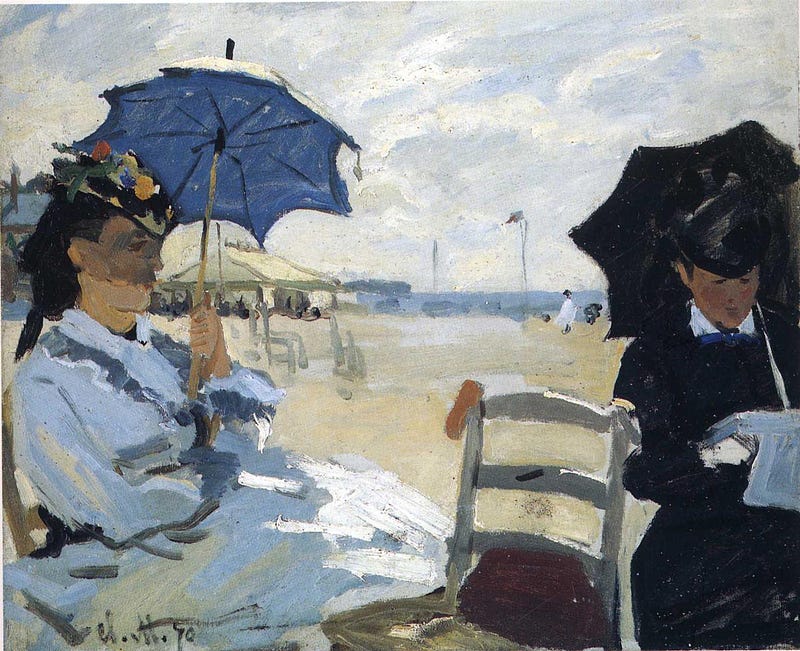
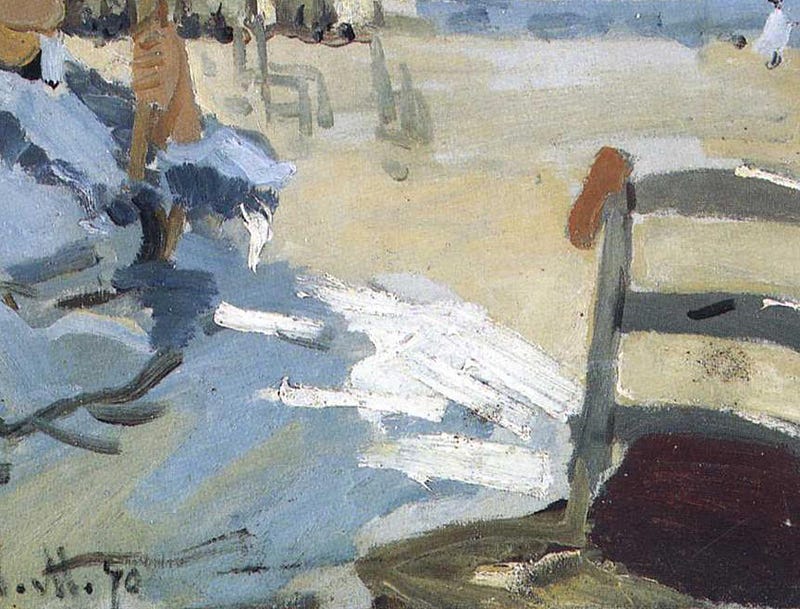
Let’s look at Monet’s painting The Beach at Trouville, in which the brisk brushwork captures the light falling on two beach-goers on a French beach. Notice most especially the white of the woman’s dress, which Monet painted as a series of highlights from the rays of the sun, with brush marks that have an energy and zest in themselves.
Savour those brush marks. Now, when you are next out on a sunny day, look around you and see how the light dazzles on surfaces in broad strokes — just as Monet described.

If you liked this, you may also be interested in my book Masterpieces of Art Explained, an examination of some of art’s most enthralling images.
Would you like to get…
A free guide to the Essential Styles in Western Art History, plus updates and exclusive news about me and my writing? Download for free here.
Join me…
On Instagram for more great paintings on the go!