ONE MINUTE BOOK REVIEWS — 11
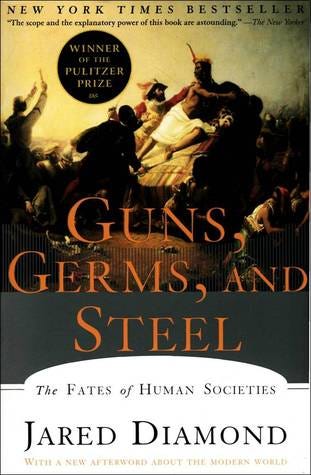
Why You Should Read “Guns, Germs, And Steel: The Fates of Human Societies”
by Jared M Diamond

“Guns, Germs and Steel” is one of the most comprehensive and multidisciplinary takes on human history. It is an ambitious synthesis of history, biology, anthropology, environment, culture, geography, linguistics, and technology explaining why and how the modern world came into being.
Life is not fair. Jared Diamond believes all humans are born with much the same abilities, but inequalities have started to develop with the development of agriculture.
In a nutshell: Agriculture led to food surplus, population density, immunity to diseases, specialization, technology, and advanced tools.
The geography of Europe and Western Asia was best suited to farming, animal domestication, free flow of information, and trade. Population growth enabled prosperity and advanced governance. Innovation accelerated due to widespread trade and competition.
Europeans were lucky that things have worked out well for them, compared to other less fortunate regions of the world, such as Africa.
Europeans did not win because of their intellectual, moral, or genetic superiority. They were just lucky and they utilized their geographic and environmental advantages. Modern civilization was not a product of ingenuity, but of opportunity and necessity.
Jared Diamond is a true polymath and he can bring together vast knowledge fields ranging from biology to ecology, and from anthropology to technology. “Guns, Germs and Steel” is a feat of multidisciplinary and holistic thinking, as it harnesses evidence from a wide variety of sources to build up a coherent big picture.
Here are some of the arguments presented in this book:
- The gaps in power and technology between societies have originated from environmental or geographic differences. These environmental differences were amplified by positive feedback loops.
- Eurasia had a wide range of plants (barley, wheat, etc.) and animal species( goats, sheep, cattle, horses, donkeys, etc.) for domestication.
- Diamond identified six criteria for domestication, such as sufficiently docile and gregarious animals willing to breed in captivity.
- Diamond identified 13 species of large animals (45 kg or more) domesticated in Eurasia. Such a huge scale of domestication was not possible in other regions of the world.
- Eurasian grains were richer in protein, easier to sow and store, compared to maize or bananas.
- Eurasia’s large landmass and long distances amplified the advantages of agriculture and domestication. Similar climates and seasons allowed Europeans to keep the same food production systems across the continent (from East to West).
- Due to trade, innovations have spread more easily. Languages, cultures, and diseases traveled widely.
- Population density and plenty of food allowed division of labor and specialization, which led to the rise of crafts, arts, technology, and innovation.
- Eurasians developed immunity to a wide range of pathogens and diseases, as they were constantly bombarded by viruses.
- Europe’s geography of mountains and rivers led to balkanization and small nation-states. Intense competition from neighbors meant that nations had to adapt and innovate quickly. This led to the rapid development of sciences, arts, and technologies.
- Chinese civilization was large, stable, and isolated, so there was no external pressure to change. This led to stagnation.
- The rapid development of technology had dire consequences on hunter-gathering societies and cultures around the world.
- 95% of the indigenous populations in America were killed off by diseases brought by the Europeans (such as smallpox, measles, and influenza). Similar things happened in Australia and South Africa.
- Tropical diseases (such as malaria) limited European penetration into Africa.
Insightful Quotes From This Book:
“History followed different courses for different peoples because of differences among peoples’ environments, not because of biological differences among peoples themselves”
“Much of human history has consisted of unequal conflicts between the haves and the have-nots.”
“Twelve thousand years ago, everybody on earth was a hunter-gatherer; now almost all of us are farmers or else are fed by farmers. The spread of farming from those few sites of origin usually did not occur as a result of the hunter-gatherers’ elsewhere adopting farming; hunter-gatherers tend to be conservative…. Instead, farming spread mainly through farmers’ outbreeding hunters, developing more potent technology, and then killing the hunters or driving them off of all lands suitable for agriculture.”
“We know from our recent history that English did not come to replace U.S. Indian languages merely because English sounded musical to Indians’ ears. Instead, the replacement entailed English-speaking immigrants’ killing most Indians by war, murder, and introduced diseases, and the surviving Indians’ being pressured into adopting English, the new majority language.”
“In short, Europe’s colonization of Africa had nothing to do with differences between European and African peoples themselves, as white racists assume. Rather, it was due to accidents of geography and biogeography — in particular, to the continents’ different areas, axes, and suites of wild plant and animal species. That is, the different historical trajectories of Africa and Europe stem ultimately from differences in real estate.”
“Not until the beginning of the 20th century did Europe’s urban populations finally become self-sustaining: before then, constant immigration of healthy peasants from the countryside was necessary to make up for the constant deaths of city dwellers from crowd diseases.”
“It invites a search for ultimate causes: why were Europeans, rather than Africans or Native Americans, the ones to end up with guns, the nastiest germs, and steel?”
“Besides justifying the transfer of wealth to kleptocrats, institutionalized religion brings two other important benefits to centralized societies. First, shared ideology or religion helps solve the problem of how unrelated individuals are to live together without killing each other — by providing them with a bond not based on kinship. Second, it gives people a motive, other than genetic self-interest, for sacrificing their lives on behalf of others.”
“What makes patriotic and religious fanatics such dangerous opponents is not the deaths of the fanatics themselves, but their willingness to accept the deaths of a fraction of their number in order to annihilate or crush their infidel enemy.”
— Jared Diamond


