
Why You Should Not Enroll Your Kids to Coding Classes

Teaching coding for kids is the latest millennial obsession.
Since around 2016 when President Obama announced his $4B funding plan to teach kids coding in school, the edTech is booming with teach-kids-to-code-early startups.
In 2020, Byju, the world’s 2nd most valuable edTech company based in India, acquired White Hat Junior for $300M — all-cash transaction. White Hat Junior is an instructor-based coding education platform.
Out of the topmost valuable edTech companies (as of April 2020), many have their coding schools already set up.
The fad is growing at an unprecedented pace. And it’s not all good.
But Kids Are Already Addicted To Computers
They are. That’s precisely the reason they should be taught coding at an early age.
This is the standard argument most parents pose.
After all, playing the most stupid zombie-killer (on a smartphone or a computer) isn’t doing any good to them. Passively consuming ads, videos, games that require acute attention — all of this is more detrimental to kid’s eyes, nervous system, and psychological well-being. Games that provide play-with-friends and chat transforms them into socially awkward animals.
Learning to code is seen as a savior from all evils of gadgets.
However, this argument doesn’t hold up, because:
- Coding classes (especially at an age below 10) wear kids out sooner. This means that they will need more relaxation after the class. This could also mean that they will demand more screen time. Online or not, this obviously adds up to their screen time.
- With all their evils, games aren’t necessarily bad for kids. Games with better UX and gamification strategy boost kids’ critical thinking, response to challenges and also improves hand-eye coordination. Examples: Minecraft, Age of Empires, Lumosity mind benders, Monument Valley, Word puzzles like Scrabble, Quiz Up — these are just from my immediate memory, and one should surely checkout their genres to explore better food for brain.
- Professional gaming is a career, though not as well-paying as coding, and not healthy (at least in its present form) to pursue for a lifetime. I do not advise parents to justify gaming with this reasoning, but the benefits of learning to code simply don’t compare against gaming. (I will expand on the reasoning in the latter part of the article)
- With their pre-existing structures, coding classes do not provide any real value to an early age kid who wants to consume the magic of a computer. We will expand upon this topic in the next section.
Coding Classes Provide No Tangible Value:
A month ago, I heard from one of my friends who knew a kid enrolled in a coding class.
What you are really buying here is the teacher’s time, not skills, and never an expertise.
They taught him how to make a shooter game, using Scratch — the most popular and free game-making tool developed by MIT. Here is a screenshot:
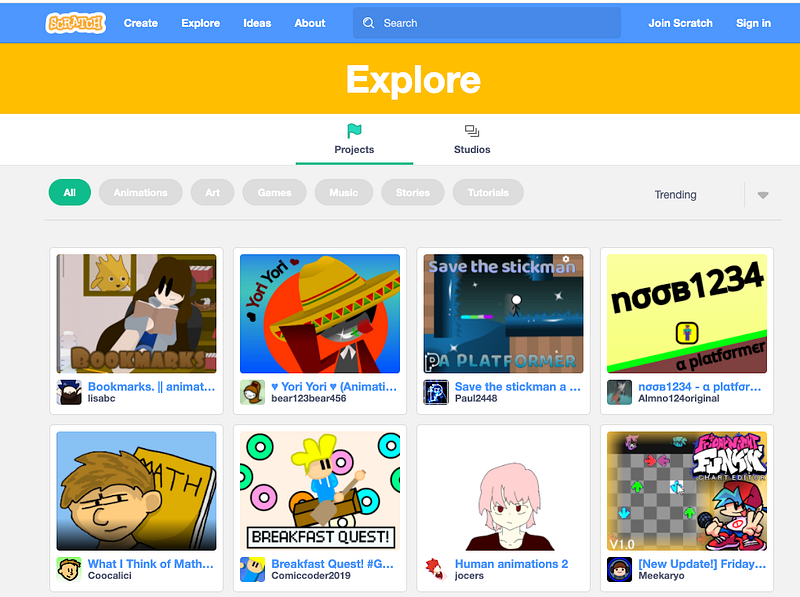
The tool is really cool in terms of how it teaches kids to do game state management, defining rules, integrate machine control, and handle user actions. If you have a Mac, Apple also provides Swift Playground which has some really good gaming templates that kids can use to start their game development journey.
But enrolling in a coding class to use an open-source tool is truly a waste of money. (I know a few programmer dads who spent it too, in which case it’s truly a shame.) What you are really buying here is the teacher’s time, not skills.
Most parents still enroll just to dust off some guilt of not having enough time for their kids. They want to feel proud for saving them from the evils of the tech by teaching them to code.
Well, now you know your choice.
Some More Reasons Not To Enroll in a Coding Class:
Crazy customer base (low user acquisition cost) + Low cost of operations (cheap teaching talent) + No accountability = $1 Billion Online Code Coaching Academy
- Attending online coaching classes is strenuous when done on top of regular schooling (during the time of online school, this puts extra pressure on kid’s online time).
- Due to paid enrollment, parental stress induces fear and stress in the kid. What should have been a fun-time endeavor becomes a compulsive ritual for the entire family.
- Due to scheduling enforcement, the kid loses out on many other activities which, if done regularly instead of learning to code, could truly boost his health and kid-worthy fun: Playing with physical toys, reading, painting, making things with dough r a 3D printer, and playing with friends.
- Most coding classes do not employ qualified talent. Rather, they rely on gig workers. The teachers may be qualified software teachers, but working at a pretty low rate, as many leading edTech firms belong to places like India and China.
- Contrary to other pieces of software, there is little liability on the part of the seller. For example, if you download a game, and don’t like it, you can ask for a refund from App Store or Google Play Store. But most users can’t (and usually don’t) ask for a refund from a coaching institute. If they fulfill the promised coaching time requirement, you really can’t complain. On the contrary, your refund requests may be turned down with “your kid fell short on the assignments” sort of rebuffs.
- Value for money is questionable. You have no way to know how effectively your kid learned coding due to the said class in question.
- In a nutshell:
Learning to code online is a fad sold by billionaire investors and greedy startup founders. What they have is a perfect recipe for a $1B unicorn that profits from its cradle:
Crazy customer base (low user acquisition cost) + Low cost of operations (cheap teaching talent) + No liability to provide results
But Mustn’t Kids Be Software Literate Today?
Of course, they must be.
But learning to code is quite overestimated for its capabilities in this area. When kids learn to code at an early age sometimes even before learning principles of mathematics and logic, they are missing out on crucial steps. Computing is not about coding. It is about transforming real-world problems into a form computers can understand. Coding and programming language come into the picture at this very later stage.
By introducing them early, we are not only overloading kids’ brains with extra baggage, but we are also ruining their capabilities in other areas.
Knowing to code better at an early age is great, but it is no mark of a genius today. It simply means that the kid can handle the tool (the computer) well — slightly better than a gamer who only passively consumes a piece of software.
True, that many successful tech founders (example: Elon Musk) tinkered with their computers at an early age. But that was an unguided + unforced exploration that yielded very high returns at a later age. It was far from the preconfigured, boring detour of command and steps that kids are taught today in coding schools.
This debate reminds me of an incident I read about Mozart’s childhood learning.
Young Composer: “Herr Mozart, I am thinking of writing a symphony. How should I get started?”
Mozart: “A symphony is a very complex musical form and you are still young. Perhaps you should start with something simpler, like a concerto.”
Young Composer: “But Herr Mozart, you were writing symphonies when you were 8 years old.”
Mozart: “Yes, but I never asked anyone how.”
Coding Is Not The Future You Think It Is:
Before you think that learning to code is completely essential for the future, do not forget that computers were invented only 7 decades earlier. By most orthodox standards, advanced human civilization is at least 5000 years old.
Coding at an early age completely overshadows the spectrum of things that runs the world without our knowledge, and a kid must know:
- Principles of science.
- Laws of mathematics.
- The way they are communicated (language).
- The thing that glues us to all those great ideas (art).
And beyond all that, the thing which enabled humans to perceive all of those disciplines.
Yes, imagination. Coupled with relentless practice, critical thinking and revisions.

- Einstein, and many more genius scientists before him, invented the laws of the universe using pencil, paper (optionally, some more barebone tools like a telescope). Imagine the amount of clarity needed from them before applying for a patent.
- The first internet was invented in the 60s. This was the time when universities & corporations paid hefty sums to PC makers like IBM to buy the programming timeshare. Imagine the amount of offline work necessary to make it work on the first try!
Before you think I am going archaic as far as to oppose computers — I am not. I am simply warning against jumping the hoops. Technology has done a great job reducing friction in our daily lives, but hoops that are crucial in one’s idea about the world must not be skipped.
When you enroll your kid in a coding academy, ask yourself:
- Are kids taken through necessary steps why coding something is necessary in the first place?
- Are kids asked how will their designed software look?
- Are they allowed to present choices and ideas?
- Are the tutorial teachers qualified in areas like UX and state management? These are the most crucial areas a game maker must be aware of, and teaching requires elevated standards, not degraded ones.
Conclusion:
Do today’s coding classes teach kids what language computers will speak tomorrow?
Consuming software to the point of forming an addiction is a necessary evil we all have embraced.
For programming career success though, it is necessary to be a habitual software user before any coding training can have a meaningful impact.
Sadly, even this requirement is skipped when hapless parents enroll their newborns in coding academies. They snatch away their Nintendo consoles and Minecraft screens (and sometimes even physical books) to hand them over to an inexperienced programming teacher vomitting on Zoom.
With all the fervor with which the present state of technology is vehemently taught to kids, who is to guarantee what world they will emerge into?
After learning all the programming languages of our time, when they reach maturity, the computers would have begun understanding human language to create programs.
Will today’s kids be able to speak it?


