
Why You Should Make Market Visits a Stop on Any International Trip
They might just change your life
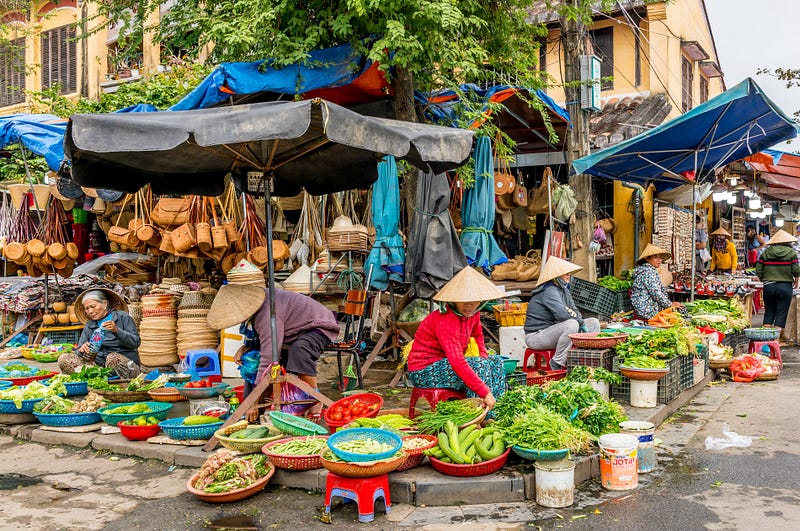
Traveling fearlessly and with an open mind unlocks experiences you couldn’t have orchestrated, yielding not just dinner party stories once you’re home, but moments that could transform you and your traveling companions into better world citizens.
An altered worldview and profound personal growth don’t happen all at once, and of course, require multiple powerful moments layered up over time.
Sometimes you don’t even know they’re happening.
You stop to watch a man mixing a deep purple drink at a food cart in Peru, and the next thing you know, you’re taking your first sip of chicha morada with him and his cronies on the curb. You turn a corner in Mahabalipuram, and a teacher invites you to talk about your country to her students; you spend an unexpectedly powerful few hours playing with Indian children with bright smiles.
Moments like these are woven by serendipity, and when they happen, we take them away like treasures in a locket, wishing we could replicate the experience day after day. There are places, though, where you can set yourself, and like a protagonist entering a setting of a novel, to await a moment of serendipity.
Visiting the world’s markets could change your life in one fell swoop.
Go to markets. Seek them out with fervor. Cross cities on rickety buses to reach them. Designate a whole day to explore them.
I don’t mean the curated spaces visibly supported with ample government funding, with spotless stalls, clear routes, accurate maps, and lots of tchotchkes for tourists to take home. I mean gritty markets with wares climbing precariously high, piles of raw meat laid out on stone or wooden slabs, the perfume of the ocean on rows of fish, and a cacophony of color overwhelming enough that you want to nap immediately upon exiting.
I’m talking about the places that make you feel a bit overwhelmed, perhaps a bit nervous, and definitely a bit excited.
I’m talking about Bangkok’s Chatuchak Market, Istanbul’s Grand Bazaar, Toulouse’s Marché Victor Hugo, or Mexico City’s Mercado La Merced. (You can even find floating markets in the world, where commerce takes place from boat to boat.)
These are the places where regular people live their regular lives. People are not dressed in traditional costumes to entertain tourists; they’re not cooking up cheeseburgers to appeal to North Americans. Within the nooks and crannies of these delightful warrens, local people buy and sell anything from mini red-skinned bananas to scooter tires, from freshly made bean cakes to Chinese gunpowder tea. In large swaths of countries that are still developing, markets are the only places to find items such as these.
Visiting a market is one of the best activities to discover what people eat, how they buy their clothing and furnishings, how they interact, where they congregate, and what they value.
As a traveler with an open mind and few expectations, you can see how people truly live their daily lives. What better way to get to know the world?
So how might you approach your trip to the world’s busiest markets?
Succumb to the madness
Markets can be labyrinthine places with narrow walkways, piles of color and scent on either side, and voices calling from all directions. The routes can be circuitous, the way unclear. Markets can immediately overwhelm, and my advice to you is, roll with it. Know that if you get lost, either you can ask for help or walk in a straight line until you find the exit.
Slow down
Take your time and enjoy the journey. Value connection with vendors over the goal of seeing the whole place. Rather than being swept up in the tides, find a place to sit for a while to observe the goings-on. If you’re feeling overwhelmed, slowing down will help.
Have a meal
Local cooks serve up some of the tastiest and most culturally authentic foods in markets (and a few have even garnered Michelin stars). Look for stalls that are crowded with locals (these stalls tend to serve the safest dishes), and be adventurous. Talk with people near you; ask what they recommend; order what they’re having.
Buy snacks you don’t recognize
In Asia, try rambutan or jackfruit; in West Africa, perhaps it’s cashew fruit, and in Central America, taste the guava. (I promise you, that shriveled guava you find in your local grocery store is a gloomy, disinherited third cousin of the real thing.) Fruit is always a good bet, but perhaps you’ll be more adventurous and sample crickets in Oaxaca or spiders in Phnom Penh.
Stay curious
Most of us tire of our daily jobs, including the Malian weaving rope out of baobab bark in the market, the Venezuelan cooking arepas, or the Ghanaian making shea butter. To these folks, the daily grind goes on, while to you, their work is revelatory.
Pause, make eye contact, show interest. If you can’t communicate in the language, use raised eyebrows, respectful pointing. Ask if you can sit. Watch how things are made. Participate. You’ll likely find that people are thrilled to share their expertise and that your inquiries honor them.
Maybe the Ghanaian woman will give you a taste of shea fruit. She may demonstrate how she removes the flesh from hundreds of nuts, roasts them in a hand-built wood-fired mud oven, removes their shells, pounds the hard, oily nuts into a paste, and cooks and stirs the paste, finally skimming off the fat to mound it into shea butter balls.
Perhaps you’ll never look at your hand lotion the same way again. Perhaps you’ll make a friend.