
Why You Should Embrace Your Impostor Syndrome
“Fake it till you make it” is the worst advice you’ll ever get

When the mind attacks
I have a moment from the beginning of my Computer Engineering career that I’ll never forget. I had just started at IBM full-time and had tested one of our products as one of my first responsibilities as a new starry-eyed new hire. I felt confident. I interned with IBM the 2 summers prior, I co-oped with them throughout my senior year of college continuing to work for them while I finished my undergrad degree. Nothing could stop me, I’ve made it!
Oh boy was I wrong… I was violently halted by my thoughts.
One day, I’m talking to one of my mentors and he tells me, “Hey, I need you for a meeting with a customer. They want the tester that worked on this item in the room for a visit tomorrow.” At this point in my head, I’m all for it. Then the numbers came…
“They want to spend about 38 million USD on the product going out the door and just have some questions before they buy.”
Now this isn’t a story about how I crushed the meeting or convinced people to buy something from IBM for an absurd amount of money. I didn’t even speak in the meeting. I sat in the corner as charts went by and business was done. This is a story about what happened when I heard 38 million dollars come from my mentor’s mouth. I crumbled… My mental was shattered…
I didn’t know it at the time, but this was the first time that I consciously fell victim to Impostor Syndrome. Keyword, consciously, it had happened before but never enough to stun me with the fears of being fired just weeks after I had started my first corporate job as an “adult”. I thought about it from the moment the last syllable left his mouth to walking into the meeting room the next day. I cried, I called my mom, total panic. You see why I put adult in quotes now.
This would serve as a lesson for me at that moment. I didn’t feel confident anymore. That blind faith that I had in myself all went away. I didn’t even think that I was a good enough developer to be at IBM anymore. I thought the people that had hired me may have made a mistake. That I somehow slipped through the cracks. Sometime that evening I learned about what impostor syndrome was.
Impostor syndrome is a psychological occurrence in which people doubt their skills, talents, or accomplishments and have a persistent internalized fear of being exposed as frauds. — Wikipedia
My favorite 4 words
As a college student, I eventually got a piece of advice that changed the way that I thought about the world. That advice was this, “It’s ok to not know what you’re doing. Just be willing to learn.” Often with the way that the world is, we’re inclined to think that we need to have the answers to everything. I don’t mesh with this approach to life. I think this just leads to needless insecurity when you don’t have the answers to things. Don’t blame yourself for this. That was a mistake that I made early on. If the world works this way and no one disagrees, am I just in the wrong? The answer to that for me is…
“I don’t know, but…”
I find myself saying these 4 words a lot in my day-to-day life. Maybe it’s a defense mechanism. Maybe I use them as a disclaimer that, I’ll help you, but I don’t know what I’m doing either. What I do know is that it’s helped me and my reputation as a Software Engineer.
A few months after the customer crisis I had, I started to feel comfortable again. I survived the trauma of the customer meeting the way any intelligent and healthy 21-year-old professional would. Over beers and burgers at our local German brew house. This lead me back to some minor bouts of confidence as I shared my story with my friends. As they reassured me they’d panic in a similar situation, I felt relieved.
After this, I’d go on to use those 4 words to do a lot of great things. They usually result in me taking on some task that is slightly out of my realm of comfort. What I’d come to find is me telling myself, “I am an impostor.” “I don’t know what I’m doing.”
“I know that I know nothing” — Plato
This time it was different though. I came to realize that everyone is just doing what they think is best for them in the moment. No one actually knows what they’re doing. They think that what they’re doing is right. None of us know for certain though. For me, and hopefully you too, that’s a relief.
The reason the impostor syndrome crept in in the first place was because you cared. You’re so passionate about this thing that you’re fixated on that you got nervous. That’s great! Lean into it. You’re ambitious. You want to make sure you succeed. That’s exactly what you should do. Improve. We just need to prove to ourselves that we’re not incapable.
“The only true wisdom is in knowing you know nothing” — Socrates
Lose is Improve
I’ve been an avid gamer forever. I got my first gaming console when I was 3. Something that I love about video games is winning. I’m a very competitive person and it’s a big part of my personality. Playing video games this long (I’m 28 at the time of my writing this) I’ve had a lot of wins. I’ve also had a lot of losses. I don’t like losing. I don’t know where it comes from but I have this superiority complex when it comes to my losses. Like it’s beneath me. As I’ve grown older I learned that I could mold that. I’m sure you’ve heard the cliches. “Lessons come from your losses, not your wins.” “We lost because we simply weren’t good enough to win.” This for me bleeds into other facets of my life. I’ve come to embrace the losses, embrace the failures. To learn from them.
One of the games that I love is Super Smash Bros. I’ve played all of them but Melee in specific has a special place in my heart for me. When people would ask my friends and I if we were good at Melee we’d typically say no. We’d then trounce most people that wanted to play us. Our opponents then would be confused wondering if we just got some sick pleasure out of pretending we were bad or something. We’d usually say something along the lines of, “The way that Melee works is that you think you’re good at Melee until you meet someone that’s actually good at Melee.” At this point, you’re probably thinking what does all of this have to do with Impostor Syndrome? Funnily enough, it’s a good parallel with the Dunning-Kruger effect.
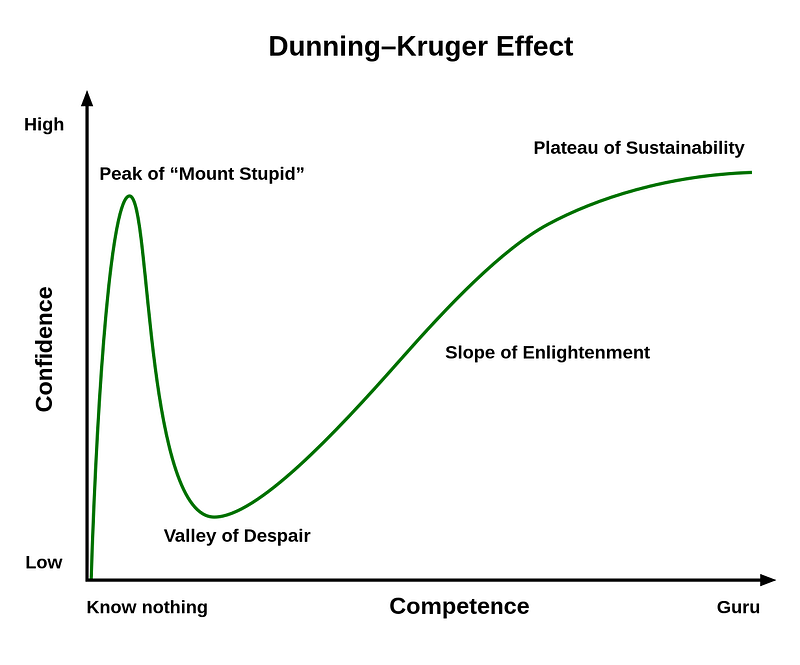

If you have impostor syndrome congratulations! You’re likely in the “Valley of Despair” on this graph. That’s great! Cause you’re on your way to greater competency! Lean into your impostor syndrome. It’s just your body telling you that you’re evolving and that you care! The fake it till you make it types are stuck on Mt. Stupid. Us? We’re on our way to bigger and better things. With our impostor syndrome serving as a guide we’re doing something right.
Where do we go from here?
So what are our takeaways? Why should you embrace your impostor syndrome?
- Everyone is just making it up as they go. Your decision-making can make you the next visionary in your field. Don’t conform!
- There’s wisdom in realizing that you don’t know everything. You’re not a fraud for realizing that you don’t have it all figured out. None of us do.
- Our losses, our failures, can ultimately be the best things to happen to us. We just have to make sure that we learn from them.
- Being a little outside of your comfort zone is the only way to grow. You’re learning new things and that doesn’t make you an impostor. It makes you brave.
- That pit in your stomach is only there because you’re passionate about your field. Embrace it. As Yes Theory says “Seek Discomfort”
- Relax. Impostor Syndrome typically affects high-performing individuals. Step out of the “Valley of Despair” into the “Slope of Enlightenment”
I hope that this was helpful for you! I don’t think that our impostor syndrome will ever go away. It will, however, serve as a sign in the future that maybe we’re doing something right. Being a little scared before making an impactful change is a good thing. Let’s go be impactful creatives.
I hope that you enjoyed this article! If you did please hold down the applause button as long as you can 👏🏽 (Really! Hold it! 😉)! Leave a comment to let me know your thoughts! Share with a friend or colleague! If you’d like to hear more from me please follow! Finally, please buy me a beer to keep me motivated! It all means the world to me! Cheers!
Check out another one of my articles if you have the time!