
Why you should do an on-site research for the setting of your novel
Whenever possible, look at the locations of your story in reality. Someone will always notice when you make mistakes.
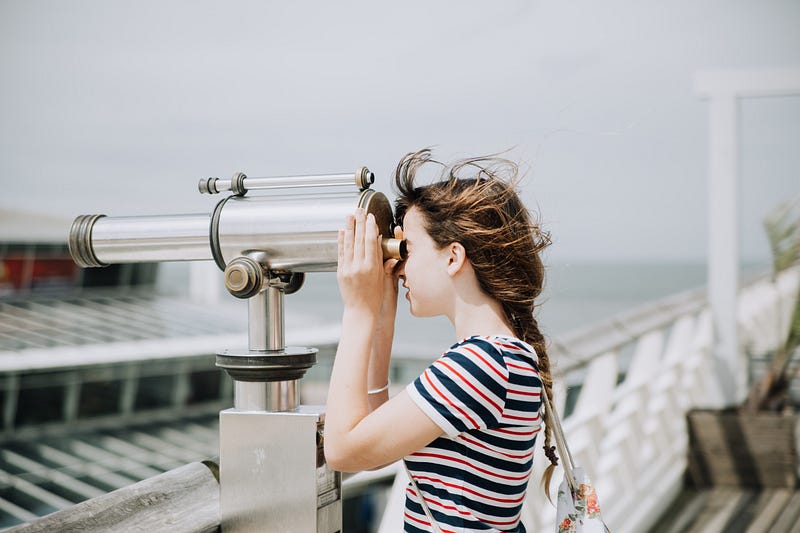
I’m not saying that you have to fly to the moon when you write a sci-fi novel about a lunar mission. But when it comes to your neighboring city? Or even the place where you live? Then you should definitely check whether everything there really looks the way you remember it.
Case study — the research for my new thriller
Three weeks ago, I started writing my new thriller. I had a good story in my head and also decided on a location.
The novel was supposed to be set in my birth town. It’s been years since I was last there, but I have a lot of vivid memories from my childhood and youth.
I know not only this place, but also some of the surrounding villages. So I thought I wouldn’t have any trouble describing the killer’s escape routes or other scenes of the plot in my book.
Then I came to a point where I couldn’t just go on. I needed to know how the police work is organized in the area where my story is set.
I found insufficient information on the Internet. I, therefore, wrote an e-mail to the press office of the police department responsible and asked my questions.
But the subject was too complex to be clarified in writing. I was offered to visit the press officer and talk to her for an hour. She would like to answer all of my questions.
The city where the press office is located is about two and a half hours by car from my place of residence. With the outward and return journey and the conversation, almost a whole working day would be gone.
Nevertheless, I agreed and made an appointment.
Then I thought to myself that I could stop right away in the place where the story takes place. I could take a closer look at the locations of my story — just in case, I thought.
So I drove to my interview appointment and made a stop on the way in the village where my story was set. There I went to several locations.
One of them was a bridge over a small river. In my story, investigators are following a suspect who is finally hiding under the bridge behind one of the bridge pillars.
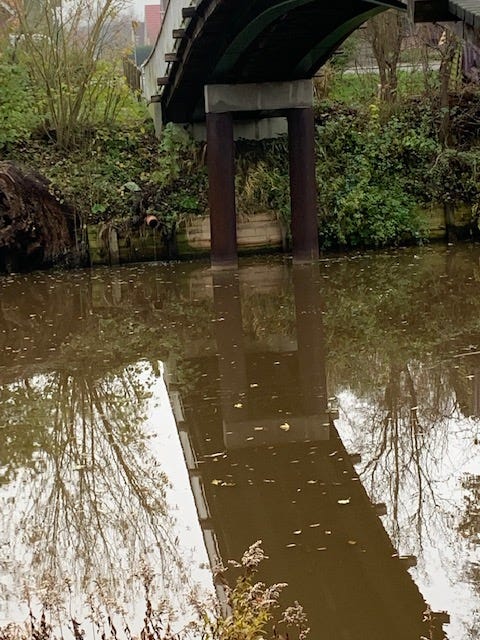
When I was there, I saw that I remembered the place completely wrong. As you can see in the photo, nobody can hide behind these bridge piers, because they are standing in the middle of the river instead of on the shore, as I thought.
I experienced similar surprises at two other locations.
I took photos and noted down details. Then I drove on to the police press office.
Here, too, I got some information that was very important for my story. A plot twist I had thought about suddenly didn’t work anymore, because the police worked differently in reality than I had assumed.
Back home, I spent the whole next day adapting my manuscript to reality.
If I hadn’t done my research on the spot, I would have made bad mistakes in the story that would have struck any reader living in the area where my novel is set.
Can’t I also work with Google Streetview?
Google Streetview is an excellent alternative if you can’t visit the original locations of your story. If you combine this with Google Maps and the photos it contains, you can describe many places around the globe quite credibly and realistically.
However, this method has its limits. Often the images are already outdated. It is also possible that you only get pictures from winter, although your story takes place in summer.
However, it is better to work with these tools than to rely on your memory.
Even places you’ve been to a lot sometimes look a lot different than you think. Our brains don’t necessarily remember the details that are important for our stories.
Sometimes it is not enough to know that one street meets another at a certain point. Sometimes we also need to know which trees are there, which part of the road is visible from where, or similar details.
In my case with the bridge described above, the Internet didn’t help me at all, because there was simply no picture material showing the bridge from below. I had to stand there and look from this particular angle to see where the bridge piers really are.
The Internet can help us describe places we’ve never been to. But if there are no good pictures of a site online, we have to go there ourselves. If that is not possible, we should decide on another place of action.
What about artistic freedom?
Sure, you’re writing a novel, not a travel guide. It can be utterly irrelevant to the story what a specific place looks like.
It also depends on where your target audience lives. A credible description of a marketplace in a small Chinese town doesn’t have to correspond to reality if your readers live exclusively in Europe.
If, however, you plan to have your books translated into Chinese, it would be better if you took a closer look at the place with the marketplace. It might then be better to stay vague in the description or to give up the scene altogether.
If you insist on artistic freedom, be radical. Stephen King, for example, sometimes redesigns Maine’s entire topography for his novels so that it fits better with his stories. He invents whole cities and changes the routing of highways when it benefits his story.
But this artistic freedom is wanted. The alienated representation of real existing places does not happen to him merely as a mistake; they are intentional.
In the case of the bridge, I would simply have made an avoidable mistake. I could not have talked myself out to artistic freedom.
do you want more stories like this?
Receive weekly emails, and don’t miss any of my articles.
subscribe here http://bit.ly/ReneJunge
Read also:


