
Why You Never Get Tired of ‘It’s a Wonderful Life’
Spoiler: It’s not because life is all that wonderful
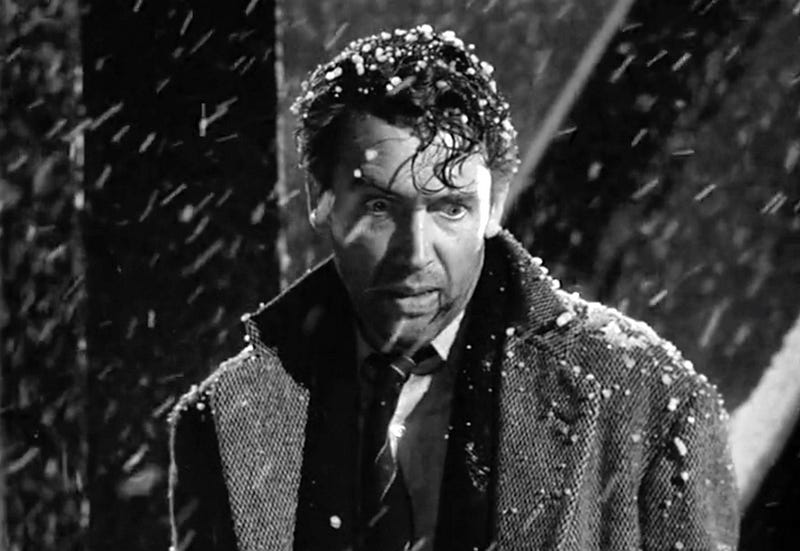
It’s a Wonderful Life, a film beloved by audiences around the world today, is a bit of a Christmas miracle when you consider it was all but forgotten for nearly three decades after its 1946 release. In fact, it was such a financial disappointment that its owners opted not to renew its copyright in 1974. Television stations across America, all too grateful to have free content drop in their laps, began to regularly broadcast it every holiday season and, by the eighties, the film had become the Christmas classic we know today.
“The film has a life of its own now,” its director, Frank Capra, said in 1984, “and I can look at it like I had nothing to do with it. I’m like a parent whose kid grows up to be president. I’m proud … but it’s the kid who did the work.”
Jimmy Stewart, its star, said of it, “Those who loved it, loved it a lot, and they must have told others. They wouldn’t let it die any more than the angel Clarence would let George Bailey die.”
Most of us today recall the film for its message of kindness, charity, and, perhaps most of all, community. George Bailey’s sacrifices, always for the greater good, always for his fellow man’s well-being, exist in stark contrast to the bitter, cynical, capitalistic greed of Henry Potter (Lionel Barrymore). Capra’s communist sympathies are etched into almost every scene of the film. But as much as everything I just described provides It’s a Wonderful Life’s uplifting “Christmas message”, it doesn’t wholly explain the film’s enduring nature.
That’s because this “Christmas message” doesn’t resonate as much with audiences as the “torture porn” Capra forces George to suffer through in his quest to depict one man’s terrifying emotional and psychological breakdown. You see, It’s a Wonderful Life is the story of a midlife crisis both unlike any other and entirely universal. Said another way, it’s a horror film about what growing up is really about — and finding the will to go on, or hope, in all that darkness.
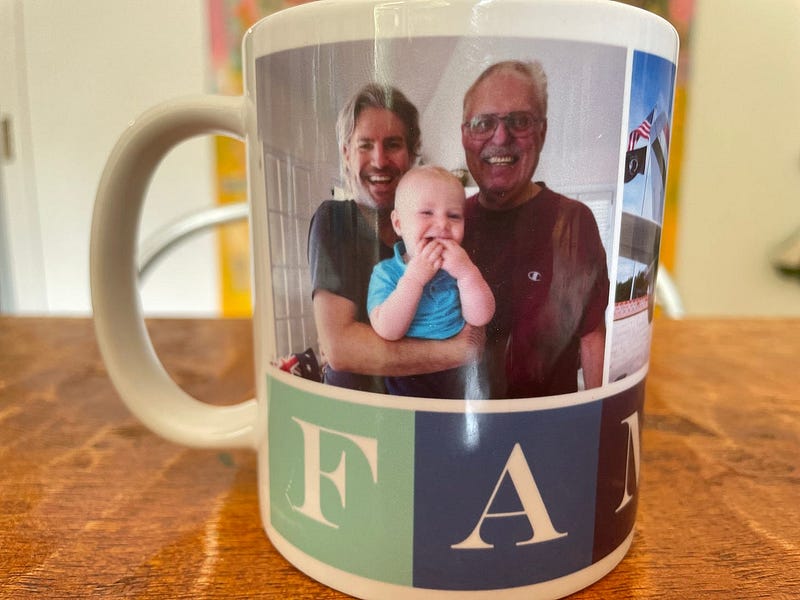
There’s a coffee mug in my cupboard. One of those you get made for family members, covered in a patchwork of photos of you and your kids. In this case, it’s wrapped in photos of me, my oldest son, and my father. My father has been dead for three years. There aren’t any other photos of him in my house, at least not on display.
Every morning, I open the cupboard and see this mug. And my father. Immediately, the impulse bubbles up inside me to punch the wall, to shout violently at the sky, to fling the mug against the wall just to watch it shatter into a million pieces. Just as quickly, it passes, but the memory of it lingers.
It’s getting easier…by increments.
It’s a Wonderful Life opens with incorporeal angels in heavenly conversation. George Bailey might kill himself tonight, and it’s up to Clarence (Henry Travers), an angel who has yet to earn his wings, to prevent the tragedy. But first, he must learn a bit about George’s personal story.
The first three incidents we’re provided to tell us who George is are as follows:
- As a young boy, he sacrificed his hearing in one ear to rescue his baby brother from drowning.
- Not long afterward, he saved the lives of a whole family because his employer, a chemist — so distraught (drunk) over the unexpected death of his son — accidentally filled a prescription with poison.
- He’s informed that his father has had a stroke. His father dies soon after.
This is how a heartwarming family film starts in Frank Capra’s world, by the way.
Through this all, George regularly proclaims his desire to escape from this “crumby little town”. Bedford Falls is where dreams go to die, by his accounting. He wants to see the world, build exciting things, do exciting things. As much as he admires his father, who runs a small savings and loan association that caters to the working class (read: desperate), he wants out.
In other words, he’s every young person ready to make their mark on the world. He’s you. He’s me. He’s all of us at some point or another in our lives.
But when George’s father unexpectedly dies, all those dreams go up in smoke. Oh, not right away. Life doesn’t usually work like that. But year by year, any chance of leaving Bedford Falls — even for a vacation — is eroded by tragedies that George can only try to emotionally negotiate with. He always loses, as most of us do in life. All that’s left behind is bitterness and resentment that periodically explodes in dark episodes.
Here’s how the “torture porn”, as I describe what Capra puts George through, relentlessly plays out after the death of his father. I call it torture porn — a horror film term — because what happens is similarly about breaking George down and ultimately reforging him into someone new.
- First, he must give up going to college to take over the Bailey Brothers Building and Loan or let all its customers suffer under Henry Potter.
- Second, he gets married to Mary (Donna Reed) — an idea that initially leaves him violently angry to such a degree that you have to wonder about her not immediately running away.
- Third, after a run on the Bailey Brothers Building and Loan, he must give up his international honeymoon to save the institution.
- Fourth, he volunteers to stay at the Building and Loan so his baby brother can go off and live his best life.
- Fifth, he has kids — a lot of them — which means he’ll never get ahead and will be stuck in his damp old house in Bedford Falls forever.
- Sixth, his brain-addled Uncle Billy misplaces a small fortune before he can deposit it in Potter’s bank — implicating George in a financial crime that could destroy his family’s seemingly tenuous place in town.
George Bailey, from the start, was a good man.
Life breaks him anyway.
He’s left with no other option, in his mind, except to hurl himself from a bridge.
I’m forty-seven years old, seven years older than George Bailey is when he peers over the edge of that bridge and imagines what comes next.
In the past seven years, both of my parents have died. My career has been up and down the whole time, wild peaks and deep troughs that have left a toll. I’ve moved between three countries and continents in that time. I’ve had a second child, which both enriched my life and complicated it in unexpected ways.
Today, I don’t remember the person I was before all this began, or at least I don’t know how to get back to him. I look at photographs, and I find that I’m confused by how easily I used to laugh before all this started. I miss him. I imagine others do, too.
I’m not alone in feeling this way, I’ve discovered. During a recent work trip to London, I found almost all of my friends, all the ones in my age group — women and men — were equally tired, confused, broken (or at least fractured). None of them were prepared for how hard “this” is. Being an adult. Not the kind we were in our twenties and even thirties, when optimism wrapped everything in a kind of glamor that hid most sharp edges. We felt like there was so much time back then. That we might yet become the people we once thought we would end up.
But not anymore.
The glamor was gone for all of us.
Reality had set in.
Marriage had seemed okay enough for everyone. But kids brought with them fear for their future, which made our own fear of climatological collapse feel more acute. Loved ones had started dying. Our friends and peers had, too. I’m not even going to get into COVID, broader economic crises, wars, and the return of fascism.
The scars had accumulated at an unexpected rate, replacing the lustrous glamor of youth I just described with an ugly armor assembled out of myriad tragedies. Tragedies just like the ones that erode George Bailey’s will to live.
“I’m not a praying man, but if you’re there and you can hear me, show me the way.”
George Bailey utters these words in a now-iconic scene near the end of It’s a Wonderful Life. But it was an unscripted line of dialogue, as it turns out.
“As I said those words, I felt the loneliness, the hopelessness of people who had nowhere to turn, and my eyes filled with tears,” Jimmy Stewart said in a 1987 interview. “I broke down sobbing.”
George wasn’t supposed to cry, but Stewart couldn’t help himself.
That’s because the actor was a broken man himself, not unlike the character he was playing. He’d just returned home from serving as a flight leader in World War II. After five years away from Hollywood — many barely recognized him upon his return — It’s a Wonderful Life was going to be his first film since witnessing the horrors of war. But he was suffering from shell shock, what we call Post-Traumatic Stress Syndrome today. Shakes, a short temper, nightmares. He had become prone to the very same mood swings and explosive outbursts George Bailey periodically displays.
Playing George was spiritually restorative for Stewart in many ways. While he rarely spoke about what he witnessed in the skies over Europe, the character taught him how to act again and, I think it’s fair to say, provided him with one of the most personal roles he ever played. His own traumas, a long list of them by that point, are fully on display throughout his performance and especially on that bridge as he begs God for help.
When I was a freshman in high school, a teacher who was otherwise completely unsuited to his position — cynical and snarky and uninspiring on the best of days — told me something that has stuck with me over the years. Great art, he argued, changes as you get older. As life happens to you, your relationship to texts, paintings, films, and songs evolves.
This is the key to truly understanding why It’s a Wonderful Life continues to resonate with so many of us, long past our childhoods and long into adulthood.
Let’s stick with the word relationship here. We begin ours with this film as kids. Maybe you catch it Thanksgiving Day after turkey. Maybe sometime during the build-up to Christmas. Snippets, really, a scene or three here or there; we’re too busy being young and there are more interesting things going on somewhere. But sooner or later, you sit through it. And it sticks. It lodges itself somewhere in your unconsciousness as a holiday memory and later, as you grow up, it begins to help define your memories of the holidays altogether. Eventually, it’s inextricably linked to the Christmas season in your mind. And even if you don’t agree, pop culture tells you it is anyway.
Maybe you take a break from it for a while. A few years. A decade. Whatever is, eventually you come back to it and it’s…changed. But not really, because it’s you who has. You’re an adult now, and George’s inability to escape Bedford Falls begins to make more sense to you in some way you can’t quite yet explain. It’s not just sad anymore. It’s kind of haunting, like a glimpse into your own future whatever “Bedford Falls” means to you.
Sooner or later, you come back to it again, but this time you’re missing a parent. Maybe both like me. But you’re married, or at least were. There’s a kid or two in the mix now. Every day starts with you thinking about someone else, which, you begin to realize, is the great conflict at the center of George’s life.
That’s when it dawns on you — the person you’ve become doesn’t even resemble the person you were when you first experienced It’s a Wonderful Life.
Except the years keep passing, faster and faster it’s beginning to seem, and every one of them makes George Bailey’s descent into darkness — the bitterness and resentfulness that even Potter recognizes — hit harder.
And harder.
And harder.
And harder.
And…
I saw a therapist for the first time this year. I’d been advised to see one for years, ever since my mother died, but for reasons I couldn’t begin to explain, I never bothered. He told me I was having a midlife crisis. He said this as if this should’ve been obvious to me.
The thing is, it should’ve been.
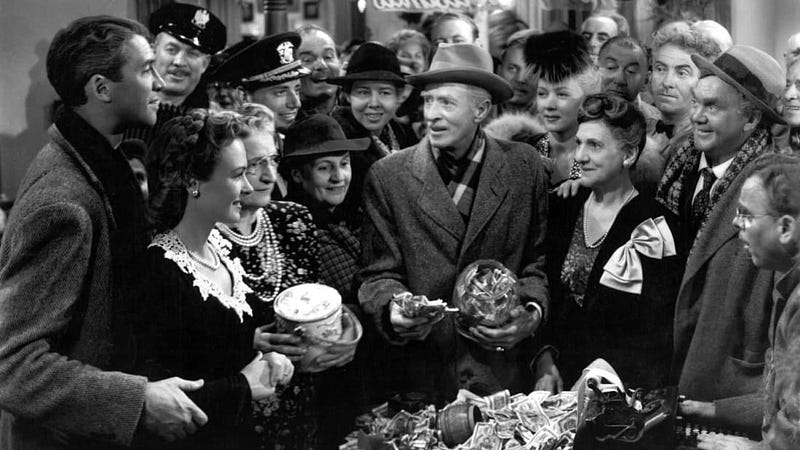
It’s a Wonderful Life isn’t the story of a man realizing he’s rich because he has friends. It’s the story of a man finding the will to go on despite how hard growing up and growing older and growing old is. That’s why I argue it’s impossible to get tired of the film — every year that passes deepens our relationship with it because every year that passes sees each of us confronted in similar, soul-crushing ways to George Bailey.
His existential terror is our existential terror.
We’re all George Bailey.
Remember, George’s spiritual transformation takes place before his community comes to his rescue. He comes home after finding a way to overcome his grief over the state of his existence. Clarence’s success is in helping him appreciate how wonderful his life was despite all his traumatic losses and self-perceived failures. Director Frank Capra’s coup de grâce is how he takes that personal character journey and, in the film’s final moments, smashes it head-and heart-first into a pretty damn blatant communist/socialist message of community over the individual.
It’s this conclusion that makes It’s a Wonderful Life a Christmas film despite its relative deficit of Christmas in general. But it’s George Bailey’s crushing disappointments, his slow, painful surrender to the inevitabilities of growing up and older — his refusal to give up — that make it a timeless classic.
A couple of weeks ago, I told my wife how much I hated the coffee mug. The one with my father’s face all over it. The one with me and him grinning at the camera, arms around each other, our other arms wrapped around my oldest son between us. I know she doesn’t understand how I feel — she still has her parents — but she did seem confused about why I hadn’t just put it in a box somewhere so I didn’t have to be confronted by it every morning.
It’s simple. Because putting the mug away won’t change the fact that my father is dead. Because doing so would be like trying to hide from what happened when the only real choice is to live with it — to find a way to keep going despite the scars.
If you want to hear more from me about storytelling and the arts and, on occasion, my musings about life, subscribe to me here at Medium or, to receive my free arts-centric Substack newsletter, subscribe to 5AM STORYTALK.