
Why You Need to Unfocus to Become More Productive
It’s the energy that matters

Your productivity has less to do with the number of hours you squeeze out of your working day and more to do with the rest you have.
I read that statement twice since it just wasn’t making sense.
Less work equals more work done.
You might also be wondering the same thing.
The Rule of 52 and 17
In 2014, a study was done by The Draugiem Group, a networking company. The study aimed to identify what habits set their most productive employees apart.
To do this, the company used a time-tracking productivity app to assess how employees used their time at work.
Interestingly, the study showed that 10% of the most productive employees didn’t work longer than everyone else. In fact, they worked less than 8 hours.
The secret they had discovered was to use multiple breaks. For every 52 minutes of work, they had a 17-minute break. Hence, the rule of 52 and 17.
Alex Soojung-Kim Pang, a Silicon Valley consultant and author of Rest: Why You Get More Done When You Work Less shares the same sentiments.
He says that we become more productive when we have more restful hours.
“Generally, short bursts of long hours do lead to increases in productivity, but over time those gains disappear…the odds of costly mistakes rise, and as a result, the gains that come from working longer hours disappear.”
It now makes sense.
As I reviewed my own habits when working, I began to understand why working longer hours never led to as many outputs as I hoped.
A 53-year-old study by Raymond Van Zelst and Willard Kerr conducted in 1951 revealed that scientists who spent 25 hours at their place of work were not more productive than those who only spent 5 hours.
Cal Newport, author of Deep Work: Rules for Focused Success in a Distracted World also explains that in our world, we have adopted being busy as a proxy of productivity.
“In the absence of clear indicators of what it means to be productive and valuable in their jobs, many workers turn back toward an industrial indicator of productivity: doing lots of stuff in a visible manner,”
There is a hidden concept that Cal Newport is trying to uncover.
This is the concept of planning your energy and not your time.
Plan your energy, not your time

There is a different concept that we should begin embracing to become more productive at work and in our own lives.
The book, The Power of Full Engagement: Managing Energy, Not Time, Is the Key to High Performance and Personal Renewal by Jim Loehr and Tony Schwartz offers actionable tips.
In the book, the authors talk about how managing our energy is the key to our peak performance.
“The number of hours in a day is fixed, but the quantity and quality of energy available to us is not,”
A visual summary of the book captures this idea so well.
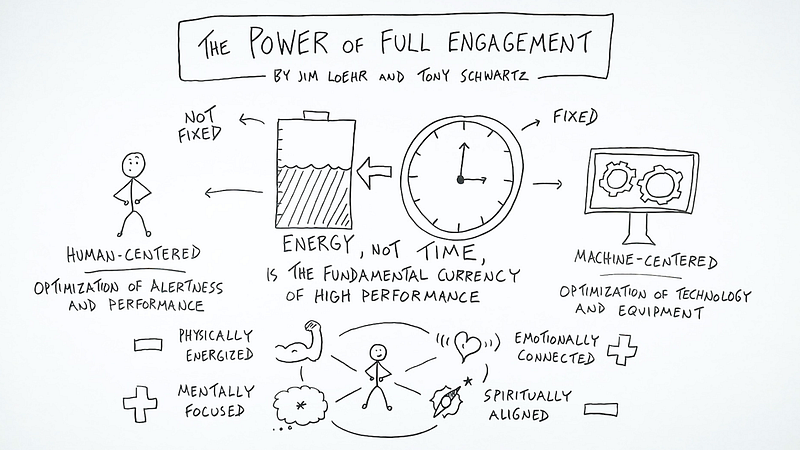
In the illustration, one thing is clear. Our time is finite, but our energy is not. Therefore, energy, not time, is the fundamental currency of high performance.
What does it mean?
This means that for us to be more productive, we need to focus on doing more activities that ensure we are energized and can bring more of ourselves to work.
We need to be physically, mentally, emotionally, and spiritually energized in order to perform at our best.
Physical Energy
If we are lacking in physical energy, it’s pretty hard to bring high-quality emotional, mental, or spiritual energy to whatever’s in front of us. Hence, begin by replenishing your physical energy.
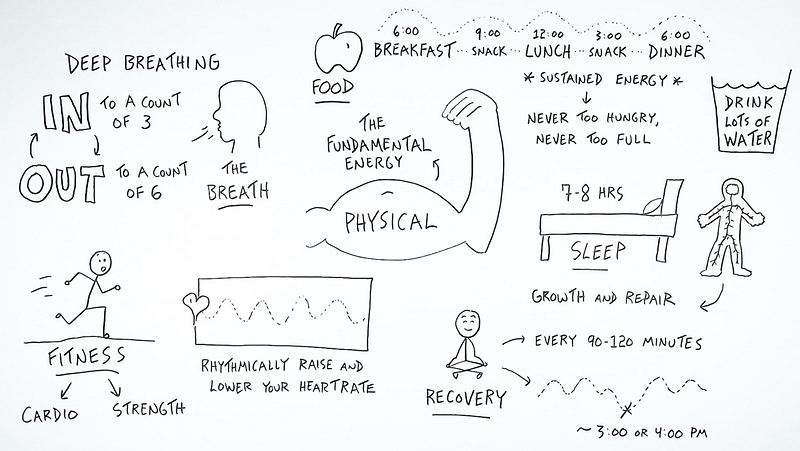
- Adequate sleep
- Nutrition
- Fitness
- Deep breathing
- Breaks during our work period
Emotional Energy
To fill our emotional energy tanks, we need to focus on self-confidence, self-control, social skills, and empathy.
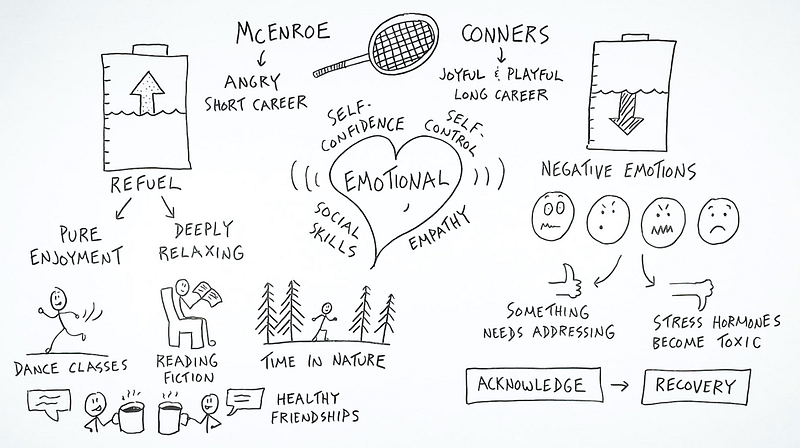
- Healthy relationships
- Reading fiction to relax
- Enjoyable activities
- Time in nature
- Acknowledge negative emotions
Mental Energy
Our mental energy should also be replenished regularly. Focus on the muscles of mental preparation, positive self-talk, creativity, effective time management, and visualization
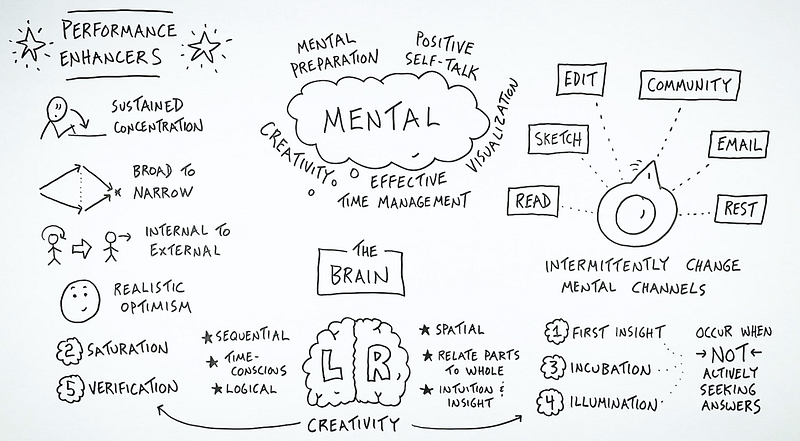
- Sustained concentration
- Being optimistic
Spiritual Energy
But taking the time to identify your deepest values and to identify a purpose that exists beyond your own self-interest, that in itself becomes an energy source that feeds into all of the others and will support the particular actions that you take each day.
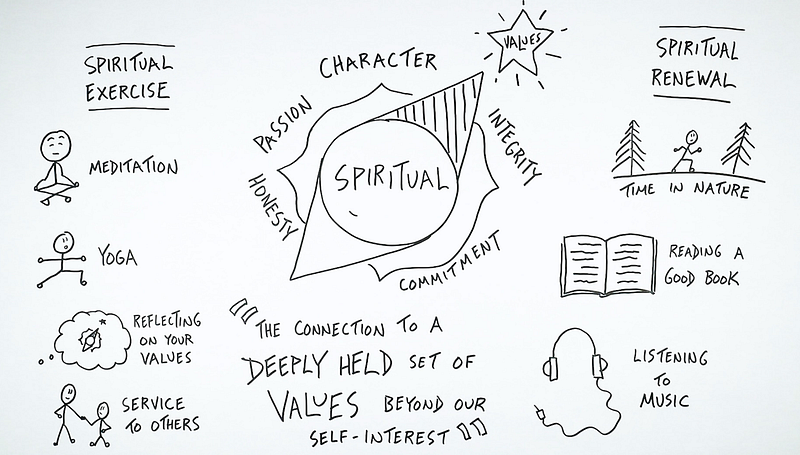
To replenish our spiritual energy, focus on the following;
- Spiritual exercises such as meditation and yoga
- Reflecting on your values
- Being of service to others
- Listening to music
- Time in nature
What you need to start doing now
The book by Jim Loehr and Tony Schwartz packs a lot of actionable tips we can begin adopting.
However, while these are a handful, here are some simple ideas you can begin practicing to manage your energy;
- Self-awareness
Understand your energy patterns and identify your peak and low-energy periods. Schedule your most important and demanding tasks during your peak times to maximize productivity.
- Work in cycles
Alternate periods of focused work with short breaks to recharge. Experiment with different work-to-break ratios to find the rhythm that suits you best.
- Focus on well-being
Do activities that enhance your physical, mental, and emotional well-being. Get enough sleep, eat nourishing foods, and engage in regular exercise. Make time for activities that bring you joy, such as hobbies, spending time with loved ones, or pursuing creative outlets.
- Reduce energy-draining activities
Identify and minimize activities that drain your energy unnecessarily. Streamline your workflow, delegate tasks whenever possible, and set boundaries to protect your energy from distractions and interruptions.
Join our newsletter to receive insights about actionable productivity tips.


