
Why You Need to Publish Your Originality
Creating: the lost art in a world of conformity.
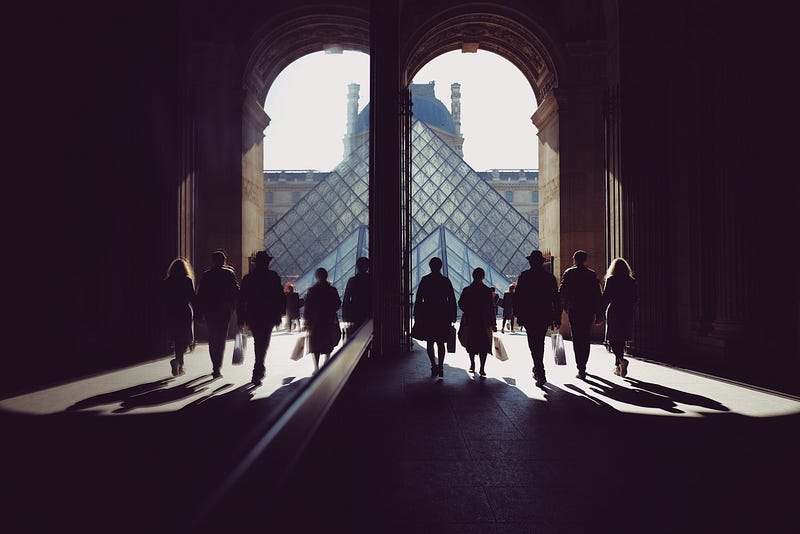
Creativity: the use of unique, imaginative ideas in the capacity of producing something new.
With all the sophisticated improvements we see nearly every day, it can become easy to forget the need to use our own imagination. We all have it. Yet, we don’t exercise it as much as we should, and it’s hurting us.
Most people resolve with following the road frequently traveled. After all, the majority of our society is seemingly fixated on the limits others place on them.
“You can only go this far.”
“That is as much as you’ll ever be able to do.”
Caution tape spans almost everywhere we look. Restrictions and guidelines informing us of the usual expectations of such commonality. Soon enough, falling in line with everybody else just seems easier and less stressful.
But is it?
When was the last time you had a spontaneous, creative idea come to your mind as though a cliche light bulb had been turned on? Or better yet, when was the last time you were able to remember that idea?
I bet it wasn’t while you were overwhelmed by demands so irrelevant and constrictive to your imagination, the only creative concept in your head was that new coffee mug you bought from IKEA.
The reality is most of our day-to-day lives include little (if any) creative thinking. Because of the hustle-and-bustle flow that describes our work/life balance, we simply put off and ignore what would — if given the chance — open our eyes to what lies inside.
Things Weren’t Always Like This
At a very young age, our minds could relate to the vast universe of imagination that encompassed every turn. A large box was something more than just a box.
It was a supersonic jet, a clean sports car, a well-equipped spaceship destined to land on the moon — no, on Mars.
The backside of a used paper was more than just “the blank side,” never to be used and discarded as void trash. It was a canvas to be filled with much of the strange and unique creations then bubbling around in our brains.
Nothing and no one could tell us anything different. We knew what we were creating, even when those well-meaning “adults” regarded it as meaningless scribble-scrabble. And what else was a window other than a glass layer between you and the limitless concepts of life, people, and the world?
What changed? Why did everything become so bland, so common?
Eventually, the influence of other individuals and their creations shaped the way we both thought and created. As our minds matured along with our perception of the world and culture that surrounded us, we began to believe those who told us something different.
That really was just a box. Not a sports car, not a jet, not a spaceship. Only a plain, brown box. Nothing you imagine will ever be as great as so-and-so’s such-and-such. So just do what everyone else does: accept it and move on.
Conformity can become our mode of existence.
But it doesn’t have to be this way.
Wasted Time
On virtually every smartphone everywhere, there’s at least one social media app. Whether it’s Instagram or Twitter, Pinterest or Facebook, everyone has access to a world within the screen.
It’s a world where you can attempt to impress people you’ve never met and perhaps wouldn’t care to meet. Where many go to find the next idea to mimic or reproduce, all while hiding behind the anxiety of the ordinary. And at the touch of a finger, their pursuits are boundless.
Then there’s the plethora of shows and movies to be explored on Netflix and other sources of entertainment. Even though we’ve seen them again and again, we just can’t help but repeat the same steps because it’s what we’re used to.
Now, I’d be a fool (and a hypocrite) to pretend as though I never fall into the trap of scrolling through my Instagram feed, double-tapping all the amazing landscape and lifestyle photos I came across.
Or the fact that I am convinced “The Office” is one of the best documentary-style TV shows ever produced. I could literally watch it all day! But at least now I’m aware of it. I’m more conscious of when I need time alone with my mind.
My point is not that either of these things is bad in and of themselves. The issues lie in our inability to pull away from them, to set aside the time to think creatively.
It has become somewhat of the standard to do so, and if we’re not careful, our minds will be replaced by artificial imagination.
These two realities are starkly different, not the same.
The Problem with Conformity
This mindset, I believe, of perpetuating redundancy has impacted our ability — and perhaps even our desire — to create, to imagine. Instead, we’ve settled with the status-quo way of living and thinking.
It’s tough to come up with new ideas when nothing is done differently.
Consequently, there remains a sense of stagnation. A feeling of being stuck on a wheel that is turning but isn’t really going anywhere.
We feel exhausted and burned out without asking ourselves why. And it’s because we’ve landed in a cycle of old habits that don’t lead anywhere.
Looking at nearly every invention in history, the new was brought about by stretching the limits of the conventional. “There has to be something more,” they’d say.
The thought of functioning for good within the boundaries of some other formation was uncomfortable.
So much so that those who were ready to use their ingenuity had to first address the issue(s) corresponding with the ordinary. And that took time, which in turn gave way to something original.

Copying isn’t creating.
Copying doesn’t reach beyond, it simply stops within and turns around with nowhere else to go. Failing to step outside of the box, it continues the trends and ignores the possibilities of something far greater, more effective, even helpful.
The reality is we don’t take enough time to think. Rather, we focus primarily on ways we can replicate what has already been created. This ultimately counteracts the way in which we were wired.
The Way Life Can Be
Truth is, the thought of acting on new ways of living with intention scares us. Sure, alleviating distractions and focusing on what matters most in life sounds great in our heads.
But when the time comes to demonstrate it, the worries set in. What will other people think about this? How am I supposed to function without checking Instagram or Twitter?
The answer is challenging but doable:
Replace all those distractions with activities that provide room for imagination and productivity.
Filmmaker and mastermind behind Break the Twitch, Anthony Ongaro, describes this desire to act upon what interrupts our potential to create as just that — a “twitch.”
The need to check that notification about that one photo you just posted. Those pair of shoes that came out yesterday, a must-have for anyone who yearns for the utmost level of attention.
Or even that one shirt that goes well with those dark blue jeans. These are all impulses beckoning us to respond to things that take away our time and ruin healthy habits, like reading a book, writing out ideas, or going for a run.
At its core, creativity is important because it solves problems, increases clarity, and imposes the possibility of improving the lives of a few people within our midst or an entire world.
In order to maximize this powerful tool, though, there has to be an attitude of intention. There has to be a desire to push the boundaries of what is in order to arrive at what will be.
Kevin Horton is a 24-year-old photographer, college student, modest book-worm, and wanna-be web developer with a new-found love for writing. He writes helpful words about creativity, productivity, and the enjoyably simple life.
’Til next time, thanks for reading!


