
Why You Need a Customer Journey Map and How to Create One for Your Business
The simple way to understand your customer and make their experience seamless

Understanding your customer needs, problems, and expectations can pose to be very overwhelming. However, having this information with relevant data helps you create a smooth customer experience and keep your customer coming back to you. As a business owner, your primary goal should be solving the problems of your consumers. You should be able to turn one-off customers into returning consumers. This can only be achieved if the first experience had a lasting impression on the customer and if any pain points are resolved.
For example, in my country, one pain point among customers of the major car haulage companies (Uber and Bolt) is the inability to pay for rides with their debit card (when not linked to their app). And boom, a new company, Universal, is tacking this as their central selling point and having a fast growth.
If you understand all the challenges that customers face while in the purchasing process, you reduce the chances of losing your customers to a competitor
What is customer journey mapping?
A customer journey mapping is a diagram that illustrates the steps your customer(s) go through in engaging with your company, whether it’s a product, an online experience, retail experience, or a service, or any combination. Customer journey mapping helps to depict your customer expectations and preferences visually.
For example, a customer journey timeline exploits how your business engages with a customer (perhaps with advertising or in a store). The process of buying the product or service, using it, sharing about the experience with others (in person or online), and then finishing the journey by upgrading, replacing, or choosing a competitor (re-starting the journey with another company). A journey map carefully highlights how your customer comes across your brand, how they interact with your brand and includes all of your customer’s actions to complete an objective — purchasing from your brand.
The customer journey map focuses on seven ideal steps. They are; introduction, discovery, purchase, adoption, engagement, renewal, and advocacy. By this, we see that the customer journey map effectively prescribes how your customer goes through your sales funnel.
According to a Gartner Customer Experience Management Survey, organizations that have and use customer journey maps are twice more likely to outperform competitors than those that don’t.
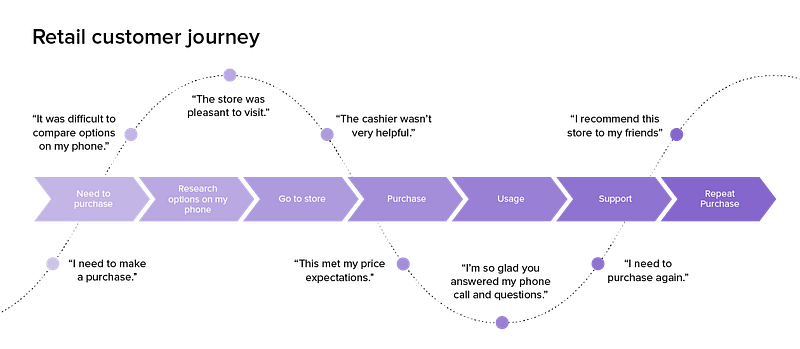
Here are six things owning a customer journey map can do for you;
- Empathize with your customers and understand their pain points: A customer journey map avails you the opportunity to know your consumers intricately. With the map, you can understand your target audience’s pain points and what motivates them. You can also understand what makes individuals buy from other brands in your niche and leverage this information to your benefit.
- Get a uniform view of the customer journey: The customer journey map ensures that everyone working with you is on the same page about the experiences that customers should have with your company. This is possible because the customer journey mapping requires that all departments work hand in hand with the same goals in mind.
- Get valuable insights: A customer journey mapping helps you gain valuable insights into what customers expect of your brand at different stages. It enables you to gain insights into the practices you have been engaging in that your customers like and those they dislike. This helps you create better experiences for your customers and keep them motivated to keep buying from you.
- Customer journey maps position your company to drive better results: A customer journey map increases customer satisfaction and fewer customer complaints. A 2018 customer journey mapping report shows that 67% of customer experience professionals surveyed across the globe are using, or have used, customer journey mapping.
- Creating a customer-centric company: Using a visual map to tell your company story will help you improve customer service and retention. You may use the map to train new and existing workers at intervals, allowing you to better track your customer success and leverage new systems that work.
- Predict and influence consumer behavior: With a detailed customer journey map, you can predict and change customer behavior which in turn optimizes the conversion process. For example, in the purchasing process, you can set defaults that smoothen the process for the customer and are suitable for your business.
It is important to state that there is no correct way to create a customer journey map as different organizations approach it in diverse ways. Therefore, before you begin, pay attention to aligning your map with a customer persona and envisaging the steps that will significantly benefit your business/brand journey.
A customer persona is a fictional character that represents your average customer based on user and market research. Imagining this persona’s age, job function, personal goals, can help you step into the customer’s shoes and thoroughly develop the customer journey story.
The frameworks provided below will enable your organization to figure out your customers’ journey process with your products.
- Identify the objectives of the journey mapping: Your customer journey mapping is effective only when the objectives and goal for curating it are clearly stated. What would you like to achieve with the customer journey mapping?
- Identify buyer personas and their goals: gather customer data through surveys and interviews. This will help you determine who your customers are, what motivates them to buy, and their needs and wants.
- Identify and map all customer touchpoints: Identify how your customers relate to your business at every point. You can use surveys and feedbacks and some analytical software that monitors how the customer interacts with your sites.
- Match the touchpoints with the buyer personas: Match your buyer behavior to the touchpoint as they go through the buying process. This will help you determine their behavior at each level.
- Identify pain points and challenges: Based on your buyer’s persona, identify the types of challenges that they might face at each end.
- Prioritize and fix pressing issues: You must pay attention to issues affecting your customers. Know what your customer does not like about your business and handle it. For example, it could be that goods ordered are not delivered on time. It could also be that messages don’t get prompt responses on your social media pages. Move to fix what is frustrating to your customer.
- Update your map regularly: Regularly update your map to accommodate new trends, new initiatives, new customers, etc.
This article is for informational purposes only. It should not be considered Financial or Legal Advice. Not all information will be accurate. Consult a financial professional before making any significant financial decisions.


