
Why You Must Discuss Training in Your Team’s Performance Reviews
And 10 types of low-cost development you could provide

When we think of performance appraisals, we generally think of SMART goals and how to delegate goals to our team.
Unfortunately, many leaders forget to include a discussion about training and development in the performance review process. As employees wait for their performance reviews to discuss training and development, you could miss an opportunity to raise the team’s competency and increase engagement.
But why do team members wait until review time to bring up training? Couldn’t they ask any time?
Remember that some direct reports find it stressful to ask for training or discuss their career aspirations with their manager. Or your team may believe that training is always decided in performance appraisals or assume that the beginning of the year is when the training budget is doled out.
If your direct reports expect to discuss their development in their appraisal and it doesn’t happen, this could lead to discontent in the team and, ultimately, lower retention.
Employees value training, especially if they are ambitious, and this was illustrated last week when I was out with friends.
We were talking about some colleagues in their thirties who only want to do work that would enhance their CVs.
We are all in our 50s and 60s, and working on your CV, not your job, wasn’t a thing when we were younger. Even if we’d thought of it, we wouldn’t have got away with choosing what we worked on in the strict working environment of the ‘90s.
One of the younger women commented that people her age engineer their work projects toward career development because no development is forthcoming from their employers. And realistically, this is a fair point.
As a leader, it’s far better to work on your team’s development with them rather than having your direct reports have an agenda of career development that you are not privy to.
Employees know which leaders develop their teams. There is a lot of chat in the lunchroom about how managers conduct performance reviews, and its well-known which leaders develop their teams.
If you want to attract people to your team, being known for developing your direct reports will help.
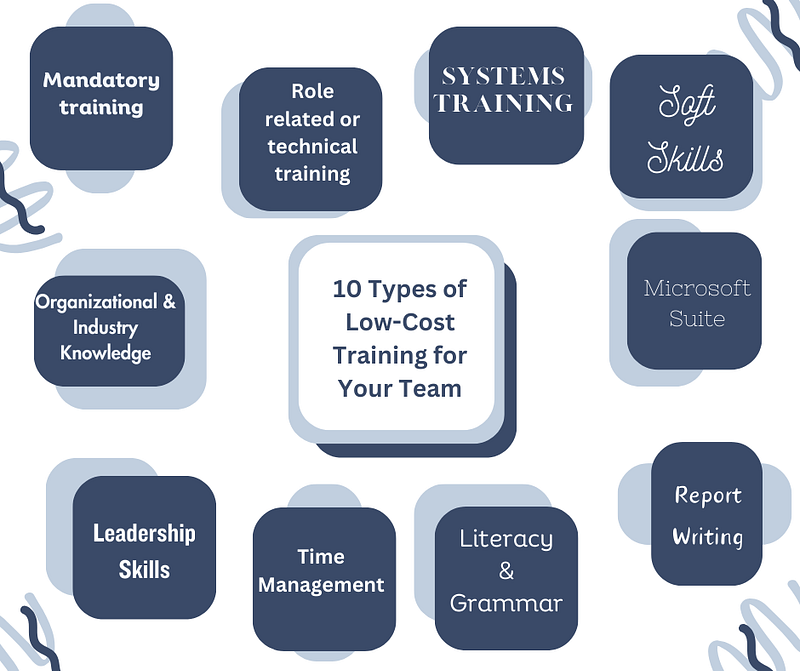
Ten Types of Low-Cost Training
Organizing training is easy if you have a budget because you can send your team members on a course, which is what people generally think the training will look like.
But even with zero budget, you can organize helpful training for your team, such as:
Mandatory training
Are all your team members up to date with mandatory training such as First Aid, Certifications, and Regulatory Training?
If not: Delegate one of your team to collate a spreadsheet to track who needs what training and organize any overdue training. If the training is mandatory, budget won’t be an issue.
Organizational & Industry Knowledge
Could your direct report benefit from more knowledge about your industry and organization?
If they would: Organize visits with other departments and leaders, run some trainings in your team meetings, and encourage your team to follow relevant industry pages on social media. You can also arrange for memberships of industry organizations. If you have a small budget, sign up one person and share the content.
Role related training
Are your team members fully competent in every aspect of their roles?
If they aren’t: Develop a training matrix for your team, ask them to develop cheat sheets or SOPs on areas they need to learn (creating a learning tool will ensure they learn the topic thoroughly themselves), and develop on-the-job learning workbooks for each role.
If you’d like a free team training matrix, get one here.
Systems training
Are all your team members sufficiently experienced with the computer systems you use? Have you got a super user and enough coverage if someone leaves or is on leave?
If not: Ask for volunteers to train as super users and send them on training provided by the system suppliers. There may be training on popular systems on YouTube or LinkedIn learning.
Soft skills
Does your team need soft skills training like communicating with others, resolving conflict, resilience, or EQ?
If so: Find someone good at the skill who can mentor your team member, check out YouTube, TED talks, books, and online courses, and encourage your team member to practice the skill and get feedback.
Microsoft suite
Are all of your team as capable in Word and Excel as they need to be?
If not: Heaps of Microsoft courses on LinkedIn learning are available for a yearly membership of a couple of hundred dollars. Alternatively, a colleague could tutor your direct report or they could find an online course or learn what they need on YouTube.
Report writing
As people move up the career ladder, they must write more reports, usually without training. Do your team members have to write reports? Are they good at report writing, or do they struggle?
If they struggle: You can coach your team members, get someone good at report writing to mentor them or get them to research how to write reports and present them back to the team. You could also run a training on report writing, and if your organization has a template, ensure everyone is familiar with it and knows how to access it.
Literacy and Grammar
Not everyone was well placed to get a good grounding in English and grammar at school, and this might show up in some of your team. Does anyone in your team need help with literacy, spelling, or grammar?
Check out how to spot literacy issues in your team here.
If so: Find someone in the organization who can assist, find out if there are any free community courses or online courses, or coach your direct report yourself. There are plenty of worksheets online, usually designed for teachers, but you could re-purpose them. Books about grammar abound, and you could make these available to your team.
Time Management
Unless your team members are very junior, they will have to manage their own time, and many employees find this a challenge. Time blindness could be an issue. Are all your direct reports managing their time well?
If not: Get them some coaching from someone who is organized, run a team session to share time management tips, research free online courses, and encourage your team members to read some time management books such as Eat That Frog. Encourage your team to download a library app called Libby, which allows you to download books for free.
Leadership Skills
If you are managing new leaders, they must be provided with some leadership training. Are any of your team new leaders or leaders who could benefit from leadership training?
If so: Encourage the team to read up on leadership skills (my newsletter for example), get them some coaching from another leader, run leadership skills sessions in your team meetings and encourage discussions about best practice leadership. LinkedIn Learning also has many leadership courses and is available for a few hundred dollars per year.
Bonus tips
- Remember that if a team member lacks a skill such as literacy, they may be embarrassed about it. You can counter this by calling training Business English or keeping the training confidential.
- If you can foster a growth mindset in your team, it will simplify developing your team.
- Talk about self-directed learning and encourage your team to be proactive around their development.
- Ensure you provide time for training activities.
- Encourage open discussions around career development; that way, you will know who will be interested in stretch projects and standing in for you when you are on leave.
- Check up on training progress in your direct report’s one-to-ones (If you’d like a free one-to-one guide and template click here).
- Don’t try to do all the coaching and training yourself; there will be others in your organization who could help.
- If you have an HR team, ask them for support, ideas, and assistance.
- Don’t underestimate the value and importance of training to your team.
Summary
If you ensure that you prioritize training and development for your team, you will retain your staff, raise engagement and productivity, and reduce turnover.
You will also gain trust and build a better system of communicating with your people, and even without a training budget, you can give your team some training; it just takes more effort than sending team members on a course.
The upside is that coaching, mentoring, and in-house training can be far more effective than a course not designed for your team members and may only contain a small amount of relevant material.
And with the internet, Google, YouTube, TED talks, podcasts, and free apps like Libby, it’s easy to access training material on any topic at a relatively low cost.
Thanks for reading and if you found this article helpful consider joining my growing weekly newsletter about leadership & training.
Visit us at DataDrivenInvestor.com
Subscribe to DDIntel here.
Have a unique story to share? Submit to DDIntel here.
Join our creator ecosystem here.
DDIntel captures the more notable pieces from our main site and our popular DDI Medium publication. Check us out for more insightful work from our community.
DDI Official Telegram Channel: https://t.me/+tafUp6ecEys4YjQ1