
Inspiration | Overcoming Obstacles | Facing Fear
Why You Fear Uncertainty and How To Handle It Better
Sticking your head in the sand isn’t such a great plan after all.
“You gain strength, courage and confidence by every experience in which you really stop to look fear in the face. You are able to say to yourself, ‘I have lived through this horror. I can take the next thing that comes along.’ You must do the thing you think you cannot do.” — Eleanor Roosevelt
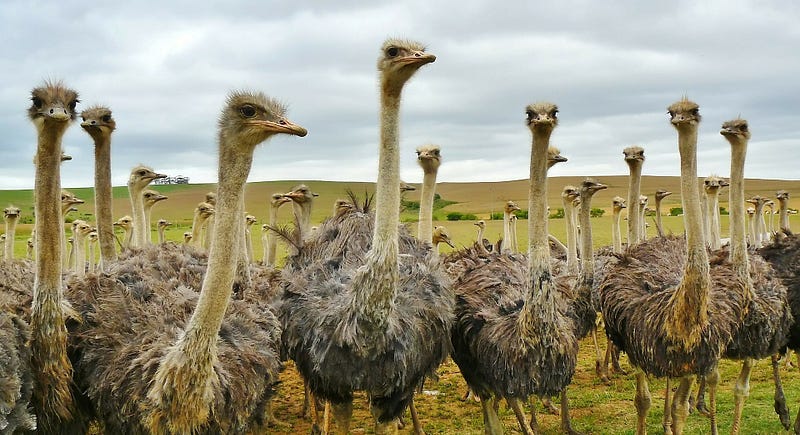
Some of us are like ostriches. We prefer not to know something that will — or might — be painful or frightening. We would much rather stick our heads in the sand and pretend it’s not happening, or continue to hope it won’t, rather than face it head on.
Then there are those times when we are blissfully unaware that our lives are about to explode. We haven’t got any idea that something dark and nasty is lurking round the corner. And then suddenly, there it is, in your face and reeking of disaster.
When explosive situations arise and our lives are turned upside down, often we didn’t see it coming. A terrible car accident, the sudden death of a loved one, an illness or unexpected job loss…there are many ways in which we can be derailed in the blink of an eye.
But in many cases, there were signs we chose not to notice. Or we made decisions that were not brilliant. And here it is, some weeks, months or perhaps even years later, and now we have to clean up the fallout from those choices.
As a psychic and medium, throughout my life I’ve heard people tell me they’re afraid to have a reading because of what they might find out. They don’t understand that if the potential for a problem is detected, it gives them the opportunity to prevent it. At the very least, it can help them prepare for it and get the best possible outcome.
Preparation Requires Awareness
Having a reading is like going to a counsellor, although plenty of people avoid doing that, too. Both are about discovering the potential for problems that can only be reduced or eliminated if you’re willing to see what might lie ahead. Otherwise, without prior knowledge, you get slammed in the head with a bag of bricks and your ability to deal with the problem is compromised.
You can’t prepare if you’re not aware.
How many times do we hear about people who have worrying symptoms but refuse to get them checked out? We tell them, “If you catch it early enough, your chances of treatment or cure are so much better than if you leave it!”
Yet still, they refuse to go. And sometimes we can say that to others but we’re not so great at taking our own advice when the shoe is on the other foot.
What if it’s nothing serious? Wouldn’t it be preferable to find out and stop worrying?
In many diseases, early diagnosis improves the chance of a cure, while ignoring it makes things worse. It’s the same with the problems and challenges of life, such as financial troubles, secrets kept by partners, anything that we sweep under the carpet because we don’t want to face the ugly truth and deal with it.
Even ignoring your car “making that weird noise now and then” could mean it becomes something big and painful when catching it early would have meant a minor pinch.
Being blissfully unaware isn’t all it’s cracked up to be. Eventually, the truth comes out and slams you upside the head.
Better to be vigilant about the facts of your life, considering and contemplating options, consequences, and daring to look at what’s really going on. Ignoring or avoiding the truth will only give you less time to figure out a way to put things right — or at least, keep them from going horribly wrong.
Fear of the Unknown
When you don’t know what you’re facing, or you fear what you might be facing, it’s easy to become nervous or anxious. An uneasiness settles into your bones. It’s distracting. It wastes energy. It messes with your productivity.
You waste time wondering about all the “what-ifs” and sometimes the ruminating can be so bad, it affects physical and mental health.
Of course, some challenges and obstacles leave themselves as surprises, no matter how diligent and “on top of things” we might be. We can’t always know what’s coming, but that’s not what I’m talking about.
I’m talking about people who live in denial. I’m talking about people who stick their heads in the sand and refuse to acknowledge something they don’t want to know.
“The oldest and strongest emotion of mankind is fear, and the oldest and strongest kind of fear is fear of the unknown.” (H.P. Lovecraft)
Our fear of the unknown is a natural survival mechanism. It is designed to protect us. The more information we have, the better our chances of staying safe — or at least, minimising an unwanted outcome. According to the BBC:
“The brain is constantly trying to predict what will happen next, allowing it to prepare the body and mind in the most effective way possible. In uncertain situations, that planning is a lot harder — and if you’re potentially facing a predator or a human foe, the wrong response could be deadly.”
Nicholas Carleton, a psychology professor at the University of Regina in Canada, says, “Treating unknowns as potential threats would have been adaptive, as long as the associated anxiety did not compromise [essential activities] such as seeking food and shelter, or selecting mates. He states that the “unknown” represents one of humanity’s “fundamental fears” — which maybe even more important to our behaviour than our fear of death.
What Can Help?
There are countless factors that go into how well we’re able to process fear and uncertainty. Certainly, mindset makes a significant difference.
A Growth Mindset vs. a Fixed Mindset — an idea pioneered by Stanford Researcher, Carol Dweck — will go a long way to improving our ability to cope with uncertainty. A Growth Mindset allows us to see past obstacles and to understand that we are not helpless. It helps us to view difficult events as challenges instead of threats. A Fixed Mindset keeps us stuck and fearful.
Even if our upbringing, habits and tendencies so far have been to shy away from the unknown and avoid it like the plague, we can learn to react differently. We can learn how to move away from a fixed mindset and adopt a growth mindset.
Thanks to neuroplasticity, our brains are capable of physical changes that can help us adapt to new situations. It forms and reorganises synaptic connections and particularly when learning or experiencing something new, or after an injury.
The combination of a growth mindset and neuroplasticity can mean the difference between cowering in a closet and refusing to face what lies ahead, and being willing to dive in and deal with whatever it might be. You can learn to face uncertainty with more confidence and less fear.
The Takeaway
Not knowing about upcoming challenges isn’t going to make them go away. The facts won’t change simply because you’re playing “Let’s pretend.” You’ll only end up shooting yourself in the foot and have a nasty shock when you reach the point of having no choice but to face the truth.
And regret tastes especially terrible when you realise you could have minimised the damage by dealing with the issue sooner and/or having had a chance to prepare.
Best to make yourself aware of the truth in all areas of your circumstances. Stay on top of the business and paperwork aspects of your life. Dare to be honest about the harsh realities in unhealthy relationships, whether they’re with a partner, a sibling, a child — anyone.
Be brave and look at the state of things in your life. It’s the only way to see what needs fixing, and your best chance at creating a happy future.
Here’s how dramatically life can improve when you stop letting fear make your decisions:
Join Medium for unlimited, ad-free access to great content! Your $5/month helps support my work and the other writers, here, too. You can sign up here:
Huge gratitude to the Good Men Project for publishing this in Change Becomes You. I appreciate all you do to make a difference in the world.
Published at libertyforrest.com.
©Liberty Forrest 2022 All Rights Reserved


