Why, Yes, I Do Feel Like an Enormous Fraud
But I’m working through my battles with imposter syndrome.
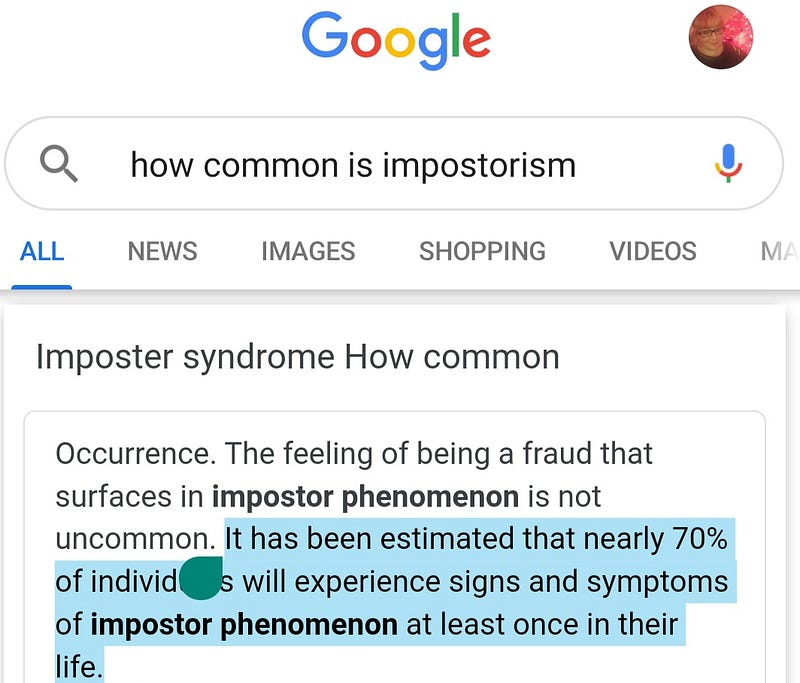
I’m one of those people who Googles everything. Every question, every curiosity. Whenever I feel sick, any time I don’t know what to do — I turn to Google.
Honestly, I don’t even remember what I did before Google existed because the habit is so deeply ingrained in me. Though, to be fair, my Googling intensified when I became a mother, and then when I took a job in social media marketing. I was a writer, sure, but I also joked that I was a professional Googler, just because I had to find so many different articles around the web for each of my clients.
Nearly six years later, Googling is a way of life for me even though I ditched that marketing gig two years ago. Oh, and God forbid if I ever find myself looking at the wrong search engine. Bing? I’ve never had a search result I’ve liked with that nonsense.
At any rate, when I Google — especially when I start searching for answers about health or lifestyle issues — it never fails. I always seem to run into some article by Robert Roy Britt. I’m not even surprised anymore.
I practically expect it. His work is everywhere.
Something I did not expect, however, was this story Robert published at the end of September, called “Feel Like a Fraud Lately? Yeah, It’s Going Around.”
Call me naive, but no, I never suspected that Robert Roy Britt might feel like a fraud. I’m not sure why it surprised me so much because I certainly know better. But knowing something isn’t the same as feeling it, and I suppose that one of the very worst things about imposter syndrome is the terrible feeling that we’re all alone in our inadequacies.
I don’t really like to talk about imposter syndrome. It’s not something I typically get into when I write about writing because, for me, it’s up there with writer’s block — everybody talks about it, everybody has an opinion about it, but neither of those things means my thoughts about it will make a difference.
For a long time, I’ve sort of just taken it for granted that every writer feels painfully inadequate some days. Don’t they?
Toward the beginning of October, I wrote a story that’s had about 360,000 views. It was a nice enough ride until the traffic began to sputter, and I wound up feeling a bit like a failure.
Maybe the story wasn’t good enough. Maybe other writers would have done much better. Maybe it was weird that the story quit spiking when it did. On and on it went with my mind making up imaginary problems just because my traffic went down again. Back to normal. Suddenly, my normal felt like a real deficit.
Everybody who deals with imposter syndrome knows that it doesn’t actually matter what you do or how well you do it. It follows you around wherever you go and beats you down just because it can. Imposter syndrome is opportunistic, and lately, it seems to find a lot more faults in me.
The truth is that my writing’s changed a lot in 2020. I suspect there’s a lot of that going around this year. A lot of general uneasiness among creatives.
For more than two-and-a-half years, I’ve been known for writing deeply vulnerable stories about my life and all the gory blunders. My best writing feels a lot like opening my veins — it’s cathartic — not just for me, but for certain readers too. For the readers who get it, who need it, there’s nothing tawdry or low-brow about bleeding on the page.
Even so, I find I do a lot less bleeding on the page these days. It feels like 2020 has chewed up and spit out more than enough of me. Much of it has to do with being a single working mother in the middle of a freaking pandemic. Some of it has to do with various health problems during a viral pandemic. A lot of it has to do with hitting perimenopause before I’m even forty… in the middle of a fucking viral pandemic.
And then, you know, there’s the election.
I mean, I’m tired and exhausted. Emotionally, mentally, and physically depleted. It feels a helluva lot better —or even safer? — to lean into cultural commentaries. Slightly less personal politics. Unpacking, reliving, and learning from my past? God, that’s so pre-corona.
For the past seven months or so, I’ve lived with so much heightened stress that I can’t get too excited about any deeply personal topic. And hello, imposter syndrome. I see how much you like to take advantage of that.
These days, I’m terrible at following a lot of my own writing advice. On at least 15 days of every month, I am wildly unproductive. Not just with my writing, mind you. I’m also hopelessly behind on household chores and on those days, any semblance of self-care I once had goes right out the window.
I am, for all intents and purposes, one hot mess. Not the cute kind. Not the kind that says, hey, we can curate such imperfect authenticity and turn it into a lifestyle brand.
This is the shit show. I'm the kind of hot mess that forgets about Zoom appointments and fails to get back to people in real llife. A hot mess whose mail got put on an involuntary 10-day hold because she failed to empty the box for more than a week. Where I dabble in writing one story, and then I move on to dabble in another. Something that’s shiny for maybe ten minutes. Dabble, dabble, move on yet again. I’m spending so much of my time dabbling that I don’t finish much of anything.
The old Shannon from 2018 or 2019 would never pull this shit, and she’d tell you not to do it either. She’d sit her ass down and finish the damn story before moving onto another idea.
Full-time writing means you won’t always feel smart or inspired. I know this, and believe that you ought to know it too. Sometimes, you’ll feel pretty stupid and you might wonder if you’re just phoning it in. How can I be positive for my readers when I’m not feeling positive for myself? To a certain extent, successful writers learn how to accept that there are going to be good and bad days. It’s not phoning it in so much as it’s learning how to roll with life’s punches.
A long time ago, I read Ayodeji Awosika say something about how your writing is like any other relationship. Sometimes you feel it, and other times you don’t. But if you’re committed to the relationship, you’ll go through the hard stuff. Those low points.
I don’t know that there’s ever been a more honest statement about writing. This is something I genuinely love to do and I feel so incredibly fortunate to get to do this thing every single day. To put my thoughts and feelings into words on digital paper and then send it out into what feels like an abyss, but then watch it turn into something a few folks even like? That’s some kind of magic right there.
Because there’s that magic, and because it literally does pay the bills, I’ve found myself willing to put up with a whole lot of crap. There aren’t many other endeavors that could put me through the wringer as writing does. I can’t see myself willing to take it from many other careers.
Though I do find myself wondering what writing might be like if there wasn’t this imposter syndrome constantly looming or lurking above my head.
Here’s the thing, though. As much as I never really expected to hear a writer like Robert Roy Britt open up about feeling like a fraud, I was so enormously happy just to read about it at all. It felt like this serious gift to hear another, “more successful” writer admit to completely natural and human feelings of inadequacy because no matter how much I tell myself that nobody has all their shit together, it never ever hurts to hear them say it.
In fact, as soon as I read the headline and saw the name, I knew I’d eventually be writing this story. I knew it would impact me in a meaningful way, so, I bookmarked the piece and let it marinate for a few weeks.
Today, I don’t feel any less fraudy. I’ve still got a ton of internal criticisms flailing themselves at me. Things like I’m too wordy or rambling or blah blah blah. My voice isn’t as “voicey” as it used to be. Maybe those critics were right about me being “the worst.”
There’s a lot that I don’t give myself credit for on the really bad days. A lot of stories that simply fall to the wayside as soon as I fear I’ve missed the mark. And I really wish that I could tie it all up into a cute bow that would finally make you battle your demons.
But I can’t. I won't.
I’ve got my demons too.
In his piece about impostorism, Robert wrote, “But now when I feel that self-doubt, my inner voice reminds me that I’ve been writing about new topics my whole career, and nobody’s called me out as a fraud yet, so maybe, just maybe, I can handle it.” I had to stifle a 2AM giggle because, in less than three years of blogging for money, I have been called a fraud. It’s happened quite a lot, actually.
Sometimes a reader will leave a nasty comment on a story. Others sometimes look for a more direct route by finding me on Facebook or Instagram (of all places) and asking me — who do I think I am? I get a lot of mansplainers, and people who think I need them to tell me what my own words mean. People who call me a clickbait writer and those who want me to know I’m undeserving of my success, along with those who gleefully tell me I’ll never be a real writer, whatever the hell that means.
I think about all of these things, and I’m reminded of some of the nastiest comments I’ve gotten on my work by people who are absolutely convinced that I’m this fake persona or a fraudulent writer who has no business writing about anything. All of these thoughts have come together simply because Robert Roy Britt was brave enough to tell a more personal story.
And it occurs to me, as I now stifle a nearly 3AM giggle, that even when people do call me a fraud, it’s never actually made me one. Better yet, I’ve discovered that I can easily survive it. And it’s that small but powerful realization that puts imposter syndrome into perspective for me.
Robert was right, just like Fred Rogers was right, and just like I was right.
Talking about tough stuff helps.
“Anything that’s human is mentionable, and anything that is mentionable can be more manageable. When we can talk about our feelings, they become less overwhelming, less upsetting, and less scary. The people we trust with that important talk can help us know that we are not alone.”
— Fred Rogers
My writing shifted this year in response to the pandemic and a variety of related personal stressors. I’ve felt guilty about that and I’ve felt bad for it, mostly because impostorism tried to turn it into some terrible flaw.
In reality, though?
I’m wrapping up yet another year of writing from home. Another year of supporting myself and my daughter through writing alone and there’s zero shame in that accomplishment. The year has been tough, but I’ve proved that I can shift my work in ways that feel right and make sense to me, and my writing can still pay the bills.
Impostorism is a bully, but the good news is that it’s not only your bully. It’s after the rest of us too — and not even just the writers.
Don’t believe me?
Try Googling it.