
Why Writers Should Deliberately Cross-pollinate To Come Up With New Ideas

Did you know that the Grand Café in Oxford was the first coffeehouse to open in England, in 1650? Before the spread of coffee and tea, alcohol used to be the drink of choice through British culture.
Both elite and mass folks drank alcohol day in and day out, from dawn until dusk. They would drink a little beer with breakfast and have a little wine at lunch, a little gin, and top it off with a little beer and wine at the end of the day. That was the healthy choice because the water wasn’t safe to drink. And so, effectively, until the rise of the coffeehouses, an entire population was drunk all day.
When coffeehouses became a vogue in the 1650s, they did something more than making people sober.
According to Steven Johnson, the author of the bestselling Where Good Ideas Come From: The Natural History of Innovation, coffeehouses became the breeding ground for sharing ideas. It was a space where people from different backgrounds, different fields of expertise, would get together and share. It was a space, as Matt Ridley talked about, where ideas could have sex. This was their conjugal bed, in a sense. And an astonishing number of innovations from this period have a coffeehouse somewhere in their story.
One of the contributing factors was the architecture of the space.
The confined, chaotic environment of the coffeehouses was exactly where people from different backgrounds were likely to have new, interesting, unpredictable collisions.
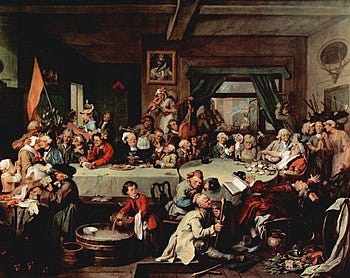
So if you are trying to come up with new ideas, this is the kind of place you need to visit often. We take ideas from other people, people we’ve learned from, people we run into in the coffee shop, and we stitch them together into new forms, and we create something new.
Building upon existing ideas is nothing new.
Artists have been doing it for centuries. Painters draw upon the tools, techniques, and approaches of other painters; musicians build upon the styles of other musicians they have heard; writers are influenced by the books they have read.
Steve Jobs, the co-founder and former CEO of Apple Computer, said in an interview that “the key to creativity is to expose yourself to the best things that humans have done and then to bring those things into what you are doing.” He goes on to say that what made the original Macintosh computer great is that the people working on it were “musicians, and poets, and artists, and zoologists, and historians, who also happened to be the best computer scientists in the world.”
The analogy “trade is to culture as sex is to biology,” from a Wall Street Journal article on the importance of trade in enhancing innovation, captures this concept. According to the article, communities at the crossroads of the world, such as ancient Alexandria and Istanbul or modern Hong Kong, London, and New York, which attract people from vastly different cultures, benefit from the cross-pollination of ideas and increased creativity.
What we call distractions, those trivial and time-wasting things, might lead to new ideas.
We might want to discard internet surfing or phone browsing as mindless activities with absolutely no result, but in fact, they are virtual coffeehouses where ideas are cross-pollinating.
Jan Fortune writes:
Productive people, we learn, are those with their heads down who do one thing well. Whilst there are people who pursue a single passion to great effect, the dictum of the one thing can also be narrowing and separating. Sometimes the price of single-minded productivity to the exclusion of all else is myopia that kills relationships and sacrifices the riches of a multi-disciplinary approach to life.
Cross-pollination is a marriage between unlike ideas.
As Suzanne Collins famously claimed in an interview with The New York Times, the idea of “The Hunger Games” came to her while flipping channels one night between reality television programs and actual footage of the Iraq War. “On one channel, there’s a group of young people competing for I don’t even know, and on the next, there’s a group of young people fighting in an actual war. I was really tired, and the lines between these stories started to blur in a very unsettling way.”
At that time, she was completing the fifth book in The Underland Chronicles. She examined the idea of an unjust war developing into a just war because of greed, xenophobia, and longstanding hatred. She wanted to continue exploring the just-war theory for young audiences and wanted a completely new world and a different angle into the just-war debate. And there it was, “The Hunger Games” was conceived,
Creativity is often simple like that.
The novel I’m currently writing started with just one incident that I witnessed as a child. As I wrote one chapter, another one surfaced and became the turning point. A five-second scene from a TV serial I watched as a teenaged became the ending.
If you go into the depths of writer’s block, you will find that you need cross-pollination. We get stuck for ideas because we make the mistake of restricting our input sources.
Writers need constant input not only cross-genre but through different mediums.
Many people who aspire to be writers use reading the type of books they want to write as their only source of input. Sticking to just your own genera makes you a boring writer.
If you’re serious about becoming a better writer, you’ll put on your headphones, put on a podcast and get some much-wanted exercise. The information that goes into your head through the medium of audio is different from video or text. You may or may not get time to watch a video or read, but there are at least a dozen opportunities for audio.
Finally, a writing style also requires cross-pollination.
When you first start as a writer, you’re likely to feel like a clone. It is because your manner of writing is either a copy of someone else’s work or some formula you picked up along the way. It feels like you don’t have a personal style. However, your own style is not that far away. And usually, the process is sped up when you cross-pollinate the writers you read and the speakers you listen to.
If you read one writer for a long time, his style becomes a part of you. When you add a second writer, a bit of her style creeps into your being as well, and soon a sort of metamorphosis starts to take place. You haven’t changed much consciously, but your work changes a lot.
A style develops when you read or listen to different authors or speakers, drink deeply from one for a while.
When you dig deep into one person’s style, you get an insight that doesn’t come with bouncing around from one author to another. The style needs a bit of monogamy for at least a while before you go out and find another writer to love. Burrow deep into one writer, one speaker for a while, and then add the second and the third and possibly the fourth and fifth.
If you do, all you have is overload, and your brain doesn’t get the opportunity to tease out the style and structure of the writers and speakers.
The best part is you don’t have to do much. Your job is to read or listen, not even to make notes necessarily. Over time the brain figures out the patterns, and when you write, you notice the difference. That difference may not be apparent right away, but there’s bound to be a clear evolution in your style over time.
You may not always have time to watch and read, but there are endless opportunities to listen every day.
In summary, cross-pollination involves reading, watching, and listening deliberately in different genres, letting the ideas percolate in you and allowing them to influence your work.
This story was originally published at www.neeramahajan.com
If you liked this article you might also like this one too.


