Why were R.F. Kuang and Neil Gaiman disqualified from the Hugo Awards?
Let me start out by saying that this is a story about award controversy and there is no satisfactory ending here (and most likely never will be)
The Hugo Awards are often considered the most coveted and highest honor in Science Fiction and Fantasy. They have not been free of controversy but for many decades, they have been very transparent and open with decisions (even ones fans and authors disagreed with).
So when the nominations for the 2023 Hugo Awards were released, many people were shocked to see that R.F. Kuang’s Babel was not listed as a finalist for Best Novel. Yes, Kuang has a large and passionate following, but this was more than just a fanbase getting prickly. Babel had already won a Locus and Nebula Award and was a finalist for the World Fantasy Award and Dragon Award.
Even if you didn’t like the book, you can’t deny its popularity, which alone, typically garners a nomination. Again, it wasn’t a shock that it didn’t win but rather that it wasn’t nominated.
Typically, after nominations are announced, the stats are released shortly thereafter to show the votes. This is typically where questions like “Why didn’t Book X get nominated?” are answered.
As you can see in the release of the 2022 stats, there is a lot of preamble that answers potential snubs or disqualifications. Here, we have 5 pages of notes from the nominating board and an explanation of how to read the data.
There are also notes as to why certain works are disqualified, despite having enough nominations. Sometimes the author declines the nomination. Sometimes the work had been previously published or was published outside of the qualifying window.
The statistics have historically (of the past decade or so) been released within a week of the nominations being announced. Often, they are released on the same day.
For 2023, the stats weren’t released for three months. The bylaws of Worldcon (the convention that hosts the Hugo Awards) state that they must be released within three months, so the first question arises in this odd voting round — would we have had any answers if this requirement didn’t exist?
Either way, the 2023 stats were released and we ended up with more questions.
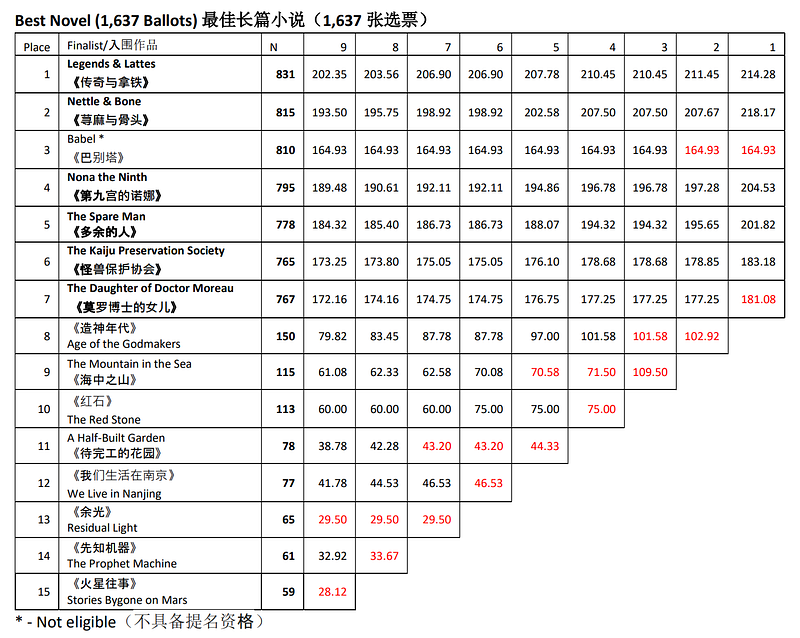
Babel received more than enough votes to be nominated as a finalist (even if it wouldn’t win), but was marked as “ineligible.” Unlike other years, however, no reason was given for its intelligibility.
The same happened for Episode 6 of Sandman — the Netflix show based on the graphic novel by Neil Gaiman (who also wrote the script).
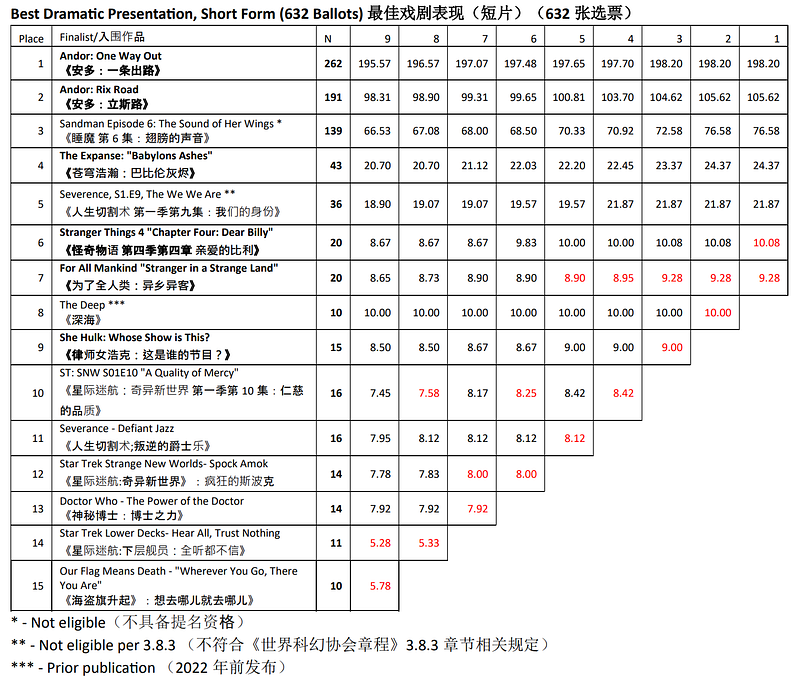
Why the vague disqualifications and oddities in stats reporting? Well, to potentially answer that, we have to talk about Worldcon as a whole.
Worldcon in China
If you aren’t familiar with Worldcon, it is an annual convention of the World Science Fiction Society (WSFS) that started in 1939 as a place for fans and professionals can come together and share their love of Science Fiction and Fantasy.
The Hugo Awards are one piece of Worldcon, where professionals and fans are honored for their work and passion. Apart from categories like “Best Novel” and “Best Short Story,” there are categories for fans such as “Best Fanzine” and “Best Fancast.”
Worldcon changes locations each year and much like the Olympics, there is a site nomination and voting process that happens to select a site 4 years before the event. In 2019, a vote was held and the two front runners were Winnipeg and Chengdu, China.
Chengdu won in a landslide with 2,006 total votes (compared to Winnipeg’s 806). There was a massive influx of local voters who had never participated in Worldcon. New local voters is typical, but based on previous voting sessions, there is typically an increase of 50–200 voters for a particular site.
The issue with Chengdu’s win was that there were 1,950, many of which had no address listed.
Although many people raised an eyebrow, ultimately everything continued forward. After all, although it was suspicious, it wasn’t out of the realm of possibility. Chengdu actively campaigned for people to vote and since so many prominent Chinese authors had been nominated in years past (Cixin Liu most notably), it stands to reason that local fans were passionate about hosting Worldcon.
The Explanation
So, you might be asking who exactly fields questions for these vague disqualifications. For the past few years, the man responsible for posting those stats is Dave McCarty (although the whole nomination board is much larger).
After the stats were released people still didn’t know why some of their favorite works were disqualified and they took to his facebook page to ask why in a thread he started.
Dave’s initial response was vague, to say the least.
“After reviewing the Constitution and the rules we must follow, the administration team determined those works/persons were not eligible.”
Without going into much detail, there is nothing clear in the constitution that would disqualify Babel as the requirements are that it was not previously published, published within the past year (September 2022 qualifies), and is in someway related Science Fiction and Fantasy (it very much is).
Sufficed to say, fans were not happy with that response. When asked again, Dave simply replied.
“asked and answered”
Things… quickly start taking a downturn as more people ask for clarification.
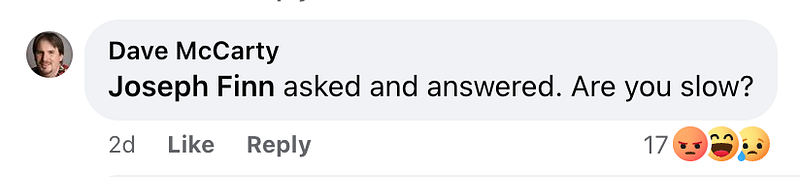
“asked and answered. Are you slow?”
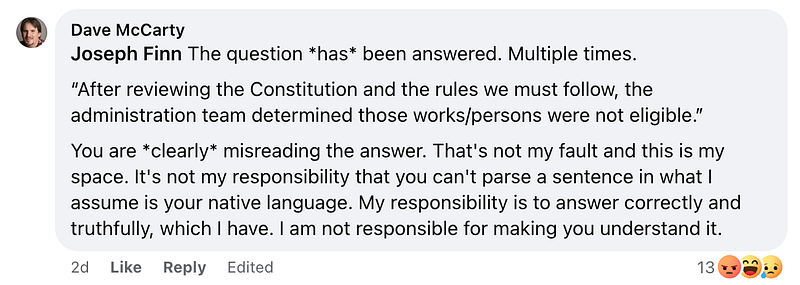
“You are *clearly* misreading the answer. That’s not my fault and this is my space. It’s not my responsibility that you can’t parse a sentence in what I assume is your native language. My responsibility is to answer correctly and truthfully, which I have. I am not responsible for making you understand it.”
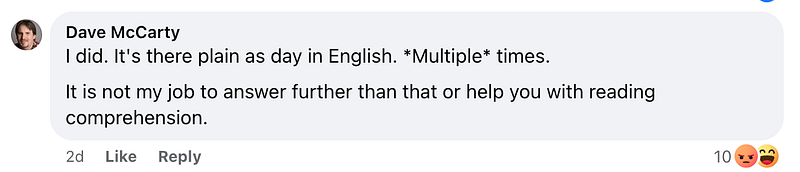
“I did. It’s there plain as day in English. *Multiple* times.
It is not my job to answer further than that or help you with reading comprehension.”
To be clear, this is not Dave’s full-time job and he does this on a part-volunteer basis. This discourse is happening on his personal facebook page and not a formal Worldcon forum. I’m sure it isn’t easy to be bombarded by fans all day,
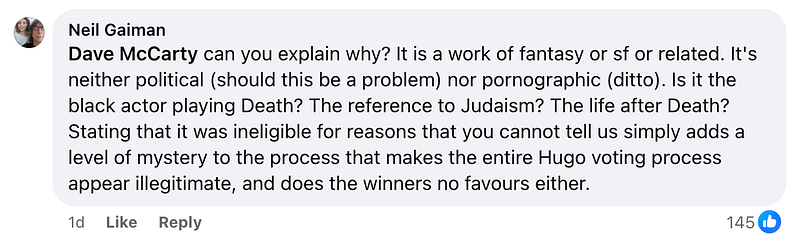
But his tone does change when Neil Gaiman himself gets involved.
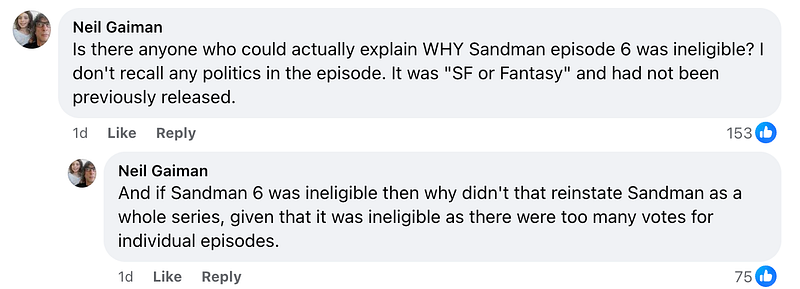
To which, Dave replied:
“The only statement from the administration team that I can share is the one that I already have, after we reviewed the constitution and the rules we must follow, we determined the work was not eligible.”
At this point, it is clear that no one is going to get more than this blanket response from Dave. To say this placated Neil Gaiman would be an understatement.
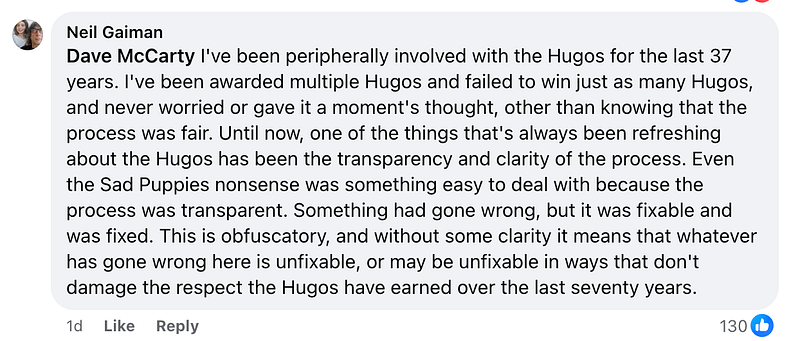
As Silvia Moreno-Garcia, author of Mexican Gothic and The Daughter of Doctor Moreau (a finalist who was not disqualified) says in the thread:
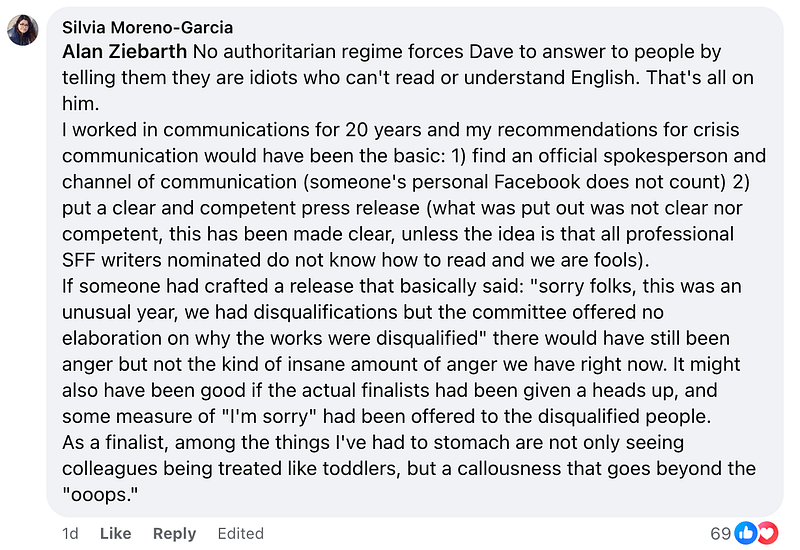
“As a finalist, among the things I’ve had to stomach are not only seeing colleagues being treated like toddlers, but a callousness that goes beyond the “ooops.””
The discourse fizzles out after this, as Dave stops responding and the rest of the comments are people speculating.
Tampering?
R.F. Kuang did not participate in this exchange, although she addressed the issue directly herself through social media.
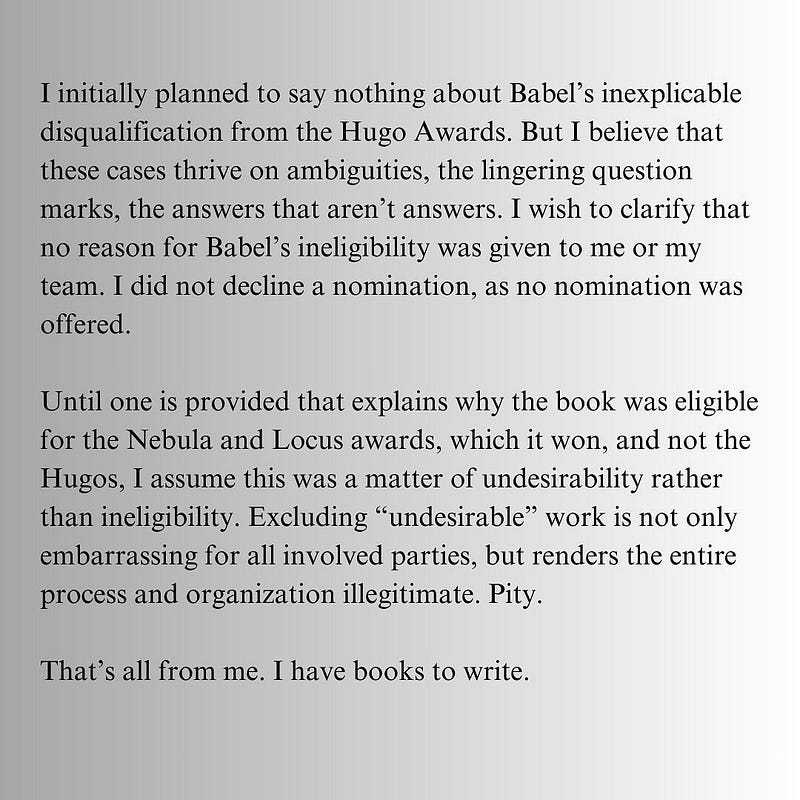
Many people suspected that Kuang was disqualified for being a Chinese ex-pat who has been critical of the People’s Republic of China. Dave denies this outright but doesn’t give any other explanation. This also doesn’t necessarily explain why other works were disqualified and Kuang’s ineligibility has become a popular point of discussion given how big of a name she is.
What can we conclude from all of this?
Someone decided to disqualify these works without a specific rule in place and there is nothing we (fans) can do about it. We’ll most likely never get a satisfactory answer.
Ultimately, this hurts the whole industry as even those who were nominated and won have to wonder if they would have without this controversy. Going forward, how can we be certain there will be a clear, equitable vote?
Notes
Cora Buhlert did an amazing write up on some of these issues plus more (and voting number discrepancies) on their blog
She also lists out many other blogs, journals, and YouTube channels covering this story.
Update (02/06/2024)
Dave McCarty has resigned from his position. There was an official statement from Worldcon Intellectual Property (W.I.P.)
Dave has deleted all facebook posts on his profile dating back to October of 2022
No official apology or explanation has given still
Update (02/15/2024)
Emails have been leaked involving correspondence between Worldcon Panelists and most notably Dave McCarty. He highlights in an email that “we need to highlight anything of a sensitive political nature in work… if the work focuses on China, taiwan, tibet, or other topics that may be an issue *in* China… that needs to be highlighted so we can determin if it is safe to put it on the ballot of[sic] if the law willr equire us to make an administrative decision bout it.”
Long story short, the Chinese government did in fact step in and told them to disqualify any works that could negatively portray China or any participant who has previously portrayed China in a negative light or referenced Tibet or Taiwan.
These emails also show that the Worldcon Panelists did the work of creating Dossiers on finalists dating back 10 years, highlighting social media posts about trips to Tibet or mentions of China dating back a decade.
You can find all the leaked emails here:
https://drive.google.com/file/d/1_QqmsxQkACoYcxSx2LVqbxD39-DJI_gS/view


