
Why We’re ‘All In’ For The Bible in a Year Podcast: Great Adventure Catholic Bible Now Sold Out
Being cut off from community during lockdowns fueled hunger for the Word, Bible studies
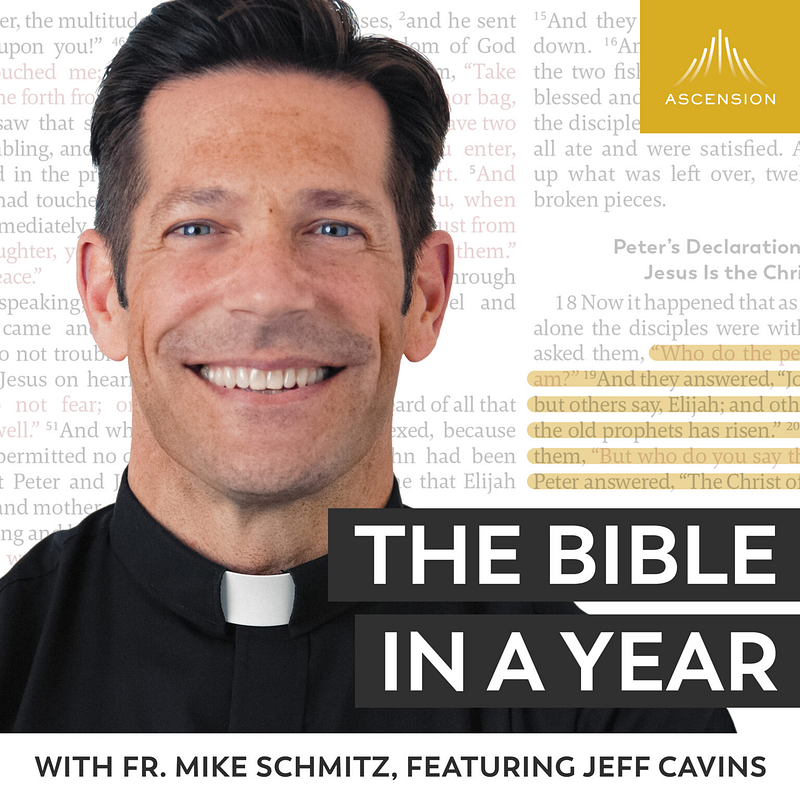
Millions now hear the entire Bible because “The Bible in the Year” became the world’s №1 podcast, selling out The Great Adventure Catholic Bible.
“I wanted to read the Bible in a way that shaped my lens,” said Father Mike Schmitz. “I wanted to be able to read the story of the people of Israel and realize ‘OK, this is part of our story of living in a broken world — but striving to be faithful.’’’
Every day the podcast appears on millions of phones. Listeners can spend about 20 minutes hearing Father Schmitz read from and comment on The Great Adventure Bible.
Ascension is taking pre-orders for a new printing due in late August, but the podcast is free, and new people join every day.
Listening to all 365 episodes gets subscribers through the whole Bible (the Catholic Bible includes everything in Protestant Bibles plus seven books Martin Luther wanted out).
Have you ever tried to read the Bible cover to cover? Go to Mass (or sign up for the USCCB daily readings) every single day for three years, and you’ll hear 71 percent of the New Testament (nearly 90 percent of the Gospels) but just 13.5 percent of the vast Old Testament (not counting the Psalms we sing).
People crave the rest of the story to put it all into a bigger context connecting history, His Story — and our own story within the bigger story.
Father Schmitz inspired by Ralph Martin’s ‘Fulfillment of All Desire’
Schmitz, chaplain at the University of Minnesota Duluth, of Duluth, Minnesota, was inspired after re-reading The Fulfillment of All Desire by author Ralph Martin.
Martin, the president of Renewal Ministries in Ann Arbor, Michigan, and a professor at Sacred Heart Major Seminary reminded Schmitz that “every saint had a Biblical world view,” that everything they saw in themselves and the world was shaped by reading and knowing Scripture.
But the Old Testament seems alien and disconnected from 2021: strange-sounding names, places, and rules make us give up and turn to modern content. Schmitz realized most of the videos and podcasts he was going to for information lacked that “Biblical worldview.”
“It just struck me so powerfully that that’s the perspective I want,” Schmitz said. “That’s the worldview I want. I want Scripture to be the №1 thing that influences how I see the world, that shapes how I see myself.”
He added, “There’s so much pain around us that we can fall into the trap of saying ‘that’s not my problem. I want to be a saint, so I want to have that same worldview as the saints had. The goal is to be able to come into contact with God’s Word daily.”
2020 took away Masses, making Catholics dive deeper into the Word
Everything changed during the 2020 lockdowns when Catholics found themselves missing the sacraments while “watching” (rather than being part of) Mass on YouTube or Facebook.
Catholics now found themselves understanding Protestants' lives: focusing on the Word of God but missing the relationship of the Sacraments and a global community. Jeff Cavins, author of The Great Adventure Bible, like many, chose to make the most of unwanted circumstances:
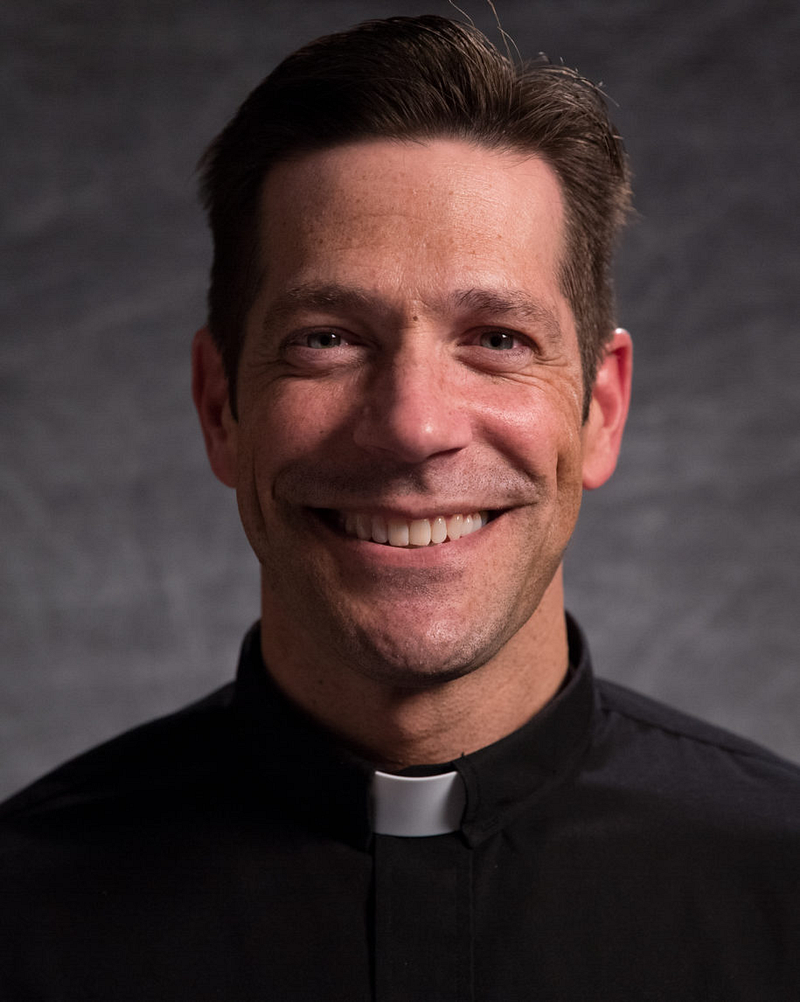
- Knowing 2020 lockdowns meant “a time of trial,” Cavins told his wife, “I want this to count.”
- His biggest fear? Ending 2020 without really learning anything new. He wanted the time of lockdowns to count for something good.
- For three weeks, he started a “three-week liquid fast,” feeding more on reading the Scripture. As a result, his hunger for the Word of God increased three-fold, starting “a time of renewal.”
- The time of fasting helped him lose 25 pounds while gaining spiritually.
- Catholics realized Jesus filled the Disciples with the Holy Spirit by “breathing on them,” and 2020 was the opposite: a time when we were told not to breathe around anyone.
Survey: 95 percent of Millennials prefer traditional Bibles
After years of reading e-books, new surveys show young Millennials would prefer to have traditional Bibles to read and highlight supplemented by the online Bible apps they can use to quickly “lookup” passages.
The beauty of podcasts? You can play them on your phone while walking the dog, doing chores around the house, or while driving in the car. Of course, you need to carve out time to “watch” videos or TV, but podcasts (like music) can follow you around in the background, slipping into your subconscious.
A fall uptick in pandemic cases meant more restrictions. Restaurants and businesses closed in some areas, and on January 1, demand for the new Bible in a Year podcast exploded. Millions signed up, making it the №1 podcast of any kind.
How to get elders to shift from CDs to new podcasts
The buzz started to build. Like Father Joe Campbell in Brighton, Michigan, parish priests nationwide started ending Masses by urging parishioners to download and listen to the podcast.
For years, we bought “Catholic Lighthouse” CD talks from the back of the Church, playing them as we drove.
But new cars don’t have CD players, giving rise to podcasts and free content that automatically “appears” on your phone.
Word of mouth traveled, and the podcast has stayed near the top throughout 2021. That’s how peer pressure kicks in with people talking about the stories they are hearing, relating them to today — then someone else subscribes.
The Gamification Effect: №1? The need to “check it out”
When something is “№1,” you feel a “tug” to check it out. I don’t consider myself a “podcast guy,” but I subscribed in January. It wasn’t love at first sight:
- We tried again in February, thinking we would “listen to about 40 podcasts on our drive from Michigan to South Carolina. But my bride dozed off. So we quit after a couple of episodes.
- “Everything clicked” in March while walking the dog in the woods. That turned out to be the perfect time to listen to a podcast. As I get a better feel for podcasts, I began listening to them in the car, the gym, and other downtimes as well.
- The “catch-up” came from starting the day with the newest podcast then going to earlier ones. From David to Adam until the relationship “clicked.”
The Bible in a Year Notebook: Writing our own daily impressions
Listeners demanded — and soon received — The Bible in a Year Notebook, essentially a journal listing each day’s readings, color-coded to Cavin’s method of explaining eras.
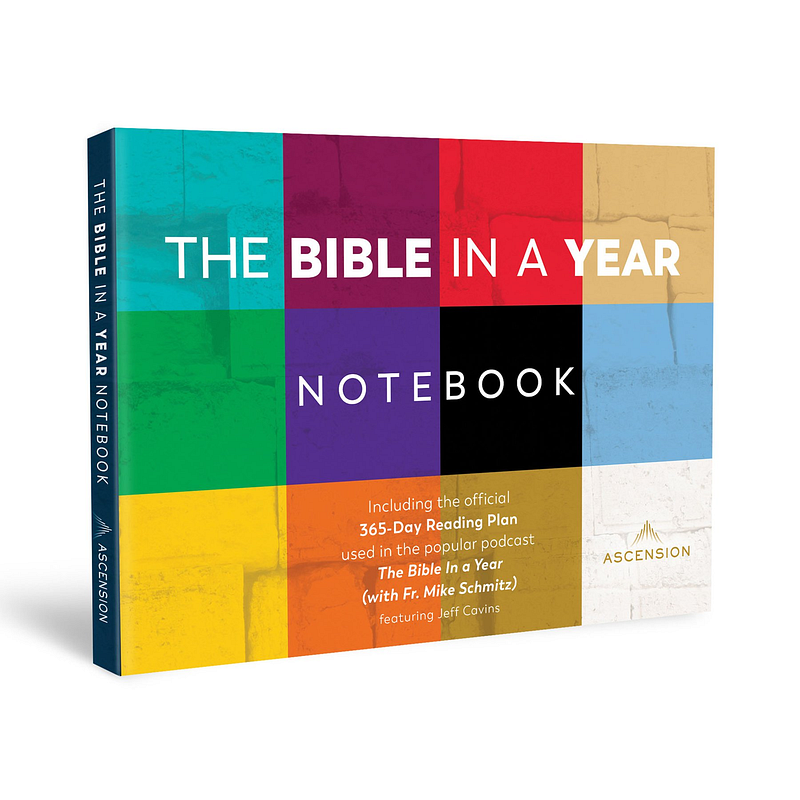
The notebook turned out to be a key missing piece of the puzzle.
Like many Catholics — we’ve always had multiple Bibles but were always hesitant to write, highlight or underline words in Sacred Scriptures.
The idea of writing in my Bible seemed like I was messing with something holy.
After all, for the first 1,500 years of the Church, Churches owned Bibles (all handwritten, all very rare and expensive), and the people listened to priests read the Word.
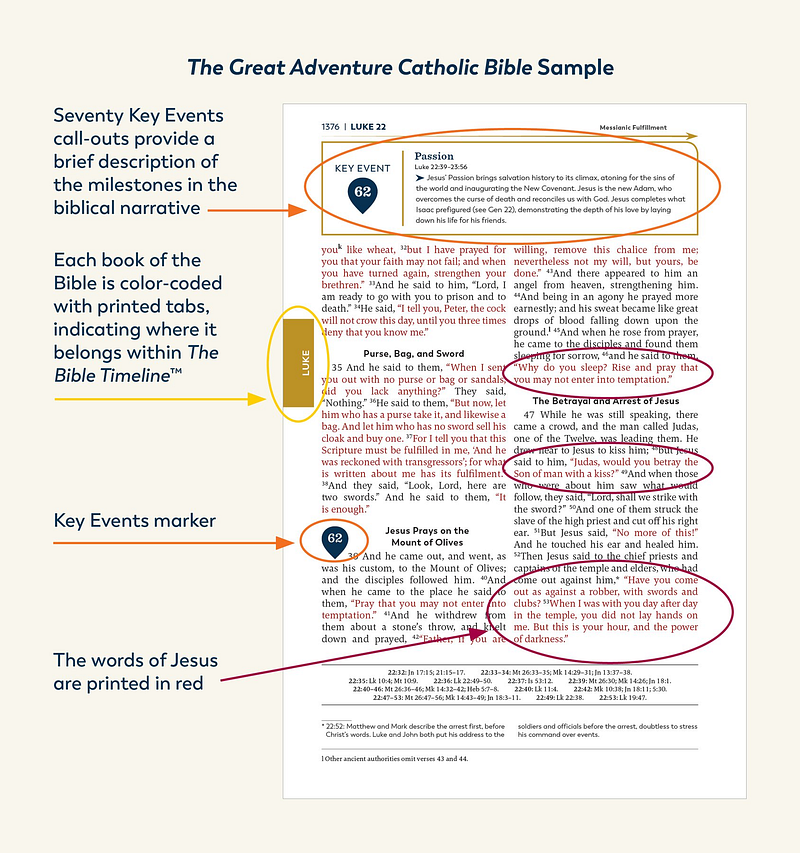
The notebook made it easier for me to take notes on each passage. And before I knew it, I found myself finally underlining passages in The Great Adventure Bible I’ve had since it came out in 2018.
Suddenly, Catholics (creatures of habit and ritual) are “all in,” listening to the podcast daily. I ordered the Great Adventure “color-coded” tabs, my bride, wonderfully attached to the correct Bible pages and now try to write notes in the notebook each day.
We finally think: These Old Testament people were as broken (and as messed up) as we are, and as the genealogies (and human patterns) repeat, we realize they are all our ancestors and family — and the ancestors of Jesus. And us.
Somehow, we are all related, all connected in some way, and these stories are our stories revealing who we are and where we came from.
Father Schmitz says listeners have become a true digital community, praying for each other, learning as we “live life through the lens of Scripture.”
‘’’’’’’’’’’


