
Why We’ll Never Defeat the Other Side of the Light
In the game of darkness versus light, we need something to fight.
It keeps happening.
Injustice and inequality. Murder and mayhem. The sufferings of the world splashed across every glowing screen, while a thousand divisive voices fight for bloodied scraps of attention.
It’s a turbulent time. But all times are turbulent. And in troubled times, you want to pick sides. You want to be on the right side. Especially when the other side is so clearly callous and cold and cruel.
But this is no grand battle of good versus evil, light versus darkness. We are not the chiseled heroes we see on our movie screens. This is a game we play, and like all good games, we need to take it seriously. But not so seriously that we forget who and what we really are.
Knowing how the trick works doesn’t stop it from working.
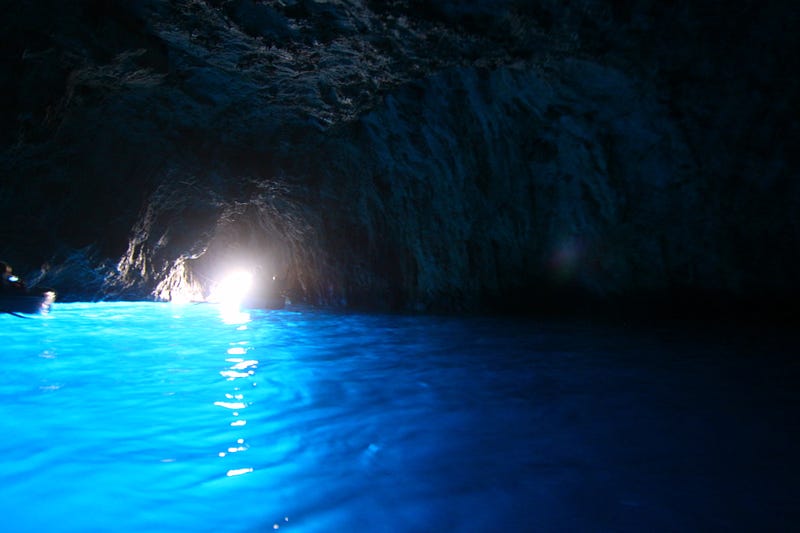
It happens anywhere with a strong sun and a clear sea and a low cave with an entrance just above the waterline. The bright ethereal blue of the water, where boats seem to float on a carpet of liquefied jewels, is never less than magical. The boatmen who work here, rowing tourists in and out of the cave’s small entrance, sing in the echoing chamber for tips. Why shouldn’t they sing? They live every day in this bright blue beauty.
And when the boatman hauls on the chain and drags you back out into the open, the sun is even brighter than it was before. Your pupils shrink from a soaked chickpea to a grain of sand. But the same light makes everything else grow. The lizards and the lemons. The basil and the bougainvillea. Your heart fills your chest like a seed inside a shell, and everything that lives is radiant.
Not any more. That kind of light is gone. Swallowed up by low clouds, invisible enemies, and a tidal wave of strident hatred. We can’t travel. We can’t work. All we can do is tear each other apart.
Rumi wrote of a chickpea in a boiling pot that tries to escape.
“Why are you doing this to me?” the chickpea asks of the cook. “I’m giving you flavor,” the cook replies. “Remember when you drank rain in the garden. That was for this.”
I drank sunlight in foreign gardens above the sea, and the blood of grapes bloomed like night flowers inside me. It was for this. The light of one part of my life gives greater darkness to another. The two things go together, like the chickpea and the boiling. I knew then, as I know now, as we all know, that suffering is the price we pay to live in the world. It’s not just inevitable. It’s necessary.
In The Book, Alan Watts describes all of our senses as a form of touch.
Our eyes touch the light that lets us see, and our ears reach out for the sound of laughter. But in our brain, it’s all electrical signals. The eighty-six billion neurons of your brain operate in two states: on or off.
Just as the binary pattern of ones and zeros conjures up the atrocities of the world on your computer screen. Just as these words appear like magic in front of your eyes and echo in the chasm of your skull. The whole world is like this. A pattern of vibration, an ongoing relationship between peaks and troughs.
Hearing music is hearing silence too. We couldn’t see the sun if it wasn’t for the darkness of the cave. We learn as children that life is a battle between light and dark, and we are told we must choose the light and fight the darkness. It looks like a battle, but it’s a game. And for the game to be in any way with playing, the outcome needs to be uncertain.
We believe in cause and effect. A cop’s knee on a man’s neck causes riots around the world. Understanding why things happen, we think, is a way to control them. To fight the darkness. To help the light to win.
Light and dark, good and evil, do more than just go together. They imply one another. They can’t exist independently, just as your head can’t exist without your heart. The more you fight the darkness, the more of it you will find. The more you embrace the light, the stronger the darkness becomes. You can’t separate the two, either in the world or in yourself. It was my knee on George Floyd’s neck. It was my neck under that knee.
We are a largely pessimistic species.
It’s served us well. Every skyscraper is a shrill scream against the earth we grew from. Every fortress is a prison. Everything we build and try to preserve is part of the same battle against decay, dissolution, and entropy. Every tower must fall, and the fall is implied even in the act of building.
Once in a while, though, our visions of the future are optimistic. In Star Trek, humanity is united, devoted to peacefully — where possible — exploring space. In a universe that has teleporters and food replicators and holodecks, basic human pleasures are easy to obtain.
In other words, it’s a post-scarcity universe. And we’ve never been closer to that dream we are today. In the developed world, the overabundance of food is more dangerous than the lack of it. We communicate with lightspeed around the world. We have the best food, the best medicine, the best entertainment, the greatest amount of personal freedom of any population throughout history.
But we claw at each other. Robbed of so many problems our ancestors faced, we seek out new ones. Liberated from the struggle for existence that constitutes life for every other species, we find ways to fight each other.
It’s the battle of light and dark. To make the game worth playing, darkness must always seem as though it’s about to win. Human history, in all its monstrous magnificence, is the story of the same struggle.
This struggle is a story we tell ourselves.
In the ancient taijitu, the symbol of yin and yang, the opposing forces of dark and light push forever against each other, separated by a sinuous line. But each contains in its core a seed of the other. If one side were ever to win, finally and completely, we would need to find another game to play.
To devote yourself to a cause you believe in is a fine way to spend your life. We all long for the light and try to be on its side. But games are played for the fun of playing, not for the outcome. No amount of effort can bring about a victory over the darkness that is the other side of the light.
And if it could, we wouldn’t want it to.


