
Why We Still Waste the Most Precious Resource on Earth?
The willingness of human beings to help and nurture others.
What do you think when you hear the word “resources”? What comes first in your mind? Some people are thinking “money”. Or “gold”, “water”, “oil”. Maybe “forest”?
All of the above are precious. Even vital — like water.
But when it comes to how they shape and nurture human life, there is something even more precious — the willingness of human beings to help and nurture others.
Sounds counterintuitive? Let me explain this. I know that when we are thirsty there is nothing more urgent than water. And there are days when we can doubt the very notions of good and goodness. And with so much worrying news around it is easy to lose faith in humanity.
But for any evil, there is countering goodness.
Look at all the support ordinary people give to people who are suffering right now. My news feed is full of people organizing themself, sharing their houses with Ukrainian refugees.
It makes me dream about how different Romania would be with good, carrying leaders. But this is another story to write about.
In the middle of this chaos, there are some people whom I call human angels. They are everywhere, not just in charities. They took upon them the hard task to take care of the ones who have nothing. They are dedicated, self-motivated, and modest. They don’t brag about how good or saintly they are. About what they are doing and how grateful the world should be because they exist. Or about how we should admire them and choose them as leaders.
They just do their thing. They are the people who make me dream about a better future despite all the bad news in the world. No matter how hard, as long some people are willing to put themselves in the service of others there is hope.
If you ask them why, why they dedicate their time, their money, their work to help someone without profit, they will just smile and say ”because we need to. Because these people need help.”
And this, the ability to keep our hearts open and to strive for good no matter what, is arguably the most precious resource we have in this life. Without it, all other resources, all the gifts that Life gives us, no matter how precious, are in danger of being wasted or even used for destructive purposes.
Each of these people has a story to tell. Something to help us to see the better angels of our nature.
For me, the most reassuring is not the stories themselves, but their multitude. For every story that reaches the news, there are dozens, maybe hundreds of smaller stories that make up a network of genuine compassion and dedication for the good of others.
There is more to this. This instinct for connection, this need to nurture and be nurtured, this struggle for good is as vital as food and shelter.
Take a look at the image below:
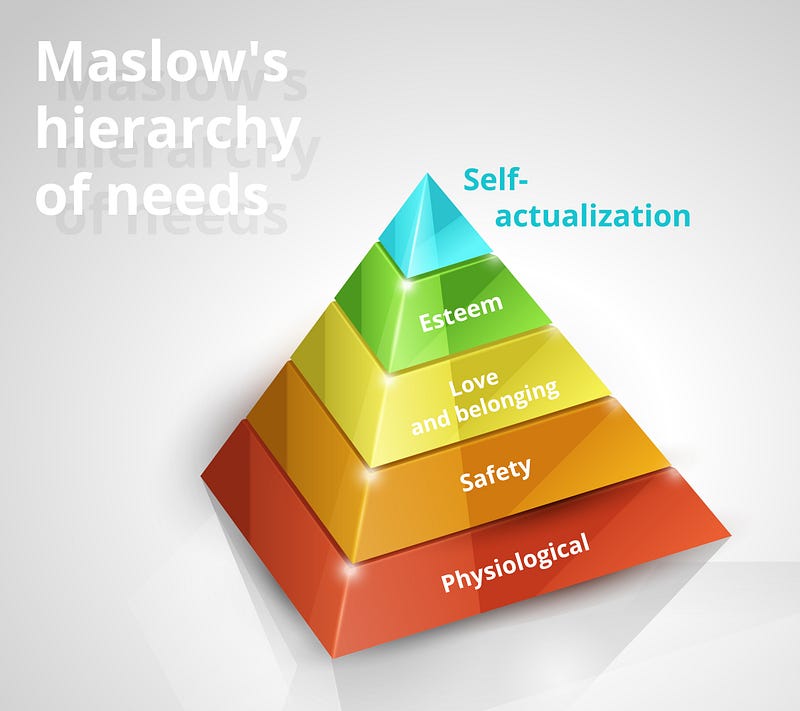
This is the famous Maslow’s “Pyramid of Needs” one of the most iconic psychological images. Different human needs are hierarchized in a pyramid with physiological needs, like air, food, water, at the base of it. The next levels are safety and security, then love and belonging, self-esteem and respect, and self-actualization at the top.
But this is not entirely true. The pyramid fails to take into consideration the social dimension of human beings. We are social animals.
As dr. Gabor Maté says:
We human beings are biopsychosocial creatures whose health or illness reflects our relationship with the world we inhabit — including all the variables of family, class, gender, race, political status, and the physical ecology of which we are a part.
In a quite disturbing study, Harry Harlow proved false the behavioral theory that stipulates the reason for mother attachment is food. The stronger need is not food, but the connection itself.
The infant monkey was choosing the clothed surrogate mother over the one made from wires, even when the latter one was the only one providing food. The infant monkey would spend most of the time with the soft surrogate mother, reaching to the other one just for food.
Even more disturbing are the stories about ”Emperor Frankenstein” and the children he killed in his obsession to find the original language — the language that was spoken before Babel.
And the ones from Romanian orphanages:
When they lack nurture, human beings do not develop properly. When there is no connection, they can even die.
This does not mean that Maslow’s theory is false, just incomplete: it takes into consideration just the individual, taking the environment for granted. It is like building a ship without considering water.
We are deeply wired for connection. We need connection as much much as food. Without it, we are just a sketch of what we can be.
And this begs the question: How can we harness the power of the human connection? How can we set the environment in such a way that we can thrive?
This is a question with no simple answers. But one clue can stand in our lack of awareness. As Einstein said, “We can’t solve problems by using the same kind of thinking we used when we created them”.
Ok, he didn't use exactly these words. Or maybe he used them talking with his friends but we don't have any written records of this phrase. But, writing about nuclear weapons he wrote:
“a new type of thinking is essential if mankind is to survive and move toward higher levels.” ( Atomic Education Urged by Enstein — Source Quora)
We waste this precious resource because we try to annihilate violence with anger. We are still focusing on who’s right instead of what is the best strategy, who to blame instead of what we can do, and who deserves to be punished instead of how to heal.
As I am writing those words, at the border of Romania thousands of people fleeing the war are queueing in dispair. Still, there are so many voices telling us that is their fault. They should not provoke a giant like Russia. They should not choose a comedian as a leader. And so on.
Granted, many of those voices belong to people who have their our agenda. But here is my point: those voices would be useless if people would learn how to change their thinking.
There is nothing more natural than when something goes wrong to search for the ones who are responsible for the situation. We need to know them, learn to avoid or even disarm them.
BUT, and this is the most important BUT I want you to pay attention to it, whenever we value finding blaming over the finding solution, we find ourselves in a witch hunt.
It is counterproductive, it hurts the victim and it hurts our innate humanity, our ability to empathize and to help.
So what can we do? A lot. Small things. From meditation to self-inquiring. From learning to doubt our thinking, especially when we feel triggered.
And most important, practicing gratitude.
I'll let you this quote from Einstein:
A hundred times every day I remind myself that my inner and outer life is based on the labors of other men, living and dead, and that I must exert myself in order to give in the same measure as I have received and am still receiving. (Albert Einstein — Source Weekipedia)
And with my article that can give you more tools to harness the power of our natural need to help and connect with others:
Thank you for reading until the end.


