
Why We Should Still Look at Paintings in the 21st Century
The benefits of sustained visual engagement
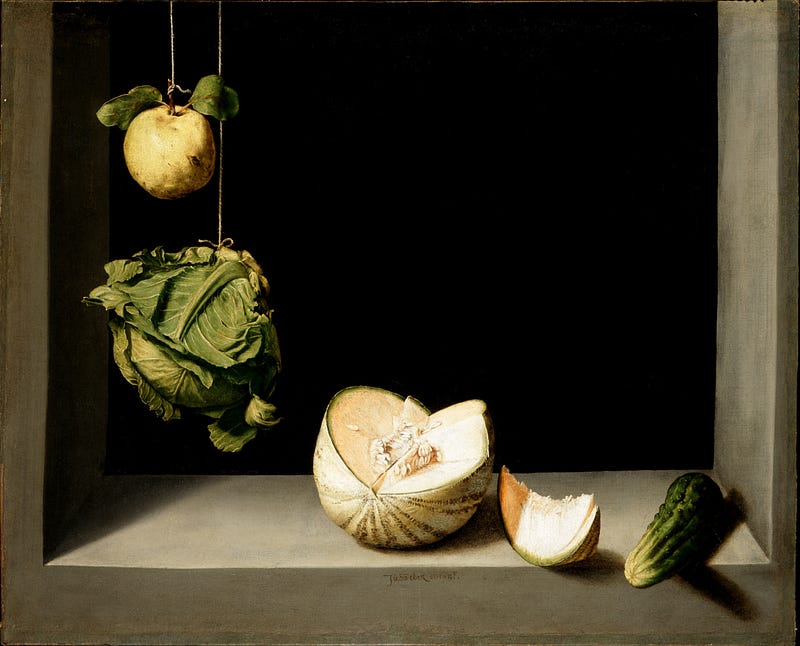
It has been said that standing in front of a painting is like looking through a window into another world.
The picture frame appears to puncture a hole in an otherwise solid wall and the painting gives us a view of what’s on the other side.
I like everything about this metaphor — especially how it suggests a touch of magic in the act of looking at a painting. But I think it also misses an all-important aspect of the experience.
When you look at a painting, or any complex object, your eyes — and therefore thoughts — are pulled this way and that by the things you notice. There is a timeline of observations. Personal perceptions come in stages.
And it is this opportunity — to watch ourselves taking part in the act of viewership — that provides at least one good reason to keep looking at paintings from art history.
We live in a time saturated with images, most of them fast-paced and fighting to gain our attention. Paintings are, almost by definition, engaged with a different pace of image generation. They are made to be looked at through prolonged engagement, where our looking is not done in a single moment but can — if we wish — last a whole lifetime.
Letting Your Eyes Roam
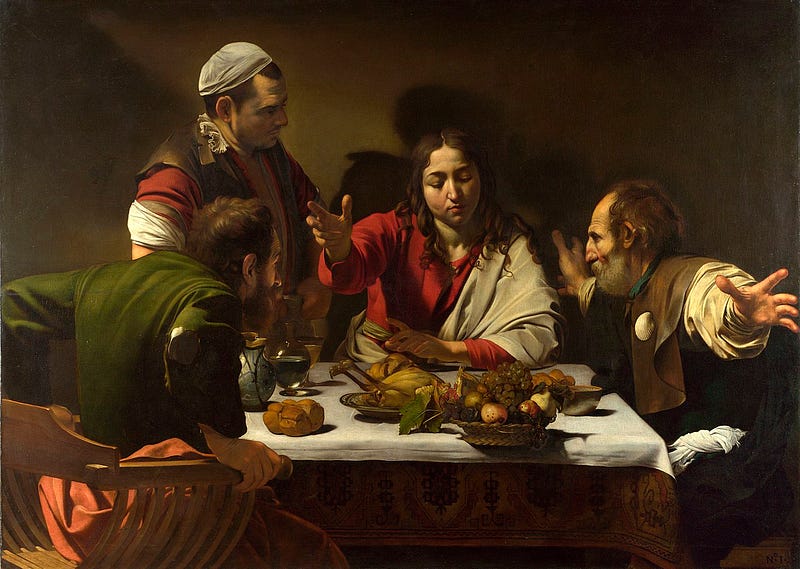
Take this painting for instance, Caravaggio’s The Supper at Emmaus. It’s a complicated image because there are so many lighting effects, shadows, textures, colours and gestures unfolding across it.
Inevitably, perhaps, a viewer might wish to understand its official meaning, the plot being told. To answer this — to place it in immediate context — the subject of the painting is the moment Jesus appeared to a pair of unsuspecting disciples several days after his Crucifixion.
With an image like this, it’s not possible to see everything at once. You have to let your eyes roam, and what you end up noticing will probably reflect your personal propensities.
Often there is something specific that grabs you, a moment in the painting of charge or excitement. It might be the character on the left with his green jacket that has torn at the elbow. Or it might be the figure on the right with his hands outstretched in amazement.
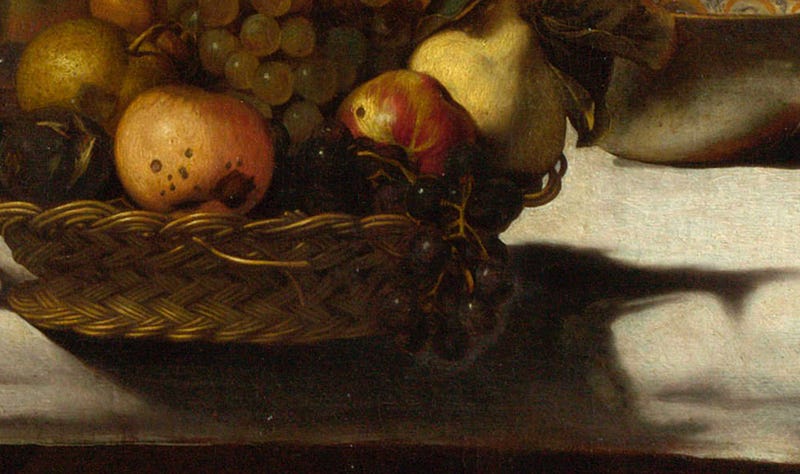
Personally, my eye is always pulled to the basket of fruit at the front of the table — a veritable still life in the middle of a biblical scene — that seems to be teetering impossibly on the edge of the table.
Even in this small portion of the image there is so much to take in. The slightly overripe texture of the fruit, the in-and-out weave of the basket, the sheen of the grapes. It is as intricate as a poem.
And I wonder how long it took you to notice the shadow that the basket of fruit casts on the tablecloth? It is undoubtedly the silhouette of a fish, a subtle referent to the moment that Jesus asked his first disciples to be “fishers of men.” The motif of a fish, known as the Ichthys emblem, was used by early Christians as a secret symbol when under the threat of persecution.
Details that Pierce
The French writer Roland Barthes coined the term punctum to describe a specific detail in an image that “pierces” or “pricks” the viewer, something poignant that draws them in.
Whilst Barthes was addressing his interest in photography, I think the idea applies to paintings too. Something personal happens. It has little to do with the meaning of the painting in any official or historical sense. It has to do with what the viewer brings, the knit of their memories and experiences, and the apparatus of their senses.
Looking at paintings yields a unique occasion to watch yourself: the evolution of your reaction, a circling around a specific detail, a growing or diminishing interest, the movement of your eyes, how you feel about the form and texture of the work, and so on.
Paintings last for centuries, which is a rare thing in our culture. They provide the opportunity to take our time and connect with something analogue and continuous, a solid body — and importantly, something counter to the all-consuming, short-lived hunger of the digital age.
Indeed, it is possible to see a painting as a child and then, if you are lucky, return to the very same work 70 years later. The work is materially unchanged, yet what we bring to it will be the result of a thousand personal re-orientations.
Time Stands Still
Paintings are fixed. The important thing is that our responses are impermanent. Revisit the same painting on multiple occasions and the impression it makes will almost certainly change. With each fresh viewing, we bring new thoughts and new insights.
There is another important sense in which paintings remain unchanged, and that is how paintings can stop time.
Juan Sánchez Cotán’s Still Life with Quince, Cabbage, Melon, and Cucumber does just that. It gives us a view of things — an arrangement of parts of the world — at a given, eternal moment. The light is set, the objects and their shadows are frozen for all time.
This unlimited pause is yet another chance for us to stop and think about what we see, and then think again and again if necessary.
The sort of free association I’m talking about is not predestined in any way. It has no terminus in mind. Degrees of subtlety enter the painting through the artist’s choices and leave the painting via the viewer’s realm of perception. The goal of looking is not to discover fixed truths or inner essences, but to provide a temporary harbour to a meaningful response.
Looking at art is about discovering what we are capable of as visual, seeing creatures, away from the flimsy motives of social media and other forms of advertising.
In this dynamic, there are an infinite number of experiences to be had. Noticing more, noticing change, being in flux, experiencing growth, experiencing doubt, cultivating new responses and embracing shifts in awareness. All these are worth giving time to.

Christopher P Jones is the author of What Great Artworks Say, an examination of some of art’s most enthralling images.
Would you like to get…
A free guide to the Essential Styles in Western Art History? Download for free here.
Join me…
On Instagram for more great paintings on the go!


.jpg)
