
Why We Should Read Japanese Essays
Exploring the genre of “zuihitsu” and what it reveals about life writing.
You can watch the video version of this essay here.
In his 2010 book, Reality Hunger: A Manifesto, David Shields argues that contemporary literature should embrace hybrid genres of writing, blur the boundaries between fiction and non-fiction, and liberate plagiarism from cultural stigma. Through a series of numbered passages written in collage, Shields attempts to represent the fragmentary nature of modern life and our increasing hunger—or at least, his hunger—for more personal narrative in fiction and vice versa.
Trends in Creative Nonfiction
His arguments are sensible, and certainly reflect recent trends in confessional memoir, auto-fiction, and blogging websites like Medium. As a non-fiction reader and writer, the first books that pop into my mind are Maggie Nelson’s “genre-bending” Bluets and The Argonauts. These works play at the intersection of memoir and academic thought while also having popular appeal.
I agree that this kind of writing is immensely relevant to our everyday lives, but I question Shields’ premise that this transformation of literature towards reality is necessarily tied to our present, technological moment. Even Nelson acknowledges in an interview that The Argonauts is but one strand in a long lineage of “anti-genre” literature. Shields is aware of this tradition and even mentions predecessors like St. Augustine and Rosseau. This is where Shields’ prodigious reading is limited: his world is Western literature and is thus blinded to the fact that his desire for a radical turn towards reality not only dates far before the Renaissance but that it has already thrived in other cultures.
Naturally, Nelson is more broadly read and explicitly recognizes her debt to the author Sei Shōnagon, a poet and court lady of Japan’s Heian period. Shōnagon is famous in Japan for her collection of writing, The Pillow Book, where through a series of numbered passages—some a sentence long, some multiple pages long—she explores her everyday life among the nobility, dipping spontaneously into topics of poetry, love, clothing, and daydreaming. The book has no overarching message. According to the author, it is only meant for amusement. Its anecdotes are often funny or engagingly petty, well-known for its many lists: “Things That Lose By Being Painted,” and “Things That Gain by Being Painted.”
Over a millennia later, her work continues to inspire imitations around the globe. American examples that come to mind: The Crying Book by Heather Christle, On Earth We Are Briefly Gorgeous by Ocean Vuong, Drifts by Kate Zambreno, and of course The Argonauts by Maggie Nelson. It is from this Japanese origin that I believe we need to focus on. Writers need to learn about the formless genre of essays that would later be categorized under the word zuihitsu.
Reading Zuihitsu
As the scholar Steven Carter notes in his introduction to The Columbia Anthology of Japanese Essays, works of zuihitsu are difficult to describe or categorize because alluding definition is fundamental to them as a genre. Often, academics simply point to The Pillow Book as the zuihitsu ur-text but clearly the genre, or should I say supergenre, is far greater than a single book. Its reach is almost infinite, often with a mix of subgenres, incorporating everything from poetry, literary criticism, biography, confession, reportage, and travelogue. Carter’s anthology is an excellent start, but clearly, it is nothing more than the beginning.
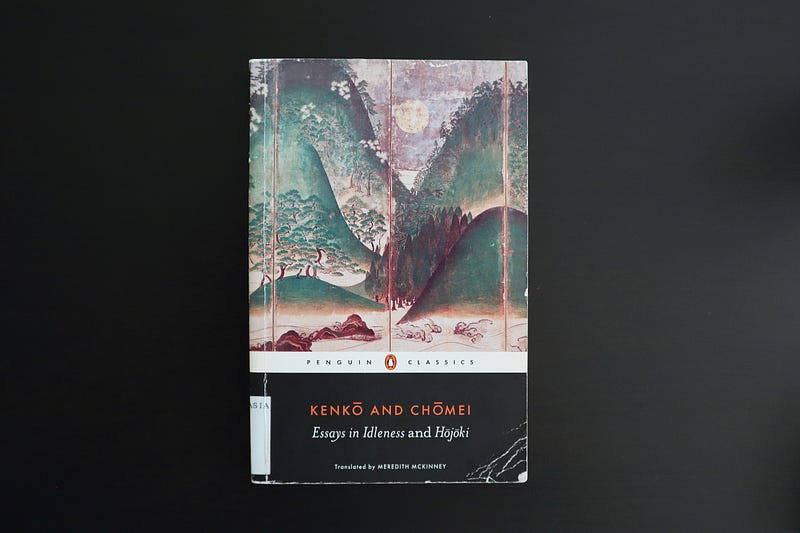
Deeply inspired by The Pillow Book, the next most well-known work of zuihitsu is Yoshida no Kenkō’s Essays in Idleness, which begins: “How foolish I feel when I realize that I have spent another day in front of my inkstone, jotting down aimless thoughts as they occurred to me, all because I was bored and had nothing better to do.” Like Shōnagon, Kenkō assembled a seemingly random assortment of anecdotes, opinion pieces, memories, and his own set of lists. As Ishiwara Masaakira would later write in his own zuihitsu piece, “In a zuihitsu, one records things one sees and hears, says and ponders, whether frivolous or serious, just as they come to mind.”
One theme of zuihitsu is therefore spontaneity or a raw sincerity that paved the way for the emergence of confessional or memoir writing in modernity. However, it is also clear that zuihitsu treasures a certain off-handed approach to writing, one that takes an almost casual orientation towards subjects, without a serious commitment to fact. To read zuihitsu, as the scholar Linda Chance said, is like sitting down with the author for “a long chat.” Almost as if you were simply listening to gossip.
This turn towards a lighthearted, humorous style of writing has an everlasting appeal. In our dire cultural times of disasters, crises, and unbearable irony it is clear why zuihitsu would have such an immense influence, even if we are not aware of it. I hope that by raising awareness about this ancient “genre,” we can create greater incentives for more translations, and inspire recognition of these unexpected roots in contemporary non-fiction.