
Why We Love Watching Artificial Intelligence Fail
Is there a human factor that AI cannot replace?
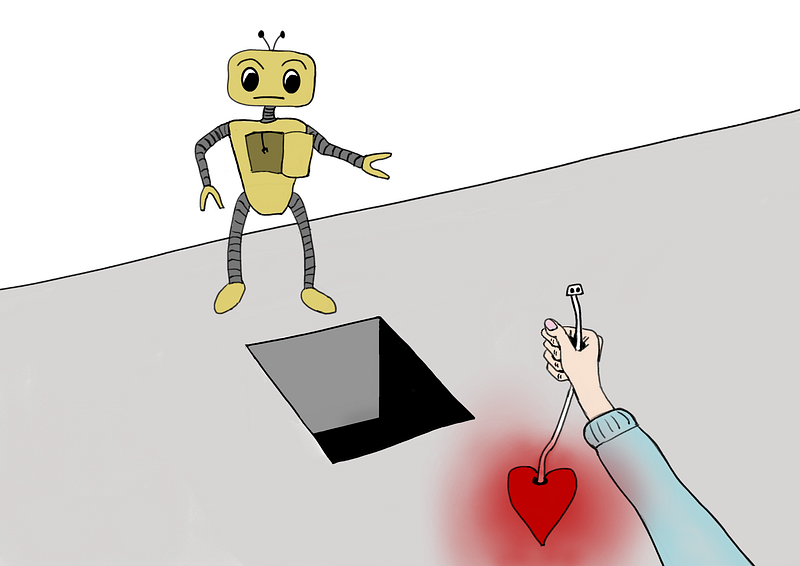
After watching a tennis match some weeks ago, I noticed something interesting. As much as we are impressed by the evolution of Artificial Intelligence, we still love watching it fail. We cannot help ourselves.
It shouldn’t come as a surprise, though. We have been sitting on top of the food chain for so many centuries that we can’t remember the feeling of being threatened by other species.
And that’s exactly the feeling that AI keeps awakening in many people. We could have accepted AI by now, but movies like The Terminator or The Matrix have made AI difficult to digest. This fear is common among those who don’t know much about technology, but it also affects technology professionals. After all, we are all human.
But what does being human mean? To some people, it means believing in “the human factor”. A mystical trait that makes us special and places our species above AI algorithms and machines.
For years, philosophers and data scientists have tried to define and implement that human factor. But is it possible at all?
The tennis match
How could a tennis match make me think about Artificial Intelligence? Let me quickly set the stage for you.
A few weeks ago, Rafael Nadal won his second Australian Open. This might not sound very impressive by itself, but let me add that this victory made him the only male tennis player to ever win 21 Grand Slams.
Nadal, who was returning from a very serious injury, started the final of the tournament losing the first two sets. During the third set, his opportunity to become the greatest male tennis player of all time seemed to be slipping through his fingers.
It was at that point of the match, that the TV displayed the following AI predictions on screen:
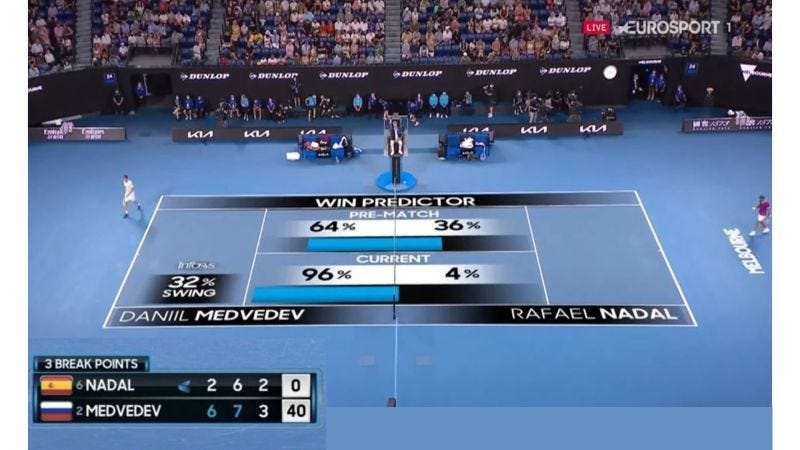
Before the match, Nadal had been given a 36% chance of winning. That percentage was now reduced to 4%.
Nadal won the match.
For those of us who support him (especially for Spaniards like me), the match was one of the most exciting sports events we have witnessed in a very long time. His willpower and perseverance kept us sitting in from of our screens for almost 6 hours. Then, his epic victory became a reality.
The reactions
Once the match was over, thousand rushed to congratulate him online. His latest victory had turned him into a legend. But he had also done something else.
Nadal had proven the AI predictions wrong. And that was also worth celebrating. Twitter was flooded with messages that emphasized the uniqueness of the human spirit.
People enjoyed Nadal’s victory, but they were actually celebrating the triumph of a human over “a machine”. To my surprise, some of these tweets came from professionals working in technology, and even data science.
The takeaway? AI predictions are fun, but kicking them in the face will always be a joy.
Searching for the human factor
Reacting to these tweets, some professionals started asking about the training of the model sitting behind those AI predictions. Had the model missed some key inputs? Had Nadal’s injury had too much weight? Maybe the algorithm didn’t know about Nadal’s previous comebacks?
I am not aware whether these data are available. Yet, the algorithm’s error brought back a classic debate: is there really a human factor?
Research conducted by MIT Sloan showed that, when given identical AI inputs, individuals make entirely different choices. In some cases, these choices beat AI predictions, but often they lead to very human mistakes.
So how can we know if adding a human factor to our algorithms will improve their results? And most importantly, how do we implement that human factor? No one has definitive answers to these questions yet. Until we get those answers, the most reasonable way to make progress seems to be the combination of AI predictions with human supervision.
Assisted human decision-making
I found a very interesting interview with Jeff McMillan (Chief Analytics and Data Officer for Morgan Stanley Wealth Management) about his career working with Machine Learning.
He is a supporter of maintaining a tight collaboration between humans and algorithms. In his opinion, Machine Learning (ML) will never be able to replace human intelligence. Instead, it should be used to support and augment human capabilities.
At a simplified level, it seems sensible to assume that if an intelligent machine predicts heavy rain in the afternoon, most humans will bring their umbrellas — Patrick Gray on TechRepublic
I can only agree with him. At the moment, that seems like the only reasonable way forward. It might be time to stop making our algorithms more human. Maybe the human factor should remain … human.
Instead, why don’t we focus on improving the collaboration between people and algorithms?
I liked how Patrick Gray describes this collaboration in an article published on TechRepublic. He writes, “At a simplified level, it seems sensible to assume that if an intelligent machine predicts heavy rain in the afternoon, most humans will bring their umbrellas.”
This doesn’t mean it will actually rain. And it doesn’t mean everyone should bring their umbrellas either. Some people might not need it if they are spending most of their afternoon indoors. The point is that predictions generated by AI are especially useful when validated by a person.
Let’s take bias, for example. We don’t want our algorithms to be racist, right? Identifying and eliminating biases is a complicated task. In this case, direct human supervision can make sure that racist decisions are not assimilated and perpetuated through AI.
Too much theory? Let me give you a real-life example.
This type of collaboration is already taking place in modern laboratories. There, scientists run their experiments with the assistance of algorithms that increase the success and speed of these experiments.
Conclusion
We don’t know how AI will evolve during the next decades. Yet, in the foreseeable future, releasing algorithms into the real world without relying on human supervision will be a risky business. Especially, when working with artificial neural network models which are so complex that very few people (or nobody) can fully understand.
The feelings that AI still awakens in us are understandable. Many people still see AI as a major threat. A threat they can’t even understand. And that will remain like that for quite some time.
Data scientists must take the lead to ensure that companies don’t rush the adoption of AI. For the time being, developing algorithms and processes that support human decision-making seems like the most reasonable compromise. A compromise that will accelerate human progress in a safe and sustainable manner.
You can subscribe to my newsletter to receive more articles like this one directly into your inbox.
If you want unlimited access to Medium for just $5 per month, you can also become a member through my referral page to support me and other Medium writers.


