
Why We Love Crosswords And Quiz Shows So Much
We hate having to study for an exam, but at the same time, we love it when a crossword or quizmaster asks us all kinds of questions, and we can give the answers. Why is this so?
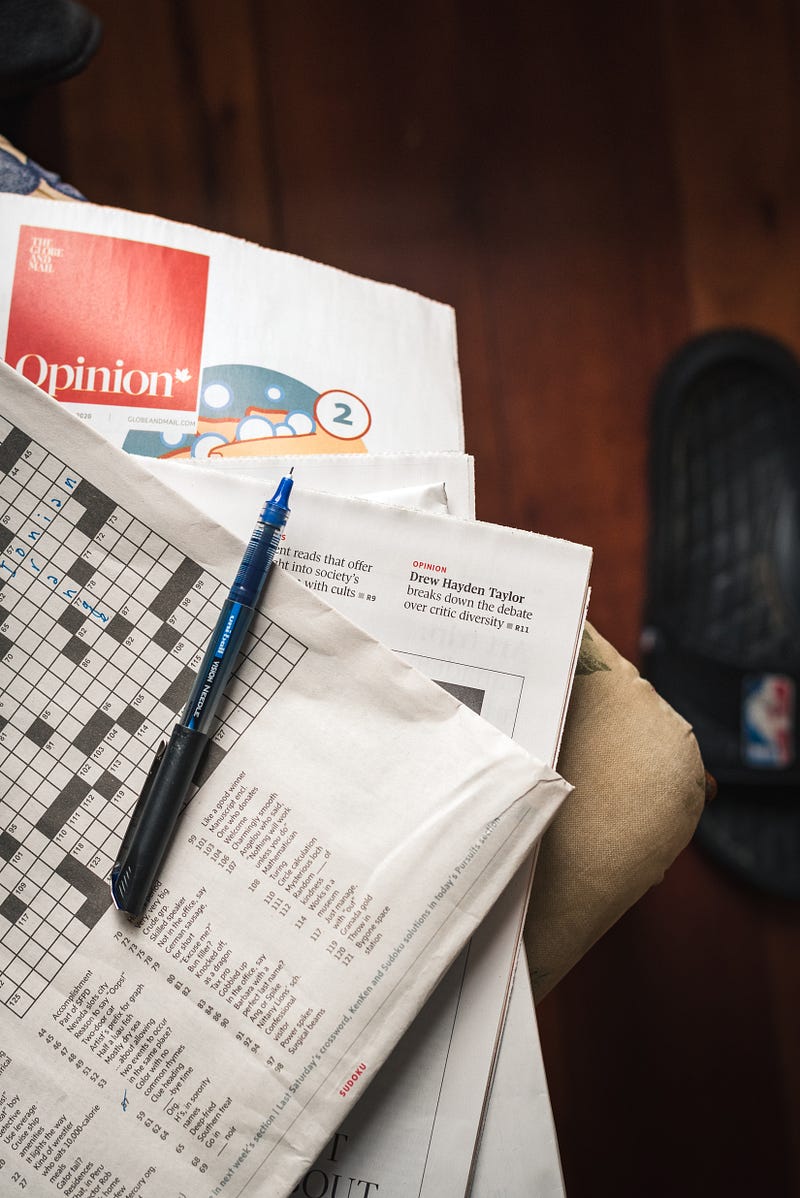
Crossword puzzles have been an integral part of newspapers and magazines for over a hundred years. Quiz shows have become an essential part of television and are real spectator magnets. Why are we so fascinated by the fact that someone is asking us for our knowledge?
Anyone who has completed a crossword puzzle or can correctly answer a question on a quiz show before the candidate on the screen feels proud and superior.
At first glance, it seems that these puzzles and shows are mainly there to satisfy our vanity.
But this is only half the truth. To really understand why puzzles and quiz shows are so successful, we have to look at how it all started.
The first crossword puzzle was published in 1913 in the New York World newspaper. In the years and decades that followed, this form of the puzzle then began its triumphal march through newspapers and magazines around the world.
It was certainly no coincidence that a newspaper invented the crossword puzzle. Whole issues and books exclusively with crosswords came up later. The natural habitat of the crossword is the newspaper.
When the medium newspaper reached its peak in the first half of the twentieth century, editorial offices had networks all over the world. For example, in Berlin, you could read what had happened in New York last week and vice versa. The newspaper was the first mass medium to gather information and facts from all over the world and make them accessible to ordinary people.
At the same time, the number of newspapers and magazines virtually exploded. Modern man was suddenly confronted with an overabundance of information. However, most of the information that reached the average citizen through the newspaper had little to do with his everyday life.
It may be interesting to know what political conflicts are going on on the other side of the world or what cultural trend is going on in another country this year. Still, for most readers, there are no consequences in everyday life.
Everyone could suddenly know about almost everything, but nobody could do anything with this knowledge. Moreover, most of the time, it was a matter of incoherent facts and bits of information not integrated into a broader context.
Television later reinforced this trend many times over.
This is where the crossword puzzle came into play. Suddenly there was a concrete application for all the accumulated but mostly useless knowledge. Finally, someone asked for all the information that the readers had gathered in their heads.
The puzzle and quiz allow us to apply our knowledge, and at the same time, they give us the feeling of knowing the world completely. If we can answer all these questions, we must be very intelligent and, therefore, successful.
So the newspaper has not only provided us with a flood of information, but with the crossword puzzle, it has also answered the question of what we should do with this knowledge. Thus, the newspaper derives part of its raison d’être from the fact that the facts it conveys can be used in the crossword puzzle.
The quiz show is only a continuation of the same principle by other means.
Through the crossword puzzle and the quiz show, the knowledge acquired incidentally and unintentionally was upgraded to a resource that could actually be used.
All this may sound as if I would reject crossword puzzles and quiz shows. But the opposite is true. I like to guess as much as most of you do when there’s a puzzle or a quiz. Knowing that I’m just using a bunch of useless knowledge for it doesn’t bother me. Even though I will never really need most of the facts I get from reading newspapers or watching TV, I don’t want to miss them.
Accumulating knowledge can and should be an intellectual pleasure. Not everything we learn in the course of our lives must be of immediate use. If there is, however, a way to use this knowledge, then it is a pleasure.
I am grateful for the existence of crossword puzzles and quiz shows. They encourage our gameplay instinct and do not hurt anyone.
We should all play much more. Not every minute needs to be used efficiently and profitably.
René Junge a published author writing on ILLUMINATION.
Receive weekly updates, and don’t miss any of my articles.
subscribe here http://bit.ly/ReneJunge
Read also:


