avatarWilliam Treseder

Free AI web copilot to create summaries, insights and extended knowledge, download it at here

6207

Abstract

y wisps that flicker in and out of our lives. And yet we are still hardwired to care about them.</p><p id="1566">That’s why you don’t make eye contact with people when you walk down the street. You don’t <i>want</i> to care.</p><h2 id="9da6">Plugged In, Tuned Out</h2><p id="fe3c">The digital world takes our social experiences to a whole new level. Now we are interacting with a wide range of people in short bursts in a variety of online environments. If 80,000 random citydwellers sounded like a big number of chance encounters, imagine how many more people you will bump into on Facebook, Twitter, Instagram, LinkedIn, and Snapchat!</p><figure id="8cf7"><img src="https://cdn-images-1.readmedium.com/v2/resize:fit:800/1*OSzi0OJPUJIwIrc_PkUCOg.jpeg"><figcaption><a href="https://yourdesignonline.com/category/social-media/">https://yourdesignonline.com/category/social-media/</a></figcaption></figure><p id="fbfd">Life on these social media is a stream of fleeting impressions. Each one is a potential source of anxiety for our maladapted brains. We are bombarded by carefully curated glimpses of events and relationships. These are ghost images. Real but not tangible.</p><p id="5614">Every word, image, and video we see has been put through a series of filters, metaphorically and literally. Each post and update is an attempt by someone else to inch up the digital hierarchy. Our social instincts are being twisted into an endless series of <a href="https://www.urbandictionary.com/define.php?term=humblebrag">humble brags</a>, those little “look at me!” posts you see all the time. We are all looking for other people to validate us, an urge that cannot be fully satisfied. So we post over and over again. It’s a compulsion.</p><p id="ec06">We’re starting to get <a href="http://journals.plos.org/plosone/article?id=10.1371/journal.pone.0069841">the first scientific studies showing us the consequences of heavy social media use</a>. <a href="http://www.cnn.com/2012/03/16/living/beauty-social-networks/">Depression, poor body image, and other kinds of negative behaviors</a> are emerging in <a href="http://www.cnn.com/2012/03/16/living/beauty-social-networks/">this hyper-connected world</a> that was grafted onto our lives in barely a decade.</p><p id="36c8">The lack of control over this phenomenon is frightening. We are all convinced that being connected has somehow made our lives better, but there is not much evidence to support that fact. We might <i>feel</i> more connected but we are confusing connection with entertaining distractions. Our natural desire for friendship and community is driving us to the very thing that is isolating us!</p><figure id="326d"><img src="https://cdn-images-1.readmedium.com/v2/resize:fit:800/1*X1rNfzLFAYpuYXzHLCyMMw.jpeg"><figcaption><a href="https://www.forbes.com/sites/keithwagstaff/2016/02/28/are-your-kids-addicted-to-their-phones-screenagers-wants-to-help/&amp;refURL=https://www.google.com/&amp;referrer=https://www.google.com/">https://www.forbes.com/sites/keithwagstaff/2016/02/28/are-your-kids-addicted-to-their-phones-screenagers-wants-to-help/</a></figcaption></figure><p id="ab85">Kids are the worst affected, since they adopt these technologies first and most intensely. Experts have speculated about a wide variety of effects, ranging from <a href="http://digitalcommons.uri.edu/cgi/viewcontent.cgi?article=1212&amp;context=srhonorsprog">obesity</a> to <a href="http://www.pewinternet.org/2012/02/29/millennials-will-benefit-and-suffer-due-to-their-hyperconnected-lives/">developmental disorders</a>. The latest generation is growing up with this hyper-connectedness integrated into every aspect of their lives. <a href="http://www.pewinternet.org/2015/04/09/teens-social-media-technology-2015/">Over 90% of them use social media every day</a>.</p><p id="929a">Few of us are exempt from the influences of these (still new) online communities. After all, most of us also use social media. This new class of social interaction dominates our daily life. Or at least it did <a href="http://www.pewinternet.org/2015/10/08/social-networking-usage-2005-2015/">for 65% of us in 2015, compared to 7% in 2005</a>. That’s a nine-fold increase in ten years!</p><p id="0387">Think about everything you do through social media. <a href="http://www.journalism.org/2015/07/14/the-evolving-role-of-news-on-twitter-and-facebook/">We get information, especially breaking news, from social media</a>. <a href="http://www.pewinternet.org/2013/10/21/online-dating-relationships/">We begin relationships through social media</a>. <a href="http://www.pewinternet.org/2015/07/16/parents-and-social-media/">We rely on social media for parenting advice and social support</a>. <a href="http://www.pewinternet.org/2014/08/26/social-media-and-the-spiral-of-silence/">We filter ourselves because of social media and concern about the popularity of our beliefs or opinions</a>. We turn to social media when we’re bored. And <a href="http://www.pewinternet.org/2015/01/09/social-media-update-2014/">we navigate all the various options simultaneously, overloading ourselves with social signals</a>. All these changes to our daily lives, based on something that didn’t even exist fifteen years ago!</p><p id="a3bb">This new type of obsessive online behavior is a double-edged sword for the same reasons as any other part of the digital world. It can be great when we consciously control our exposure and behavior, but that is not how most of us use social media. Instead it is often an obstacle to a fulfilling life.</p><p id="4598">We must use the tool, not be used by it. We can let ourselves be overwhelmed by a tsunami of social signals every day, or we can start curating our exposure. The human desire for social interaction is a beautiful thing. Our empathy explains the most remarkable kinds of selfless behavior. We don’t want to get rid of that. We want to harness it, which is precisely what we discuss later on, especially in Chapter 11.</p><figure id="06b7"><img src="https://cdn-images-1.readmedium.com/v2/resize:fit:800/1*qzB_het1SW9Fb0wDwPkgkQ.jpeg"><figcaption><a href="https://newmystoly.blogspot.com/2014/02/et-extra-terrestrial.html">https://newmystoly.b

Options

logspot.com/2014/02/et-extra-terrestrial.html</a></figcaption></figure><h2 id="9499">Stranger Danger</h2><p id="f1c3">Our mismatched social instincts betray us in another dangerous way: we overestimate danger in the world around us. This tendency makes sense in some ways. As animals, we are conditioned to avoid danger however possible. We respond to perceived threats with a knee-jerk emotional reaction. We are built to believe that there is something out there that we should be afraid of.</p><p id="8ab3">Consider the articles that get shared online. How many are positive versus negative? Which ones do we tend to get shared? Which ones go viral? <a href="https://www.fastcompany.com/3027699/how-our-brains-decide-what-we-share-online">The outrageous and grotesque events, of course</a>. The “I can’t believe it!” events. And this has a devastating impact on us, whether or not we realize it. All these terrible images and stories blend together into a constant sense of fear. A manufactured fear. This paralyzing dynamic darkens our view of the world.</p><p id="a72e">But perception is not reality.</p><figure id="ae3a"><img src="https://cdn-images-1.readmedium.com/v2/resize:fit:800/1*6fG7HQushXH5bEg4_gKAsg.png"><figcaption><a href="https://www.emaze.com/@AILQQCRL/Fear-and-the-Media">https://www.emaze.com/@AILQQCRL/Fear-and-the-Media</a></figcaption></figure><p id="6978">Despite what you would think from the constant stream of online news, American society is safer today than it’s ever been. <a href="http://www.cdc.gov/nchs/data/nvsr/nvsr64/nvsr64_02.pdf">Child mortality rates are about 50% of the 1990 levels, which is a record low</a>. <a href="https://www.washingtonpost.com/news/wonk/wp/2015/04/14/theres-never-been-a-safer-time-to-be-a-kid-in-america/">Missing children reports are down 40% since 1993</a>. <a href="http://www-nrd.nhtsa.dot.gov/CATS/listpublications.aspx?Id=A&amp;ShowBy=DocType">The number of kids hit and killed by cars is down by more than 70% since 1993</a>. And it’s not just children who are safer. We all are. <a href="https://www.fbi.gov/about-us/cjis/ucr/crime-in-the-u.s/2014/crime-in-the-u.s.-2014/tables/table-1">The rates of murder, armed robbery, aggravated assault, and property crime are all at their lowest levels in history</a>!</p><p id="7e77">Do you feel twice as safe as you did twenty years ago? Of course not. The opposite is probably true. We are saturated with fear-based media for one reason: we pay attention to it. As everyone knows, “if it bleeds, it leads.” But this phrase takes on a whole new meaning in the hyperconnected digital world where anything, credible or not, can feed into our sense of the world.</p><h2 id="499b">Fear Not</h2><p id="0fdf">Fear has a catastrophic effect on our well-being. Fear holds us back from building and deepening the authentic relationships that we crave as humans. <a href="https://www.psychologytoday.com/blog/two-takes-depression/201106/if-it-bleeds-it-leads-understanding-fear-based-media">We will overestimate our odds of becoming a victim, perceive our communities as unsafe, and the view the whole world as dangerous</a>.</p><p id="6b5f">It’s like pouring acid on our own souls.</p><p id="185f">This kind of manufactured fear is photoshopping in much more insidious way. Instead of airbrushing that model’s face on the latest cover of <i>Vogue</i>, we are letting digital media put negative filters on the world beyond our front door. “Why go out into a sea of lunatics?”, we ask ourselves. And we’re only half-kidding. Blinded by fake dangers, we cannot see the opportunities in front of us. We shift our gaze from goals and aspirations to threats and dangers. And our natural response is to stay inside, to check out of life.</p><figure id="385c"><img src="https://cdn-images-1.readmedium.com/v2/resize:fit:800/1*4C3PoYIKlosH26wMM6tUzQ.jpeg"><figcaption><a href="http://www.yellowtrace.com.au/surreal-distorted-reality-by-erik-johansson/">http://www.yellowtrace.com.au/surreal-distorted-reality-by-erik-johansson/</a></figcaption></figure><p id="1a61">Neither of these distorted perspectives — jealousy or fear — will take us in the right direction. We will never be fulfilled by chasing after illusions of success or filtered party pictures on Instagram. And we will never be safe by running away from manufactured dangers that are crammed down our throats every day.</p><p id="23d5">Our biology and our technology are not meshing well. Someone out there is making things much harder on us, spoiling the promise of the digital world.</p><p id="791a"><b>What to remember about “Photoshopping”</b></p><ul><li>We are experiencing a distorted reality every day</li><li>Other people make their lives seem way better than they are</li><li>The media makes the world seem way worse than it is</li><li>The false highs and lows rob us of energy and optimism</li></ul><p id="529f"><b>Take three minutes to reflect on these questions</b></p><ul><li>How much time do I spend on social media?</li><li>Do I ever freak out as a result of things that my friends post?</li><li>Am I constantly worried about things that I read about in media reports?</li></ul><p id="60e5">If you want to spend seven minutes learning more about photoshopping, read “<a href="https://readmedium.com/5-things-the-media-does-to-manufacture-outrage-ba79125e1262#.8vwc7c6pb">5 things the media does to manufacture outrage</a>” by Parker Molloy.</p><p id="c692">If you want to spend twelve minutes learning more about photoshopping, watch “<a href="https://www.ted.com/talks/abha_dawesar_life_in_the_digital_now">Life in the ‘Digital Now’</a>” a TED talk by Abha Dawesar.</p><p id="45c5">If you want to spend thirty minutes learning more about photoshopping, read “<a href="http://waitbutwhy.com/2014/06/taming-mammoth-let-peoples-opinions-run-life.html">Taming the Mammoth: Why You Should Stop Caring What Other People Think</a>” by Tim Urban.</p><h2 id="67ae">If you enjoyed this story, please recommend and share to help others find it! Feel free to leave a comment below.</h2><h2 id="3114">The Mission publishes stories, videos, and podcasts that make smart people smarter. You can subscribe to get them here.</h2></article></body>

Why We Lie to Our Friends & Family

[Author’s note: This post is a chapter of my forthcoming book RESET: Building Purpose in the Age of Digital Distraction]
https://smazing.wordpress.com/2015/03/02/how-fomo-drives-social-engagement-and-experiences/

Chapter Three: Photoshopping

Why do I feel like I’m missing out on life?

“I am an old man and have known a great many troubles, but most of them never happened.”

(Attributed to) Mark Twain, American Author

Our inadequate education is only one part of the mismatch between us and our environment. The digital world is operating one way, while you and I are still rooted in an older system with very different rules.

Nowhere is this dynamic more powerful than the way we interact with other people. Human beings are social animals, and this can be twisted to our disadvantage. In fact, that is happening right now.

Our online behavior is creating an echo chamber of depression.

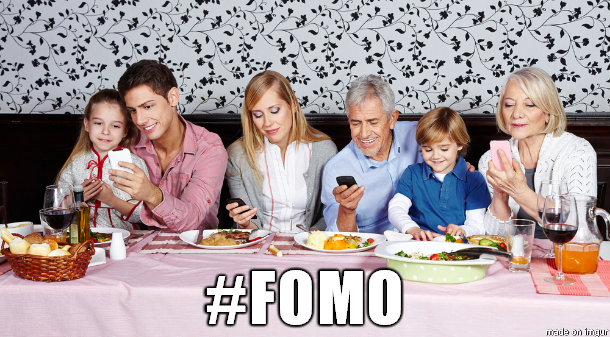
My wife and I were recently at a party where we were both bored out of our minds. Everything about this party sucked: the music, the people, the food, everything. So what did we do? Leave? Of course not! We took a great picture of us smiling and put it up on Instagram.

Not the actual picture. I’m not trying to get myself in trouble!

The rest of this story should sound familiar. My wife’s friends see the picture and think we are having a great time. More importantly, they are convinced that we are having a better time than them.

Cue the destructive self talk.

“Look at them, having so much fun. She looks so good. And he’s smiling so nicely. I bet they are going someplace awesome after that, too. Maybe I should have gone to that other party instead. Everyone around here looks so bored.” And on and on and on.

Of course, they don’t understand that we took this picture because we were bored. Their emotions are aroused based on one digitally retouched picture with no context! That’s the point: No one ever sees the whole story when we’re interacting with friends online. We only show each other what we want to show.

Everyone does this. You, me, everyone. We put up the idealized slices of our lives, which then become the standard by which others judge themselves. We exaggerate the highs, and that exaggerates the lows of everyone else. Our online communities are constantly infecting us with unrealistic impressions of the world around us.

Photoshopping.

Mismatch

This self-destructive behavior stems from new tools that we haven’t yet learned how to use properly. Humans can invent things much faster than we can learn to use things. Our biology doesn’t update like a computer.

You and I make decisions using the same brain that our ancestors had thousands of years ago. And unfortunately, our socio-technical environment is changing a lot faster than our each individual’s ability to adapt.

https://conversation.which.co.uk/technology/technology-balanced-diet-bt-communications/

Why is this a problem? Because our expectations about life — rooted in legacy culture — no longer correspond to reality. These expectations affect our behavior in thousands of tiny ways every day. And those mismatched interactions causes everyone to suffer needlessly.

The Original Social Network

Human beings are inherently social. We are built to care about our family and friends. That instinct helps us survive.

Collaboration in tribes and other small communities — relying on each other to accomplish common goals — has worked out very well for us as a species. It even seems to be reflected in the structure of our brains and the natural size limits of our tribal communities.

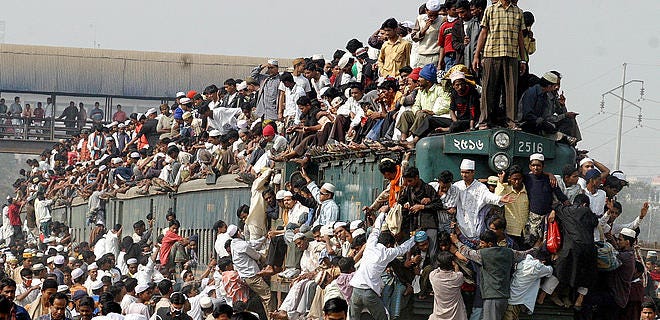
While these hardwired social inclinations have been useful for us, they only make sense in the physical world. There is a limit to the number of people we can interact with at one time, and over the course of a lifetime. The digital world overwhelms us with too much noise, causing social overload.
https://www.allianz.com/en/about_us/open-knowledge/topics/demography/articles/110711-world-population-growth-are-we-too-many.html/

Our extended family and tribal networks used to number dozens, maybe hundreds of members. We knew them for long periods of time. And we knew them within the context of our daily lives. Compare that to the reality most of us experience in an urban environment. It is estimated that the average city-dweller will meet at least 80,000 people during the course of his or her life. How many of our urban neighbors will you and I every really know? They are like ghosts, blurry wisps that flicker in and out of our lives. And yet we are still hardwired to care about them.

That’s why you don’t make eye contact with people when you walk down the street. You don’t want to care.

Plugged In, Tuned Out

The digital world takes our social experiences to a whole new level. Now we are interacting with a wide range of people in short bursts in a variety of online environments. If 80,000 random citydwellers sounded like a big number of chance encounters, imagine how many more people you will bump into on Facebook, Twitter, Instagram, LinkedIn, and Snapchat!

https://yourdesignonline.com/category/social-media/

Life on these social media is a stream of fleeting impressions. Each one is a potential source of anxiety for our maladapted brains. We are bombarded by carefully curated glimpses of events and relationships. These are ghost images. Real but not tangible.

Every word, image, and video we see has been put through a series of filters, metaphorically and literally. Each post and update is an attempt by someone else to inch up the digital hierarchy. Our social instincts are being twisted into an endless series of humble brags, those little “look at me!” posts you see all the time. We are all looking for other people to validate us, an urge that cannot be fully satisfied. So we post over and over again. It’s a compulsion.

We’re starting to get the first scientific studies showing us the consequences of heavy social media use. Depression, poor body image, and other kinds of negative behaviors are emerging in this hyper-connected world that was grafted onto our lives in barely a decade.

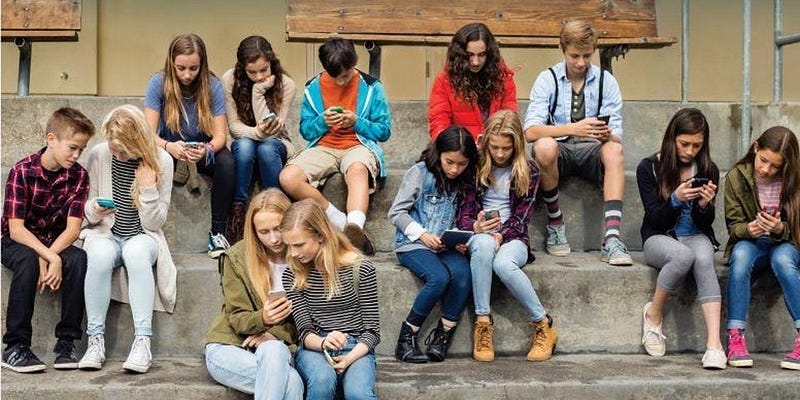
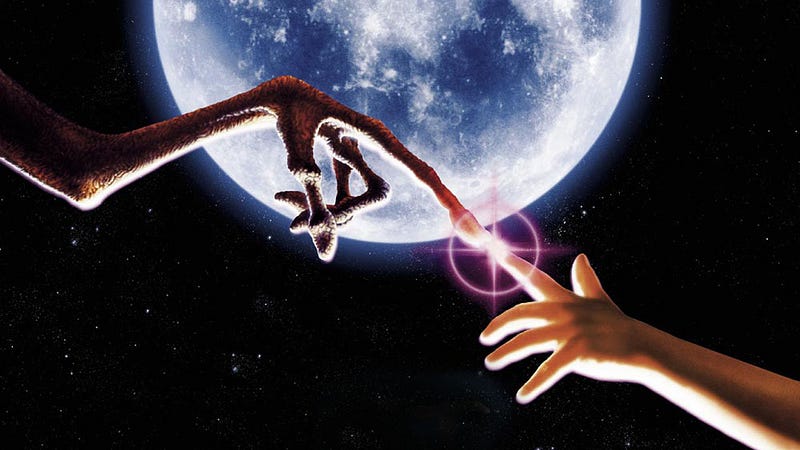
The lack of control over this phenomenon is frightening. We are all convinced that being connected has somehow made our lives better, but there is not much evidence to support that fact. We might feel more connected but we are confusing connection with entertaining distractions. Our natural desire for friendship and community is driving us to the very thing that is isolating us!
https://www.forbes.com/sites/keithwagstaff/2016/02/28/are-your-kids-addicted-to-their-phones-screenagers-wants-to-help/

Kids are the worst affected, since they adopt these technologies first and most intensely. Experts have speculated about a wide variety of effects, ranging from obesity to developmental disorders. The latest generation is growing up with this hyper-connectedness integrated into every aspect of their lives. Over 90% of them use social media every day.

Few of us are exempt from the influences of these (still new) online communities. After all, most of us also use social media. This new class of social interaction dominates our daily life. Or at least it did for 65% of us in 2015, compared to 7% in 2005. That’s a nine-fold increase in ten years!

Think about everything you do through social media. We get information, especially breaking news, from social media. We begin relationships through social media. We rely on social media for parenting advice and social support. We filter ourselves because of social media and concern about the popularity of our beliefs or opinions. We turn to social media when we’re bored. And we navigate all the various options simultaneously, overloading ourselves with social signals. All these changes to our daily lives, based on something that didn’t even exist fifteen years ago!

This new type of obsessive online behavior is a double-edged sword for the same reasons as any other part of the digital world. It can be great when we consciously control our exposure and behavior, but that is not how most of us use social media. Instead it is often an obstacle to a fulfilling life.

We must use the tool, not be used by it. We can let ourselves be overwhelmed by a tsunami of social signals every day, or we can start curating our exposure. The human desire for social interaction is a beautiful thing. Our empathy explains the most remarkable kinds of selfless behavior. We don’t want to get rid of that. We want to harness it, which is precisely what we discuss later on, especially in Chapter 11.
https://newmystoly.blogspot.com/2014/02/et-extra-terrestrial.html

Stranger Danger

Our mismatched social instincts betray us in another dangerous way: we overestimate danger in the world around us. This tendency makes sense in some ways. As animals, we are conditioned to avoid danger however possible. We respond to perceived threats with a knee-jerk emotional reaction. We are built to believe that there is something out there that we should be afraid of.

Consider the articles that get shared online. How many are positive versus negative? Which ones do we tend to get shared? Which ones go viral? The outrageous and grotesque events, of course. The “I can’t believe it!” events. And this has a devastating impact on us, whether or not we realize it. All these terrible images and stories blend together into a constant sense of fear. A manufactured fear. This paralyzing dynamic darkens our view of the world.

But perception is not reality.

https://www.emaze.com/@AILQQCRL/Fear-and-the-Media

Despite what you would think from the constant stream of online news, American society is safer today than it’s ever been. Child mortality rates are about 50% of the 1990 levels, which is a record low. Missing children reports are down 40% since 1993. The number of kids hit and killed by cars is down by more than 70% since 1993. And it’s not just children who are safer. We all are. The rates of murder, armed robbery, aggravated assault, and property crime are all at their lowest levels in history!

Do you feel twice as safe as you did twenty years ago? Of course not. The opposite is probably true. We are saturated with fear-based media for one reason: we pay attention to it. As everyone knows, “if it bleeds, it leads.” But this phrase takes on a whole new meaning in the hyperconnected digital world where anything, credible or not, can feed into our sense of the world.

Fear Not

Fear has a catastrophic effect on our well-being. Fear holds us back from building and deepening the authentic relationships that we crave as humans. We will overestimate our odds of becoming a victim, perceive our communities as unsafe, and the view the whole world as dangerous.

It’s like pouring acid on our own souls.

This kind of manufactured fear is photoshopping in much more insidious way. Instead of airbrushing that model’s face on the latest cover of Vogue, we are letting digital media put negative filters on the world beyond our front door. “Why go out into a sea of lunatics?”, we ask ourselves. And we’re only half-kidding. Blinded by fake dangers, we cannot see the opportunities in front of us. We shift our gaze from goals and aspirations to threats and dangers. And our natural response is to stay inside, to check out of life.
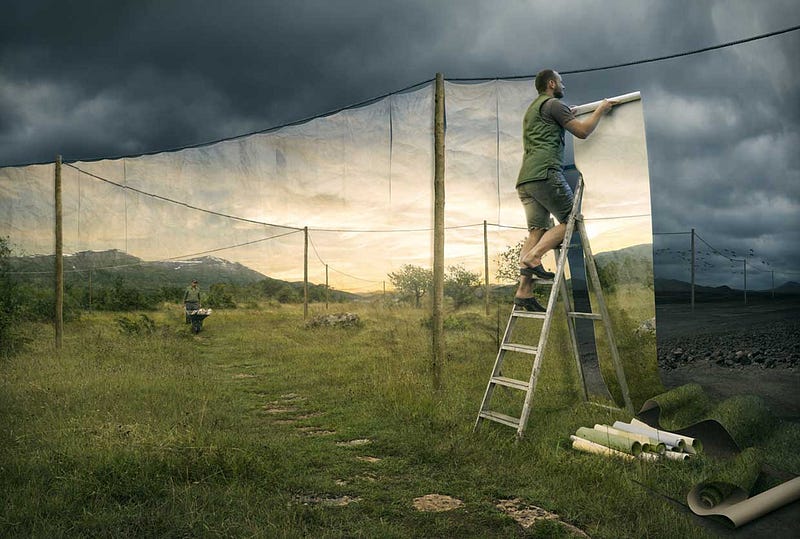
http://www.yellowtrace.com.au/surreal-distorted-reality-by-erik-johansson/

Neither of these distorted perspectives — jealousy or fear — will take us in the right direction. We will never be fulfilled by chasing after illusions of success or filtered party pictures on Instagram. And we will never be safe by running away from manufactured dangers that are crammed down our throats every day.

Our biology and our technology are not meshing well. Someone out there is making things much harder on us, spoiling the promise of the digital world.

What to remember about “Photoshopping”

  • We are experiencing a distorted reality every day
  • Other people make their lives seem way better than they are
  • The media makes the world seem way worse than it is
  • The false highs and lows rob us of energy and optimism

Take three minutes to reflect on these questions

  • How much time do I spend on social media?
  • Do I ever freak out as a result of things that my friends post?
  • Am I constantly worried about things that I read about in media reports?

If you want to spend seven minutes learning more about photoshopping, read “5 things the media does to manufacture outrage” by Parker Molloy.

If you want to spend twelve minutes learning more about photoshopping, watch “Life in the ‘Digital Now’” a TED talk by Abha Dawesar.

If you want to spend thirty minutes learning more about photoshopping, read “Taming the Mammoth: Why You Should Stop Caring What Other People Think” by Tim Urban.

If you enjoyed this story, please recommend and share to help others find it! Feel free to leave a comment below.

The Mission publishes stories, videos, and podcasts that make smart people smarter. You can subscribe to get them here.

Social Media
Technology
Fear
Self Improvement
Life
Recommended from ReadMedium