
Science | Physics
Why We Don’t Live in a Simulation
Describing reality as a simulation vastly understates the complexities of our world. Here’s why the simulation hypothesis is a lousy one
With the advent of artificial intelligence, and ever-increasing computational power, it seems like there’s no limit to what computers can do. From hyper-realistic 3D rendering to deepfake images and videos (e.g., thispersondoesnotexist), the possibility of fully simulating reality seems to be right around the corner.
All these advances have generated hype around questions like “Can computers simulate the world?”, soon followed by “Do we already live in a simulation?”.
There are even outlandish articles on the internet proclaiming “evidence” and “proof” that we in fact live in a simulation (e.g. scientificamerican.com, vulture.com).
But clickbait articles aside, what is the science behind this simulation hypothesis? With all the hype, surely there must have been some science already done to examine this hypothesis… right? Well, as a former researcher in particle physics, I can say the answer is firmly in the negative. Here are the reasons:
- The premises for proposing/believing in the simulation hypothesis are dubious
- Many aspects of typical simulations contradict what we know about reality
Now, let’s break down these ideas down.
Dismantling the Simulation Argument
The common arguments for the simulation hypothesis are as follows:
- Computational power is exponentiating quickly (Moore’s Law)
- Our world obeys simple and logical laws that can be easily mimicked by computers
- By extrapolation, computers in the future would be able to create and simulate worlds similar to ours
- Eventually, there will be many more simulated worlds than ordinary worlds. Thus, our world is almost certainly already in a simulation.
However, all of the arguments above are fallacious. Below is a summary counter-argument for each of them:
- Realistic systems exhibiting exponential growth eventually slow down (e.g. population growth, virus transmissions). For empirical observations like the Moore’s Law, there is no reason to conclude the trend will continue indefinitely as it isn’t based on any fundamental laws.
- Simple physical laws do not imply that they are amendable for simulations, more on that later.
- Given that 1 and 2 are both false, there is no reason to believe that computers can truly mimic anything close to our world.
- Given the problematic nature of 1–3, the entire argument falls apart. This is in addition to the fallacious Bayesian argument, which we won’t discuss this time.
Given that this article is from the perspective of a physicist, we will focus on 2 above. It is a particularly under-appreciated point, as it is intimately related to our physical laws. The upshot is that
Our world contains an incredible amount of hidden complexities, far beyond what a simulation can ever achieve
Let’s explore what that means.
Hidden Complexities of our World
Humans are incredibly effective at human-centric tasks: things like walking around and interacting with objects. The common theme is that these tasks largely involve macroscopic objects (relative to our human scale).
For example, when reading, we never look at the microscopic smearing of the ink on paper or individual pixel patterns on a screen. Reading only require us to look at zoomed out images, the microscopic ink/pixel arrangements are completely irrelevant.
However, it doesn’t mean the intricate ink/pixel patterns do not exist or do not matter in the world. They don’t matter relative to us. Indeed, the behavior of ants or bacteria could easily be affected these microscopic patterns.

The upshot is simply that
The world contains far more details than what we care about
Why is this relevant? Well, when we talk about simulations, like virtual reality and games, only macroscopic details are simulated, while microscopic details are completed overlooked.
Of course, this isn’t a problem for a simulation. As long as the macroscopic world is accurate, the simulation has done its job (to a human eye). In fact, this ignorance of the microscopic is often a feature to increase efficiency. After-all, why spend extra computation to simulate something we won’t notice?
We see that
Computer simulations only capture the macroscopic, while ignoring the microscopic
Indeed, there is an easy method for distinguishing simulation from reality: try zooming in! In the real world, we can take out a magnifying class to see the ink patterns on a page. If more details are desired, we can put the pages under a microscope to see finer details. On an extreme level, we can even vaporize the content and put it under an accelerator to see its constituents in the sub-atomic world!
But what if we just throw more computational resources to simulate the microscopic details? surely one day we should be able to simulate all the way down the atomic scale… right?
Well, not so fast. Just look at our physics experiments: we have zoomed out to the furthest galaxies close to the edge of the observable universe (~100 billion light years), and zoomed in to the tiniest subatomic particle (~fm, or one quadrillionth of a meter, the size of a quark). The difference in scale is close to 10⁴⁰, and so far no hints of pixelations or glitches have ever been detected. The enormity of scale dwarfs even our incredible improvements in computational power. In fact, it is quite likely that we will continue to probe smaller and larger in scale, so the real magnitudes of our Universe is likely to be even larger. Does our world still sound like a simulation? I think not.
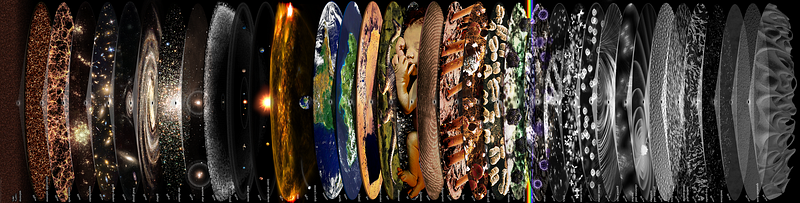
#/media/File:Orders_of_magnitude_(english_annotations).png)
So far in all these discussions, we have not even touched upon dynamics yet. What happens when we include 13 billion years of dynamical evolution of our Universe? It turns out the simulation hypothesis is even less plausible.
A Chaotic World
Our world is highly dynamical, and every second, there are immeasurable changes from the tiniest to the largest. With changes come unpredictability: from weather patterns, to the stock markets and casinos, uncertainties are built-into our societies.
In most cases, what we call uncertainties are really ignorances. For example, the stock market appears unpredictable because no one can fully account for everyone’s psychology and buy/sell patterns. The weather is unpredictable because it depends on dynamics of a huge number of molecules, which is impossible for us to keep track.

The high levels of uncertainties are symptoms of a generic pattern for complicated systems. These behaviors are collectively referred to as chaos.
Chaos occurs when a system reaches a certain level of complexity, such that there is no obvious simple mathematical equation that can fully track their evolutions. These systems typically lack any special properties (or symmetries) that constrain them, except some general overarching physical laws (i.e. energy and momentum conservation). They are exemplified by the following traits:
- Patterns never repeat
- Any possible configuration will eventually be (approximately) reached
- Small disturbances will eventually lead to big changes
Another more computational viewpoint is that chaotic events are really efficient scrambler of information, much like the pseudo-random number generators in a computer.
Point 3 above is also known as the Butterfly Effect. Like its names suggest, the Butterfly Effect indicates that small changes like the flap of a butterfly’s wings will eventually lead to dramatically outcomes (i.e. storms and even hurricanes).
From a simulation perspective, this means that when simulating chaotic systems, the error on the simulated outcome will grow exponentially:

Because of the exponential growth, even the tiniest initial error will eventually become intractable. Given that a computer always has finite precision, it can never predict outcomes of a chaotic system (after a long enough time). This is ultimately the source of uncertainty in chaotic systems like the weather. The conclusion is incredibly profound:
No matter how powerful a computer is, it will eventually fail to simulate a chaotic system as the errors grow exponentially.

In other words, even if we have enough computational resource to realistically simulate both the microscopic and the macroscopic parts of a system, it will still not be the same as the real system!
How do we get around this problem in modern simulations? We generate pseudo-random numbers and use statistical approximations. Because the outcomes of chaotic systems are so predictable, the approximations will not be noticeable to a human! This is why many simulations of chaotic systems only yield probabilistic outcomes, together with some quantifiable uncertainties (i.e. weather and stock predictions). Once again, simulations are still ways away from reality.
A Simulation Perspective?
So far, one could justifiably point out a potential “flaw” in our arguments: that we are examining the simulation hypothesis by assuming that the laws of physics don’t come from a simulation!
Okay then, let’s assume our current physical law is wrong, and that the world actually follows a “simulated” version of our laws, and that our experimentally tested laws are mere approximations. This means that all the numbers we’ve measured have finite precisions, and there must be glitches and errors waiting to be discovered.
This is where physics comes in: no experiment has ever found deviations or glitches, even when we examine systems with increasing precisions and in ever smaller time intervals.
For example, in 2015, LIGO made one of the most startling discoveries ever — gravitational waves from the merger of two blackholes (which eventually lead to Nobel Prize in 2017). The discovery hinges on measuring tiny distance variation the size of 1/10000th of the width of a proton, caused by gravitational waves from over 1 billion light years away! The result matches Einstein’s equation perfectly, with no significant glitches or deviations. While it possible that these glitches might be discoverable just around the corner, it is hard to justify spending resources to anticipate for them.
More importantly though, our laws of physical aren’t just compatible with experiments, they are both theoretically elegant, and mathematically consistent on some level. Why wrap our laws around a “simulation” clause when they are perfectly adequate? Adding a “simulation” tag does not add any predicability, value or simplicity to a physical theory.
The Omnipotent Simulation?
There is another potential counter-argument to our discussions: that maybe even our experiences are simulated; every-time we zoom-in, take a closer look, or perform a detailed experiment, our experiences are simulated in real time to mimic the appearance of a more complicated world.

This is where the simulation hypothesis leaves the scientific realm: that all the inconsistencies can be “explained” away as being simulated. If this is true, then thoughts about simulations are all simulated as well, so how are we to trust that them as genuine thoughts? Then there’s the question on free will, determinism…etc. the discussions become endless.
Philosophy aside, from a practical perspective, there is nothing to be gain by abandoning well-defined physical laws, just to opt for an all powerful “simulation”. Doing so robs us predictability and falsifiability, as all explanations for natural phenomenon are reduced to “just because”.
Since this omnipotent version of the simulation hypothesis lacks any scientific value, I will refrain from further discussion on this possibility.
The Quantum World
There is an elephant left in the room: so far all of the discussions involve classical physics, ignoring all the quantum mechanical glory!
It doesn’t invalidate our arguments above, as classical physics is a good approximation in the regime we are interested in. Quantum physics does, however, make our discussion incomplete. A complete discourse necessitates defining what a quantum simulation is. Even before that, we need a complete understanding of our quantum mechanical world!
Unfortunately, none of these are possible right now, as we
- Do not have a working and scalable quantum computer yet
- Still don’t fully understand how fundamental physics works quantum mechanically (gravity, in particular).
Given that the science is still not clear on many aspects of our quantum world, I don’t think it makes sense to talk about whether not we live in a quantum simulation. As such, I will refrain from further speculative arguments. Nonetheless, here are some highlights on the intricacies:
- Quantum mechanics contains even more hidden complexities (due to entanglement), and is even more difficult to simulate using a classical computer. However, a quantum computer could mitigate such an issue.
- Quantum computers are restricted by mathematical theorems such as the no-cloning theorem (and the equivalent no-deleting theorem). This makes the idea of simulating something even more subtle.
- Recent research have hint at some links between quantum computing and quantum gravity (arXiv:hep-th/1411.7041 ).
Some die-hard simulation proponents might argue that some of these intricacies are evidence of a quantum mechanical version of the simulation hypothesis. But in the end, if we can’t even define what a quantum simulation means, it would be nothing more than an extraneous label.
Conclusions
In natural sciences (and physics specifically), hypotheses need to be specific and predictive in order to have scientific values. The simulation hypothesis cannot avoid the same scrutiny.
As we attempt to turn the hypothesis into something amendable to scientific scrutiny, we are forced to compare the natural world to computer simulations as we understand them now. We see that despite enormous progress in improving computational power, what we currently can simulation still dwarfs our highly scalable, highly dynamical, highly complex, highly chaotic, and inherently quantum mechanical world. As such, the simulation hypothesis, as a candidate to a scientific hypothesis, is not tenable.
If we still insist to call our world a simulation, it would either have to have an omnipotent simulation, or it would have to be the clunkiest, most inefficient simulation ever. In the latter case, the “computer” that is hosting such a simulation, would necessarily have vastly more moving parts and complexities. The physics governing the computation would likely be way more complicated than the laws of physics in our world for there to be any scientific value.
It is no wonder that there hasn’t been many published peer-reviewed papers on such a topic in fundamental physics. This is not to deny that some aspects of computations and simulations can inspire new research in theoretical physics. However, the simulation hypothesis, as it stands right now, should just be a potential source of inspiration that helps generate ideas, but not something that should guide or sway our understanding of the world.
Epilogue
It’s interesting to estimate the required number of bits to capture the entire content of our Universe (classically). From the LIGO measurement to the size of the observable Universe, there is a span of roughly 10⁴⁵ orders of magnitude. If each location stores at least one bit, there would at least be (10⁴⁵)³ = 10¹³⁵ bits.
A sparse representation may be a more efficient way. To estimate a lower bound on the number of bits in a sparse representation: we use roughly 10⁸⁰ number of atoms, with a precision of 10⁴⁵ for each location variable, which requires at least 100 bits, yielding 10⁸² bits. Additional information will probably require more.
Intriguingly, quantum gravity offers another way to compute the number of quantum bits in our observable Universe (or more technically an upper bound, which is related to black hole entropy). A quick calculation gives something of the order of 10¹²⁰ quantum bits (accuracy not guaranteed!). While we can’t exactly compare quantum bits to classical bits, it shows that the Universe has a surprisingly efficient way of storing information. While we can compute this bound through black hole physics, we don’t understand how the bits are arranged to make it that efficient yet! This is just one of many intriguing facts about quantum gravity!