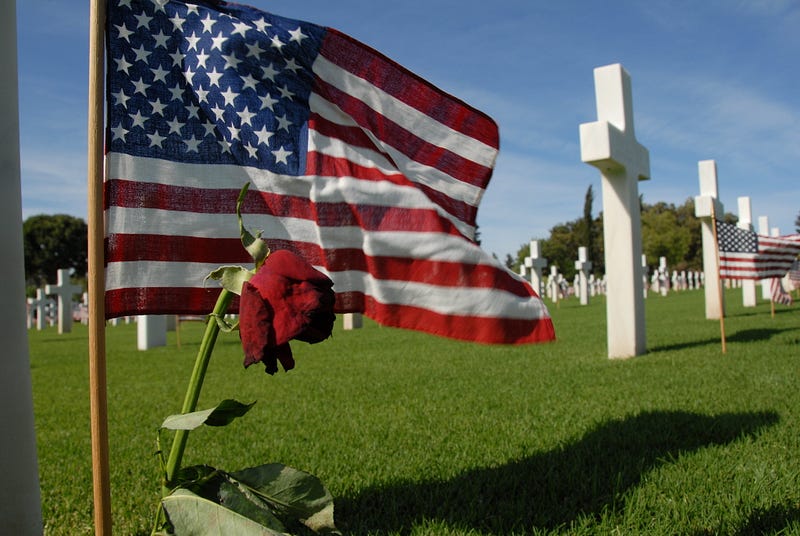
Why We Celebrate Memorial Day
I’m a little late (writing this in the early evening of Memorial Day) on this, but I suppose that, in the spirit of this message, timing doesn’t matter so much as long as the message is delivered.
I was originally not going to write anything at all for Memorial Day and let the day take its course in remembrance of those who gave all that is at the center of this poignant holiday, along with good food and war movie marathons on Turner Classic Movies.
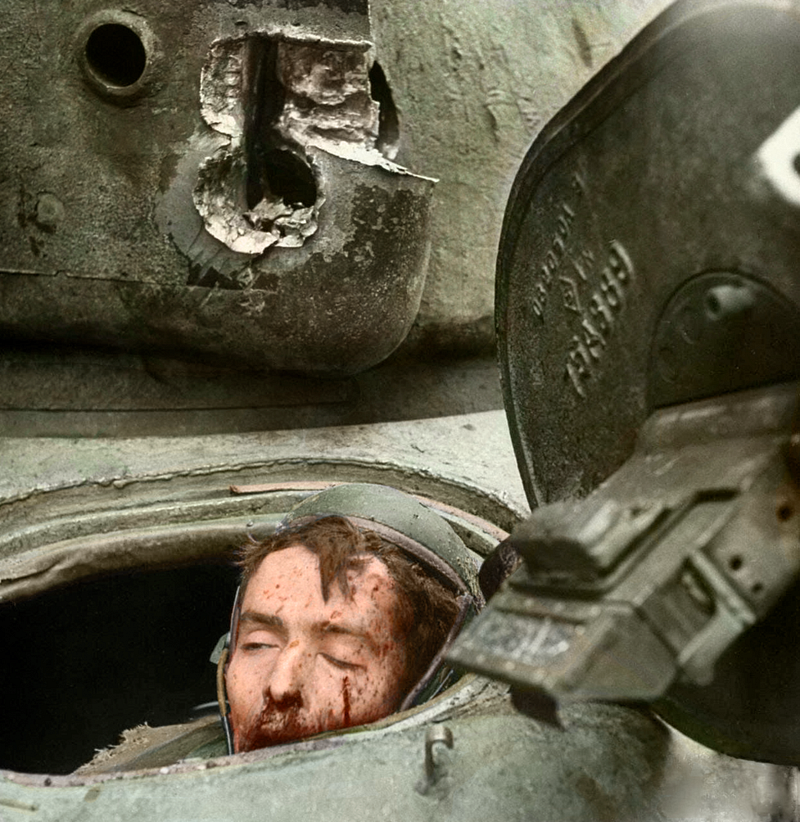
Incidentally, while looking for ideal photos for another Medium project I’ve been working on, I came across this rather unpleasantly solemn photo that, in short, seemed uncannily appropriate to be found on such a day as today.
And yes, in case you’re wondering (as it is bizarre at times to come across such grizzly photos that we question its authenticity despite truly knowing that there is nothing fake about it), it is unfortunately real.
What is the story behind this photo?
This is Pfc. Julian H. Patrick from Salyersville, Magoffin County, Kentucky; he served in the 3rd Armored Division as a tank driver during World War II. He was the youngest of four brothers, all of them also serving in the war. All three brothers would return home in the end, and though no doubt overjoyed being embraced by their kinfolk again, they would have to endure the pain of knowing that the youngest of them would not be joining them.
He was killed on March 6, 1945, during a famous tank battle near the Cologne Cathedral in western Germany. His tank, an M4 Sherman, was hit low, and though none of the rest of his crew were killed alongside him, Pfc. Patrick’s body was exposed in a vulnerable position in relation to the German shell’s point of impact.
He was 23 or 24 years old.
It is a photo that beggars the imagination. We only see the upper portion of his head, his face permanently frozen in this macabre-beaten and limp moan, a face that shows death clearly and pure battle-borne exhaustion. God knows how much he has seen until his death and what all he has endured.
It is bizarre to think of this man is the same age as me (or one year younger). But it is an inevitable fact that most casualties of war are those that are young and who do not wish to be where they are.
As military historian Stephen E. Ambrose wrote in his bestselling book, which tells the story of the Easy Company of the 101st Airborne Division, Band of Brothers:
“They knew they were going into great danger. They knew they would be doing more than their part. They resented having to sacrifice years of their youth to a war they never made. They wanted to throw baseballs, not grenades, shoot a .22 rifle, not an M-1. But having been caught up in the war, they decided to be as positive as possible in their Army careers.”
And though Ambrose refers to the men of Easy Company, I see it as a statement befitting all men in all wars in terms of the actual combatants. And just as most sacrificed ‘years of their youth’ to defend our country, many would, in addition, pay with the ultimate sacrifice of never moving on past their younger years, as such was the case of Pfc. Julian H. Patrick.
So much has been sacrificed by our men and women in uniform, past, and present. Sometimes I have wondered myself what it is like to be in their boots, and I’m thankful that I will never really have to experience that. As an enthusiast of history and my enthrallment with both World Wars, it is easy for me to lose myself to romanticism.
But for those who actually had been there, be it in Pennsylvania, France, Okinawa, Korea, Vietnam, or Iraq, I’m sure they’ve experienced first-hand that there is nothing romantic about war. War is only romantic for politicians, mad rulers, some generals, and onlookers such as myself.
In conclusion, I wish to send my thanks and appreciation to the men and women who’ve given their lives for this great country of ours, as well as to the men and women who have served still living and those who are presently serving.
God bless you and keep you — you’ve done more in a few years of service than many people can manage to do in a single lifetime.
And thank you, Julian Patrick — RIP.