
Why we are unlikely to solve the climate change and energy crisis
Let's start being honest about what is not going to happen
Sustainable development, emission reduction, or mitigation efforts, the words differ, but the general idea of a necessary paradigm shift is preached and discussed in most books on ecology, by most politicians, and by many environmental groups from Greta Thunberg to Extinction Rebellion. Even the Working Group III of the IPCC, in its "Climate Change 2022: Mitigation of Climate Change" ¹ showcases different scenarios that would lead to solving the crisis …. but they are very unlikely to happen.
Fallacy 1: Substitutability of resources
There is a common misunderstanding of the history, and current dynamics, of our civilization's relationship with natural resources. One of the fundamental misconceptions that most people have is the idea that historically we replaced one resource, or energy production method, with a new "cleaner" one. Another perspective to this common misconception is that we moved from wood to coal, to petrol, to nuclear and renewables, that we replaced coal, and that consequently, we are less dependent on the more "primitive" solutions. These ideas lead to the hope that the next shift will solve our current problems.
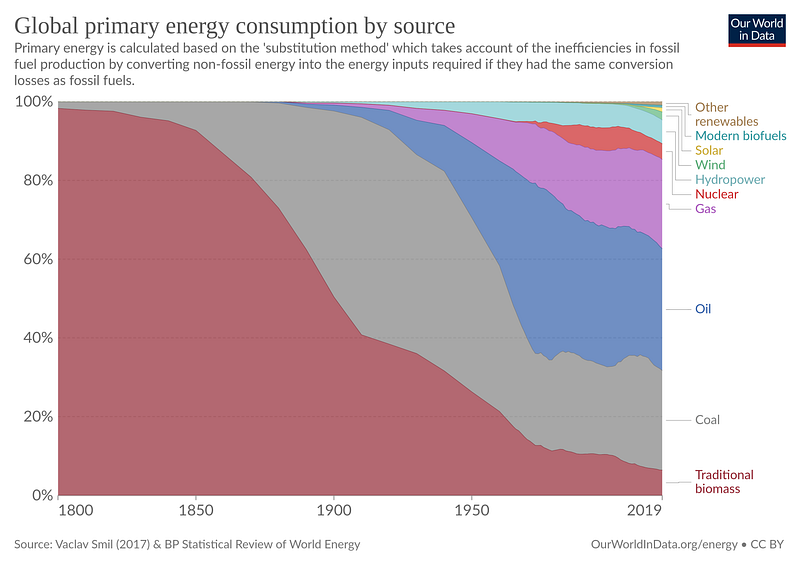
The graph above may be a reason why the previous falsehoods are widespread. You see on the chart the "transition" between wood (traditional biomass) and coal at the end of the 19th century and the transition to petroleum and gas mid-20th century. On the graph, coal usage seems to have decreased in the last 70 years. So, where is the deception? The graph above shows the proportion or relative quantity of primary energy used. The chart below completes the picture giving a more accurate overview of the situation.
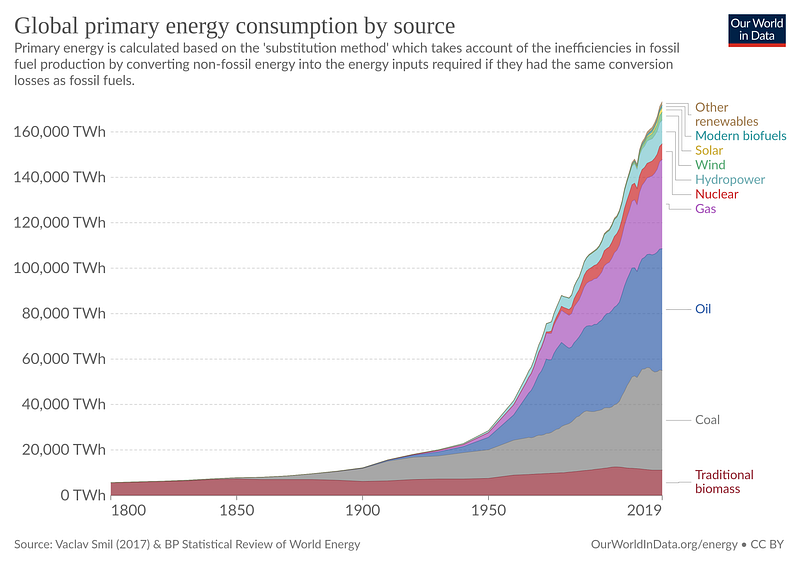
As this last figure shows, there has never been any "replacing" of primary energy source or any "transition" but an addition of the sources. Energy sources historically have never been substituted but accumulated instead.
New energy sources have the opposite effect on the previous resources. The imaginary transitions, on the contrary, stimulate the production and extraction of the prior "unclean" energy source. Oil based fuels made it possible for machines to cut down forests in a couple of weeks using less effort, reducing the price of the raw material, making it more attractive, and therefore increasing its consumption. Likewise oil based fuel meant that coal could be mined with machines. When coal usage and production soared, wood was not simply left to one side. The opposite happened; instead, wood production increased tenfold to build mines and associated infrastructure. From pit props to railway sleepers, wood production was essential to our "better and transitioned" lives. Sadly, the same can be said about renewable energies that need steel (coal), batteries, concrete, and petroleum (a lot of it).
If we take into account the fact that machines and technology in general have improved immensely, notably their efficiency, we can understand that the trends depicted above are actually giving us a relatively positive picture of our actual technological frenzy; where the same quantity of ressources is actually powering more and more technology.
Fallacy 2: Technological solutions need to and will be found
From carbon capture machines to geoengineering (the deliberate intervention in the Earth's natural systems to counteract climate change), a common falsehood is the hope of technological salvation. The idea of transition, shift through technical solutions, is akin to climate change skepticism and may be more dangerous because of how insidious it is.
One of the fundamental issues is the timeframe for many of these technological solutions. Nuclear fusion will probably not be seen actively producing energy for consumers before 2050. The International Thermonuclear Experimental Reactor (ITER) in France will be finished in 2025, if there are no delays. The American equivalent SPARC is planned to be built by 2035. However, these two reactors are only experimental, meaning they have been constructed to continue research in this field. Nuclear fusion research started in the 1950s, and we are still trying to work out how to harness it.
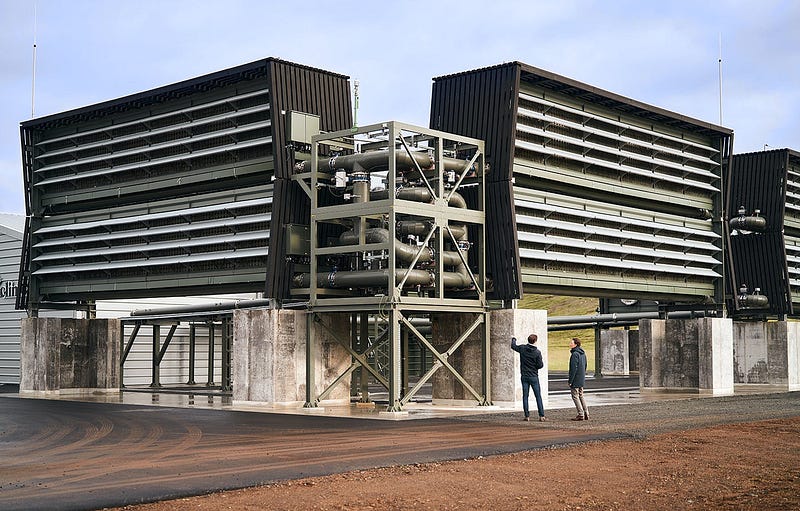
Just looking at the photo above should convince you how ridiculous the idea is. We have plants, forests, and seas that are capable of carbon storage and atmosphere purification, and instead, we want to build big concrete and steel machines to do the same job. Other ideas have appeared and are seriously being looked into, such as Stratospheric Aerosol Injection. S.A.I is a solar geoengineering tool where products like sulfates or tiny reflective particles are injected into the stratosphere to reduce global warming. As usual, we do not really know what collateral damage would actually happen, but scientists have warned of problems ranging from monsoon cycle disruption and High-Latitude Seasonal Cycle unbalance, as explained here, to acidification of oceans.
In their report WGIII, the IPCC describes many scenarios and technological changes that could help us in the near future. The Working Group IIIs goal is to find these scenarios even if they are unlikely to happen and/or find solutions even if they risky. Governments currently have no incentive to implement harmful solutions to the economy but will probably only start doing so when backed into a corner. At that point, every solution will be on the table, even the potentially dangerous ones. If India (for example), with the growing occurence of heat waves, starts, out of despair, shooting particles into the stratosphere, the impact will not be limited to their own country. Any country and any crisis could create desperate decision-making, bringing us to the next fallacy.
Fallacy 3: In a time of crisis, we will overcome and reinvent ourselves
Another widespread belief is that humankind will rise to the occasion, that crises or hard times are when we are the most likely to reinvent ourselves. When Covid broke out, so did the idea of a world after Covid. A world where people who during lockdown reconnected with their creativity and minimalism would take more time to hone healthier lifestyles. A world where those during Covid who "awakened" would build new lives far from cities and the frantic rhythms of our society. A world where the climate and the environment are going to be a priority, because how could they not be when we know that the hard times Covid put many of us through are encouraged by our modern irresponsible approach to life. You can see, in the following link, how much hope and optimism people had in this new world.
During Covid, the economy slowed, emissions and the general impact of humankind subsided. One of the simplest solutions to help mitigate the environmental crisis is to reduce the economy but in a world economy predicated on growth, this is not going to happen. Currently, in the situation of economic war between China and the USA, the question of reducing growth will not even be articulated. The idea that after a crisis we will privilege retrospection and evolution instead of economic catch-up is unlikely as recent history shows. The Ukrainian war will not encourage Europe to reduce economic growth but will, instead, create strain on the energy sector, logistics and freight, and agriculture, to name a few. To stimulate growth, governments are more likely to lift safeguard policies enabling companies to bypass previously imposed restrictions; this happened in many countries around the world with Covid.
Historically economic crises (1929, 2000, 2008, Covid, …), energy crises (1970, 1979, 2000 …), and wars have been at best distracting on the environmental front, but most of them were times of regression and relapse. The climate crisis is already upon us, and it has been for a while. There is not going to be a huge "awakening" event but a slower (for us) degradation leading to irreversible situations. We can not simply sit around thinking, "it's OK; if it gets really bad, the governments will put all their efforts into it and bail us out". That simply will not happen. Governments might (probably not) put all their efforts behind it, but it will be too late. They are not going to bail us out of anything.
Conclusion
We are f*****
Well maybe not but we are very unlikely to change what is coming so all we can do is be as ready as we can.


