
Why Wall Street, Silicon Valley & Finfluncers Want You to Trade Options
Don’t become someone else’s passive income
What do Investment brokerages, online trading apps, and people selling investment courses online have in common?
They make more money by convincing you to take stupid risks with yours.
As I have covered in great detail countless times, the best investment strategy for most people in the world is to buy and hold a portfolio of low-cost index funds.
But there’s more money to be made by Wall Street, Silicon Valley fintech startups, and online finfluncers in selling people expensive and complicated investment products and strategies.
In last week’s post, I discussed why trading stocks is an ineffective way to build wealth.
Today, I review why trading options is an equally bad idea.
What are call and put options?
Call and put options are a contract that gives the option holder the right but not the obligation to buy or sell a specific asset at a specified price (referred to as the strike price) within a specific time range.
Call options provide the holder the right, but not the obligation, to buy a stock at a specified price within a predetermined time range.
If the stock price does not reach the specified price, the option expires, and the option becomes worthless. To obtain this right, you would have to pay an “option premium.” If you do not exercise your call option, your loss is the amount of the option premium.
Put Options provide the holder the right, but not the obligation, to sell a stock at a specified price within a predetermined time range. Simply put (I could not resist the pun), a put option is the opposite of a call option.
Options trading exploded in popularity in the early days of COVID. People were stuck inside, with no sports to bet on and extra money burning a hole through their pockets.
This coincided with the rise of online trading platforms like Robinhood, which encourage individual investors to engage in options trading. Once options trading went mainstream, finfluncers began popping up on YouTube and Twitter, selling online courses “teaching” naive investors how to trade options successfully.
The online trading platforms employed a brilliant — and diabolical — marketing strategy to entice investors into options trading by claiming they were “democratizing” finance.
In a sense, that was true. By removing the upfront financial cost of trading options, almost anyone can open up an account and trade options.
But just because you can trade options does not mean you should.
The trio of wealth-destroying mistakes retail options traders make
In a 2021 paper titled “Trading Behavior of Retail Investors in Derivatives Markets: Evidence from Mini Options,” Li Et al. used so-called “mini options” to compare how retail investors stack up against professional traders in the options market.
They found that retail options traders had a much more limited attention span than institutional traders. Retail investors focused the majority of their trades when the stock market opened. That timing may also line up with retail investors having to report to their day jobs. This intense trading at the opening bell leads to poor performance compared to the institutional traders who, in addition to having more experience, education, and resources — have the luxury of this being their day job and can make trades at any time.
Imagine trying to outperform professional investors when the bulk of your trades need to be done during your 15-minute coffee break.
Retail traders were also more likely to trade intensely after headline-grabbing events and reduce trading volumes on quiet news days. Given the reasonable efficiency of the stock market, big headline news gets priced into stocks within seconds.
By the time a retail investor reads the headline and logs into their trading account, the news is already baked into the price. Further trading in an attempt to exploit that news is a pointless waste of time and money.
This is backed up by the findings of a 2022 paper titled “Losing is Optional: Retail Option Trading and Earnings Announcement Volatility.” The researchers found that most retail options traders were active around attention-grabbing events, like when a company announces its quarterly earnings.
The researchers found that individual options traders make a “trio of wealth-destroying mistakes by focusing on headline-grabbing events.”
1. Overpaying for options.
2. Paying high transaction costs.
3. Investors were too slow to respond to changes in market prices.
Put simply: They overpay for the privilege to trade options and are very bad at options trading. This acts as a wealth transfer from the retail investor to the company selling options and the investor on the other side of the trade.
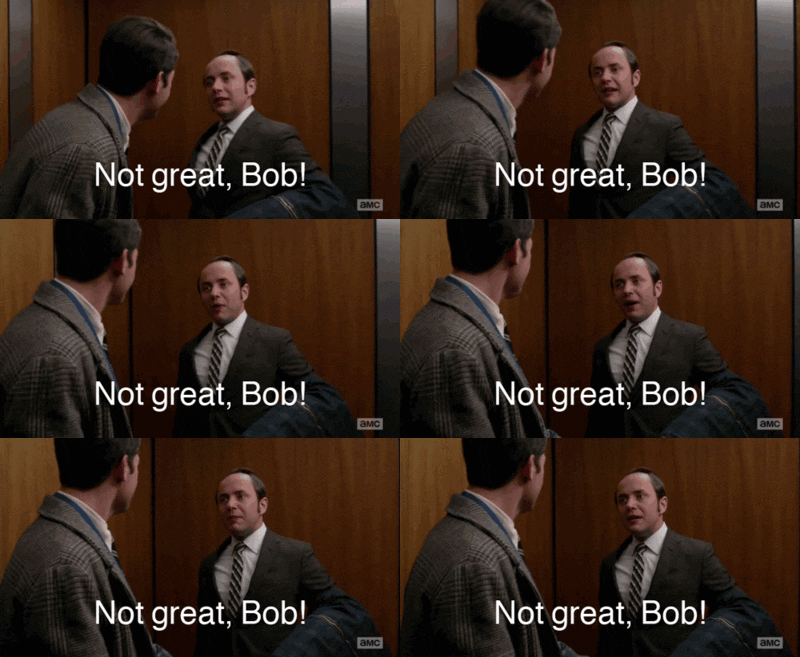
The researchers found retail options traders lost between 5%-14% on these trades. To quote one of my favorite TV shows of all time:
What’s best for your broker may not be what’s best for you
I find it funny that online trading platforms tell you that no-fee options trading is some kind of investment revolution.
To be clear, the world of investing was democratized decades ago by Jack Bogle and Vanguard when they made it easy and cheap for retail investors to buy the entire stock market through low-cost index funds.
The investment revolution is over. We won.
The problem for Wall Street is that given the low costs of index funds, the only way to make real money providing them is to have north of a trillion dollars in assets under management — a feat that only a handful of firms ever achieve. Instead, they introduce complex products that investors don’t need and brand them as democratizing the investment for “the little guy or gal.”
If Wall Street — or even worse, Silicon Valley — tells you they are “democratizing” an asset class, hold onto your wallet, and run in the opposite direction.
Consider subscribing to my Substack for more articles like this.
This article is for informational purposes only. It should not be considered Financial or Legal Advice. Not all information will be accurate. Consult a financial professional before making any major financial decisions.


