
Why Utopias Are Irrational and Violent
And How We Should Actually Be Politicking
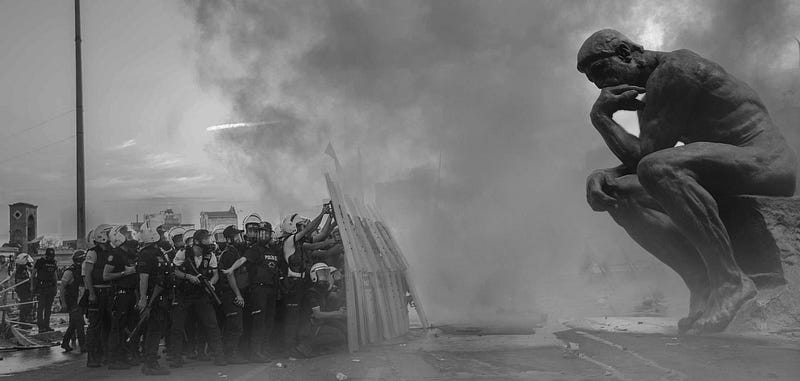
In the human effort to improve the world, ending violence would be a massive achievement. How do we know that? Let’s imagine a world without violence or the conditions that breed violence. Doesn’t that world seem good? Certainly better than our current one.
If that world is really better than the one we inhabit now, shouldn’t we work to make it our reality? In fact, wouldn’t it be our moral duty to strive for that goal?
This is how I thought about my purpose in life, my moral duty, about Utopia, for a long time. Until now.
Until I read the essay “Utopia and Violence” by Philosopher Sir Karl Raimund Popper, in which he argues that violence needs to be defeated by rationalism, but that Utopianism is the wrong sort of rationalism that actually brings about more violence.
Popper begins by defining what he believes is the right sort of rationalism:
“I think I am right, but I may be wrong and you may be right, and in any case let us discuss it, for in this way we are likely to get nearer to a true understanding than if we merely insist that we are right.”
He thinks that discussion, argument, or debate is the only way to avoid violence in disagreements as violence stems from an inability to resolve disagreements in any other way, itself a situation that stems from the stance that you are right and your opponent is wrong. Openmindedness is reasonableness and it is what can end violence.
This being said, Popper goes on to address what he thinks of as false rationality and states that it leads to Utopianism:
“An action, it may be argued, is rational if it makes the best use of the available means in order to achieve a certain end. The end, admittedly, may be incapable of being determined rationally. However this may be, we can judge an action rationally, and describe it as rational or adequate, only relative to some given end.”
Utopianism is essentially the idea that all actions must be rational by working towards the blueprint of an ideal state. But how would one determine this end, this ideal state? It can’t be through true rationalism because that requires not knowing if you’re right or not, counter to false rationalism which determines if you’re right or not depending on if you’re achieving a certain end or not.
But why is this false rationalism considered false in the first place? Because it is self-defeating. Because Utopianism requires action to achieve an end, and action cannot be taken unless people agree on an end, and people can’t agree on an end, action can’t be taken. The only way for “rational” action to be taken is to violently eliminate all dissenting opinions, in the pursuit of a perfect world.
Furthermore, since Utopian actions require social change, the consequences of those changes might end up changing people’s minds as to the value of the initial Utopian goal. Thus, either the initial goal must be upheld through even more violence, or the goal must be changed resulting in more violence like at the beginning.
However, while Popper opposes Utopianism, he isn’t opposed to political reform and proposes this plan that works with true rationalism:
“Work for the elimination of concrete evils rather than for the realization of abstract goods. Do not aim at establishing happiness by political means. Rather aim at the elimination of concrete miseries.”
It is also much easier to agree on what is wrong now and experienceable now than on what could be ideal eventually, and agreement prevents violence.
Popper’s philosophy made me rethink my political beliefs. Utopianism seemed so noble before, but it is undoubtedly true that my Utopia will not look the same as yours, and if we are both obligated to take actions to fulfill our different Utopias, won’t we inevitably come into conflict? And how would we solve that conflict without violence? To do so would discount Utopianism.
It seems wiser anyway to admit that no one knows what the perfect world is. Admitting that, we can then engage with others through true rationalism to find solutions to concrete problems. Perhaps that is noble enough; to eliminate specific evils from our world, rather than to destroy the world by fighting over imagined perfection.
More on similar topics:
This essay details some of my beliefs that have now changed as a result of Popper’s essay.
…I don’t believe anything of value can happen when we as a country and as a people are as divided as we are now…
…anyone who says they know what morality is is both wrong and an invaluable facet of the search for it…


