
Social Media
Why Twitter’s New Fact-Checking Tool Reassures Me
The reason I returned to Twitter … two deactivated accounts later
Fake news scares me. When ‘fake news’ first became a thing in 2016, I never thought it would be an issue. It was relatively easy to determine fact from fiction and I thought to myself, “surely nobody would believe that there was an illicit child sex ring in the basement of a pizza place?”. Yet, ‘Pizzagate’ led to a shooting that never should have happened.
Twitter is a micro-blogging site and retweets exacerbate the echo chamber effect that fake news thrives on. The possibility that fabricated information may be validated by a significant volume of retweets and thus increasingly regarded as the truth is a reality that I did not want to be a part of. The potency of fake news horrifies me and I was glad that I had deactivated my Twitter account years before (I was embarrassed by the nonsense I was tweeting in my teenage years).
Fake News can be Endangering
Baseless allegations amid a pandemic can lead to mass hysteria and more panic buying that are unnecessary and disruptive. In the past few months, I have variously been forwarded misinformation (I am bolding this word in case you think the following bullet points are facts, they are not) regarding coronavirus along the lines of:
- Holding your breath for ten seconds is an inexpensive way to check whether you are infected
- Chickens are spreading the coronavirus, stop eating chicken rice (a local delicacy here)
- Coronavirus can be ‘killed’ at low temperatures
- Gargling with salt can kill the Coronavirus while it is still localised to your throat
Due to the novelty of the coronavirus, there is still much uncertainty surrounding the virus and I could not rely on my instincts or knowledge to determine the truth. I had to fact-check and subsequently debunk these untruths to protect my loved ones. In the process, I discovered that the World Health Organisation (WHO) has an excellent page that counters all the ‘myths’ you will probably ever find about the coronavirus. Still, it baffles me why anyone would make the effort to create infographics and PDF slides to mislead and potentially harm unsuspecting individuals.
Fact-Checking is Finally Coming to Social Media
With all the hassle that goes into fact-checking, it would have been nice if I could call out fake news with just a tap. This morning, I woke up to the pleasant surprise that Twitter has done just that and I cannot be more relieved. This development alone was a sufficient final nudge for me to return to Twitter for the third time running.
Twitter introduced fact-checking on two of President Trump’s tweets as shown below:
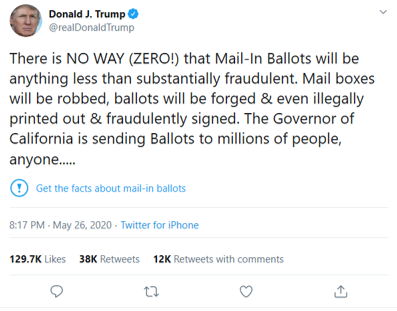
In this case, Twitter’s fact-checking merely eliminates the cumbersome step of Googling ‘mail-in ballots’ for users — which I sure hope you were going to do anyway— while ensuring users do not navigate away from the application. It is a win-win situation for both Twitter’s developers and regular users such as you and I.
Upon tapping on ‘get the facts about mail-in ballots’, the following is what appears:
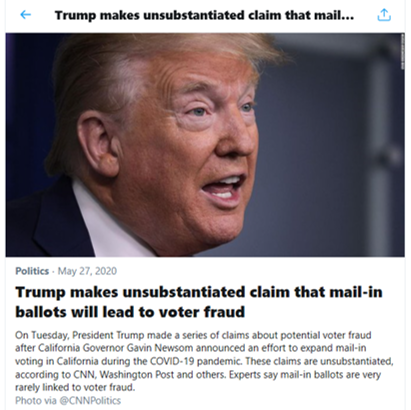
Notably, Twitter cites articles written by fact-checkers employed by reliable media sources instead of simply labelling a tweet as ‘fake news’.
The argument that “if they have now decided to exercise an editorial role like a publisher then they should no longer be shielded from liability & treated as publishers under the law” is invalid. Twitter is shepherding information and placing them side by side for users to make an informed judgement. Aggregating relevant information is something all social media platforms do. Twitter is certainly not telling you what or how to think. Even the phrase “unsubstantiated claim” instead of “fake news” is a neutral term that tells readers that “hey, this tweet is unsupported but here is what other media sources are saying”.
Although it is unclear whether Twitter intends to enforce fact-checking across the board, it is a consequential move by a major social media platform. We have enabled fake news for far too long and it is time to move on from this so-called ‘post-truth era’ and make fake news a blip in history, one tweet at a time.


