
META | READING | MEDIUM | TWITTER
Why Tweeting Text Segments is Better Than Sharing and Highlighting Articles
I’m sure you all missed my adorable meta articles

After tens of thousands of words of fiction, poetry and quite a bit of non fiction I think the time is ripe for one of my meta articles you all appear to love so much. So let’s ‘cut right to the roast’ as we say it in Greek.
Being a notoriously slow reader and repeat off.. er… commenter I have been trying to spend less time reading and commenting, so that I read more words of those I follow.
The main reason I read slow is fracking highlighting. I highlight more than I should and then ‘quote highlight’ 1 to 5 segments in 1 to 5 comments respectively. In that way I waste both my own time and that of the writers, who then read my comments and reply or clap.
My solution to this problem is to skip highlighting and have sweet Emma read for me, then clap and leave one meaningful comment. I could never skip comments too and turn into a mere clapper. Emma rarely exceeds the read time and she always secures a full Read.
Using Emma or the AI of your choice and highlighting at the same time is virtually impossible. The text jerks all over, so you need to pause the AI repeatedly. At the end you spend more time than with mere highlighting and your nerves get shredded as a bonus. So switching to listening sessions can work only if you ditch highlights.
So how do I compensate for the lack of highlights since listening sessions are only registered deep within Medium’s digital black holes? Via tweeting text segments. Tweeting segments, even of your own articles, is inherently better than normally tweeting the article or retweeting tweets of other writers. And it has only one drawback.
When you tweet a Medium post, either by copy/pasting its URL -which, when clicked, will count as an ‘external view’- or via the sharing options Medium provides -which lead to ‘internal views’- potential readers only see the title, the header image and the first couple of lines in the tweet preview. That’s it. They get no sense of the text itself and you do not demonstrate that you actually read it.
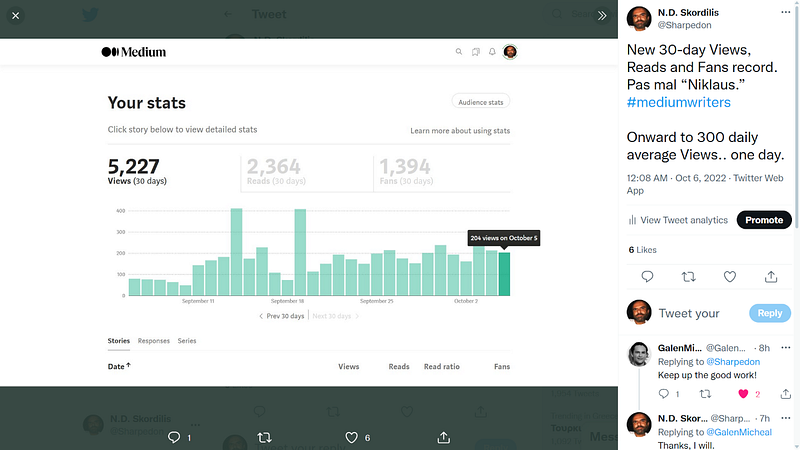
You do not choose a text segment you liked, what you think is representative of the piece or what moved you the most. In Twitter you get extensive analytics per tweet, which Facebook provides only in brand pages. How extensive? I tweeted my Stats a few hours ago:
These are its analytics, which you see when you click ‘View Tweet analytics’ above:
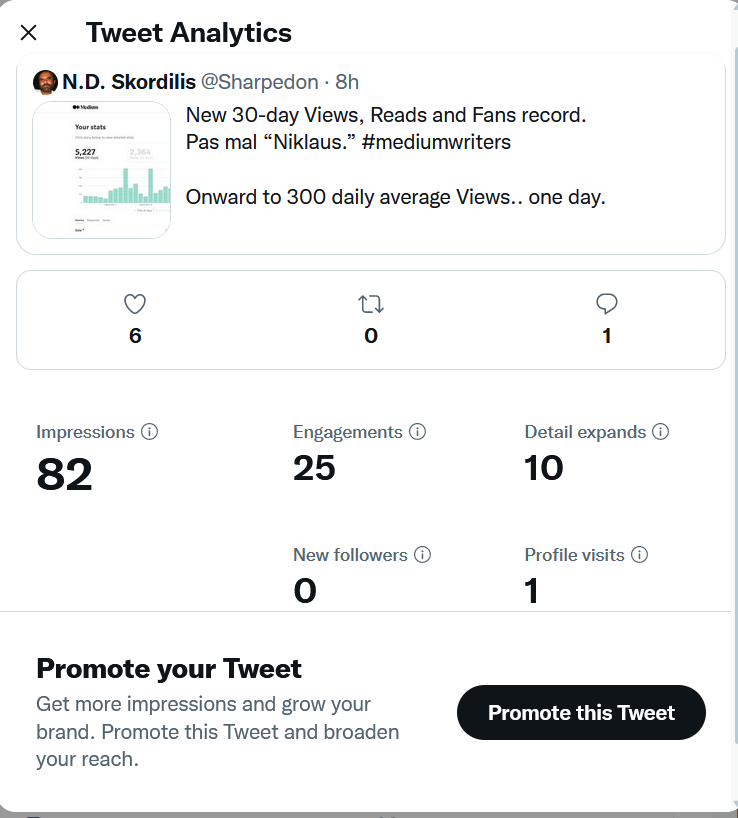
I’ve compared tweets, retweets, and text segment tweets of my articles and articles of others. I’ve invariably seen higher values in the analytics of text segment tweets and higher click rates in them. I cannot see the analytics of the tweets of others, but I can make educative guesses based on their likes, comments etc
Tweeting text segments -the segment can be the intro or anything else you like- allows readers to read the segment, the title, the subtitle or first couple of lines, see the header image and you also automatically tag the twitter handle of the writer, to nod to them that you read and shared their article.
This leads to more direct views and/or motivates other Twitter members to check out the Twitter profile of the writer. And that’s where the above ‘drawback’ comes in:
If the writer has not linked their Twitter account with Medium, or if they do not have a Twitter account at all, tweeting text segments makes far less sense because there is no way to let the writer know that you tweeted their article or for other Twitter members to check out their account — if one exists.
Medium, from Day 1, was tightly interconnected with Twitter, and it’s no accident that tweeting a text segment can be done simply by choosing a text (without necessarily highlighting it.)
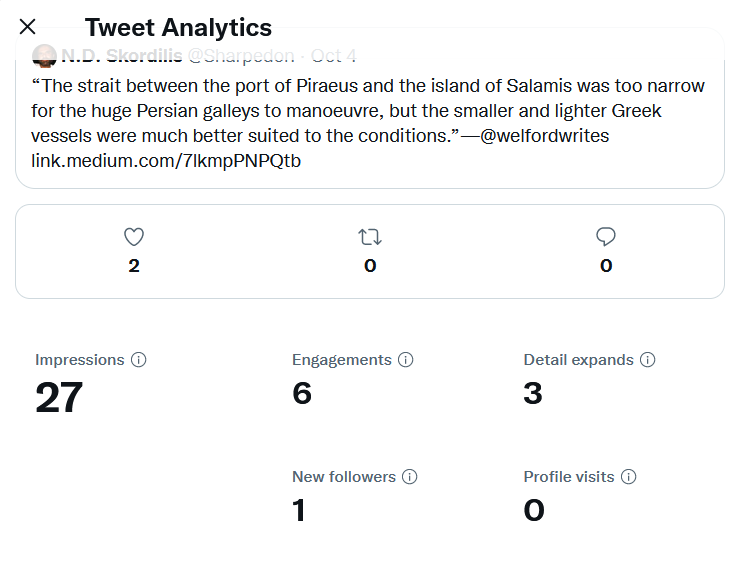
Another advantage of tweeting text segments is that you can get new followers directly from text segment tweets of other writers. A couple of days ago I shared this article of John Welford and I got a new follower by someone who checked out the tweet:
Tweets generate many Views and Reads too. Not often from (paying) ‘medium members’ which can be added to ‘member reading time,’ but it is far easier for an article to go viral via Twitter than via Facebook.
Sharing on Facebook barely works. If you share on your profile it does not work, unless you have 5,000 friends many of whom read everything you share. If you have an FB brand account with 10K followers it’s far better, but who has those?
Sharing on Medium FB groups might lead to more reads from ‘medium members’, but not everyone who uses them is a paying member, and they expect read-for-reads. As a social medium Twitter is better designed for high and rapid engagement -and potential ‘virality’- than FB, and Medium -which is derived from Twitter- borrowed some of its elements.
Views and Reads from non paying & non members do not give revenue (directly) but they are still counted in the Stats. They are the main generators of Top Writers statuses, as we see in the e-mails we get from Medium for Top Writer status notices.
Top Writer statuses do not pay (directly) either, but the more you have the more you are exposed in the main page with more tags, so the more paying members see you and read you. I have no idea how Medium curates posts -probably via the algorithm as well- but I’d strongly doubt total Views are not taken into account at all.
If they are then total Views -which are the only views Medium lists in Stats- should contribute to curation as well. Which for me barely works to raise views and reads, but for some others it does.
Last but not least, for the privacy sensitive among you it is far easier to open an anonymous or pen-name account on Twitter than on Facebook. Unlike Medium -for those of you who have joined the MPP program- Twitter will not ask you for your personal, tax and banking data. They only require an email and, if you want, a cell phone number for 2FA.
Let me close this meta-rant on a tip about privacy and security: Your Medium account is far less private than you think if you used Gmail to open it. I can see the e-mails of all my subscribers here: https://medium.com/@handle/audience/email-subscribers
This is a private page. If you change the ‘handle’ with your Medium handle you can see them as well. Do you know what I see? 90+% of my subscribers use Gmail (Google), with 2–3 using Hotmail & Outlook (Microsoft). Only one of them use an independent email provider.
If you really want to be private, secure and anonymous, do not disclose your online activity to Google and Microsoft. Open an e-mail account using this provider. These are the same guys who operate CERN and the Large Hadron Collider, in Switzerland:
It is a Swiss based, non commercial, privacy and security focused email provider, funded via a grant from the European Union’s Horizon 2020 program. They also provide a VPN and a Drive for files. They use end-to-end encryption, meaning even Proton cannot read your e-mails.
That’s a wrap everyone. This article got a bit longer than I expected. Let me know what you think in the comments. If you have a particular reason for refusing to use Twitter I’d love to read it. And those few of you who read up to here -yes, you!- you rock! ☺️💖
A meta-article by Nikolaos Skordilis.


