
Commentary
Why TV Screens Make Me Quickly Apprehensive
The unexamined screen is not worth watching.
Recently I was traveling by air.
I am a scholastic who ended up in the modern world by accident. I still find traveling by air quite an unquieting experience. I don’t think I’ll ever get used to it.
But what was even more disquieting, was this scene I witnessed.
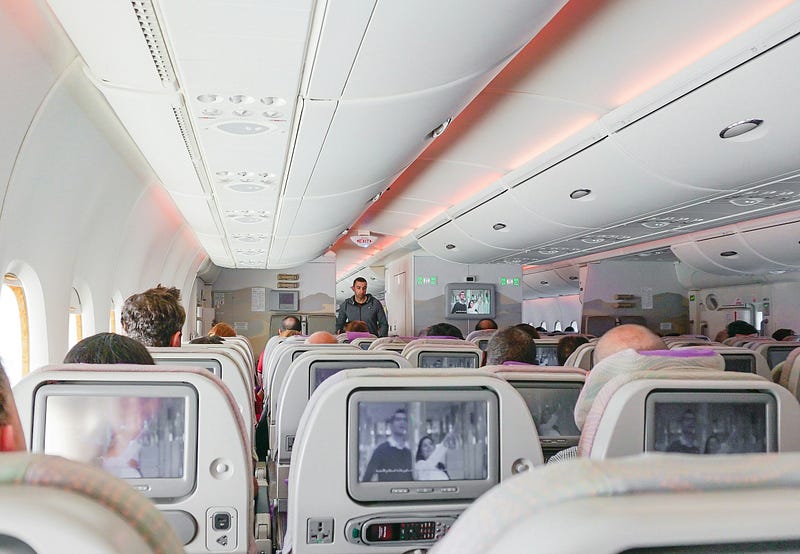
When I boarded, I sat down and looked around.
For the first time in my life, I’ve noticed the significance of this sight.
Everyone started turning on their screen, plugging in their earmuffs, and playing their movie of choice.
After take-off, when the lights were turned off, I looked across the cabin. There was a screen flashing — its lights dancing — in front of every seat.
I turned on the light above my seat, which illumined my book. I felt slightly uncomfortable, aware that the light might be a nuisance for someone who was trying to get to sleep. But part of the discomfort was also because no one else opted for reading.
I looked upwards again, and again I saw a sea glittering. Not of reflected sunlight on salty waters, but of pixels twinkling a message crafted for the viewer, designed to capture their maximum, sustained attention.
Even while a movie was playing on my neighbor’s screen, my eyes helplessly started drifting over to it.
Until a voice of reason asserted itself in my mind, and I summoned my eyes back to the pages on my table.
In case you haven’t noticed, I have fairly strong opinions against TV. Not so much intrinsically, but against unpremeditated use.
I, for one, was blissfully unaware of what TV presupposes and could cause. It remained the case until 2017 when I followed an interview with historian Yuval Noah Harari.
He said:
“I know those other times I end up watching two or three videos and I end up getting sucked into it, but this time it’s going to be really different. I’m just going to watch this one video and then somehow, that’s not what happens.
You wake up from a trance three hours later and you say, “What the hell just happened?” And it’s because you didn’t realize you had a supercomputer pointed at your brain.
So when you open up that video you’re activating Google’s billions of dollars of computing power and they’ve looked at what has ever gotten 2 billion human animals to click on another video.” (Emphasis mine)
It doesn’t even give you the choice. Maybe that’s what I’m against as well. If you place a book and a flashing TV screen in front of a child (or a young person), and offer them a choice between them, which would they choose?
Or could they fairly choose the book? Could they resist the temptation to fixate their eyes on the TV even as (and if) they reach out their hand for the book?
I have written about the negative effects of TV at greater length here:
This is not to say that it is not important to keep ourselves abreast of what’s happening.
But if you’ve never thought about this viewing ritual we do by default, it’s probably worth sparing some time to do that.
After my flight, I entered a car.
Sure enough, there were two TV screens set behind the headrests of the front seats.
My nemesis. (Nemeses — plural?!)
They were turned off. So they were black like their frames were black.
An image of a sleeping dragon was conjured up in my mind. They were of course dangerous when asleep, but when they wake, they are capable of mesmerising the viewer with their great power of enchantment.
But why would we suppose the passengers need entertainment other than a pleasant conversation with the rest of the passengers?
Could we not switch off for a moment?
This weekend, why not consider setting aside some time to switch off our TVs (and leave our phones somewhere else) and go for a walk or read a book?
Time is precious, and TV has already eaten up lots of it.
But the power is in our hands to limit further encroachment.
Check out my other articles on diverse topics:


