
Why try to help people if they don’t want your help?
The slow, painful death of an idealist

I recently started a new project. It is a good, solid, give-back-to-the-community kind of project, and the motivation for doing it comes from a pure place of sincerely wanting to use my expertise to help and empower groups of women for whom I have a lot of respect and a lot of warm feelings. And yet, it has been shot down by forces that make me question everything — like literally everything! And as a result, the idealist within me feels extremely frustrated, sad, despaired, well, on the verge of death, really.
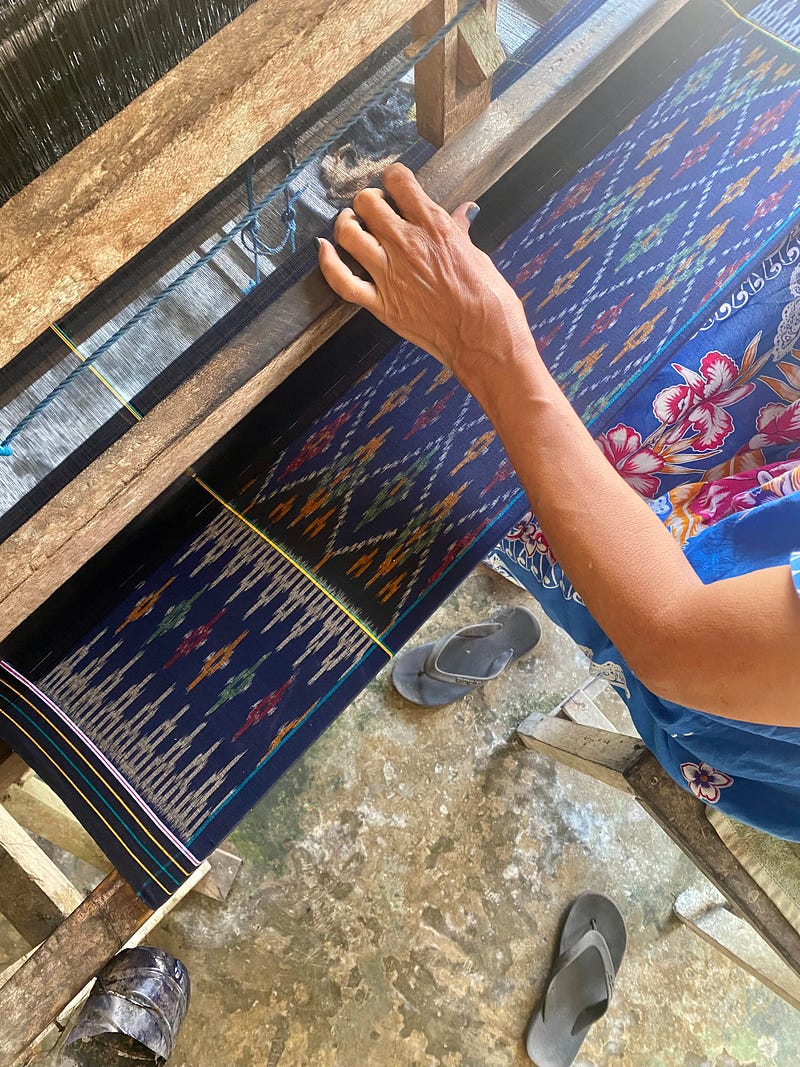
To make a long (and slightly complicated) story short, I am engaged in crafts preservation, upcycling of waste, and the empowerment of women in remote regions of Indonesia. This involves me creating products that can (hopefully) breathe some life into these traditions (weaving mainly). Traditions that I find immensely valuable, but that are unfortunately suffering — and are nearly extinct — due to the competition from mass-produced, synthetically dyed, cheap textiles. I wish to help preserve these traditional crafts techniques — not only because they are longstanding, beautiful ways of creating cloth; they are also an embodiment of centuries of history and a treasure chest of aesthetically nourishing patterns that are not documented (in writing or photos), but have been passed on through generations from hand to hand.
This is a meaningful thing to do, I feel. I honestly think (or thought) there is something worth fighting for here.
However, the first step towards my current state of despair was initiated by the craftswomen themselves. They definitely have a desire to preserve the techniques, but a lot of them have become rather cynical — probably due to a decade of fighting the mass-market and trying to optimize their value chains in order to make just a little bit of profit, and will often choose the cheapest thread and synthetic dye in stead of natural (as it, besides form being cheaper, is much faster), and cut corners when it comes to preserving original patterns (no-one knows anyway, as one of the women said, and I guess she is right).
The thing is, though, that once you have taken that first step towards a cheaper, less aesthetically nourishing, more synthetic (and hence more polluting) version of a traditional crafts-product, turning back is hard. And, another important point is that taking this route — the route towards worsened quality, more homogeneous, sense-numbing, boring products, and less aesthetically nourishing imperfections (that f.ex. come with hand-spun cotton, natural dyes and immensely complex patterns and techniques) — is in so many ways the wrong decision right now. The world needs more aesthetically nourishing products that can last a lifetime, not more smooth homogeneous, insignificant products that, due to their triviality, get discarded before being worn out or broken.
Furthermore, if time is invested in creating enduring, aesthetically sustainable products, the money will follow. It might not be the instant pay-off that quickly made cloth will provide you with, but it will be more lucrative in the long run. One of the weavers I spoke with recently understood this; she makes synthetically dyed sarongs and earns around 7 dollars a piece (and mind you, these sarongs are handwoven, which is always a slow process, so creating one will take her around 2 days). However, she also at times creates naturally dyed sarongs in a more complex traditional pattern, and the price she will get is at least tenfold what she gets for the more homogeneous sarongs.
So why doesn’t she focus more on creating the slow-made, naturally dyes textiles?
Well, there are multiple reasons for this. You might think that one of them is related to a lack of buyers, but that is actually not the case; plenty of people are interested in naturally dyed, slow-made textiles (this is also where my support efforts come in), and this demand is rising due to their rarity. The reasons for the weaver(s) not creating the slow, aesthetically enduring textiles are:
- she would have to make the payments from her products stretch; in stead of getting paid once a week, she would have to accept getting paid only every second week or once a month, and that would mean her having to budget.
- the creation of natural dye is a very time-consuming process, and it involves understanding which plants are usable and how to process them, picking these plants and preserving them, plus planning the yarn dying. Not only is the slowness unappealing to many of the weavers, the expertise is also disappearing, making this a good example of a crafts tradition that is more or less already gone. If only the weavers understood how trendy their slow lifestyle, slow textile-creation and slowly handpicked wild plants for natural textile dye are in the part of the world from where I come…
- the weavers are convinced that their customers want more vivid colours, and while that might be true when it comes to a local segment, it is not the case when it comes to larger audience. Many of the weavers also have a preference for the new, synthetic vivid colours and will say: it looks better like this — pointing to an added magenta stripe or a bright yellow embroidery. It is kind of a strange aesthetic dominance that is exhibited here that I experienced, when I recently wanted one of the weavers to create a tapestry based on a watercolour painting by by artist friend. When I got it back there was no trace of the original douche colours — the tapestry was bright yellow, blue, red and pink. I asked what happened, and the weaver said: I thought it was prettier that way.
- the weavers seem reluctant to collaborate. Even though a collaboration between the ones who still understand and master the natural dyeing processes, the ones who can set up backstrap as well as large looms, and the ones who are masters at weaving traditional patterns would optimize the process, there is no desire to do so. I don’t want to share my money, one of the weavers responded, when I asked her: why not collaborate?
I have spoken a lot to the different weavers, who live in small villages and work from home. My main focus is always: how do we save these traditional patterns and techniques; how do we prevent them from disappearing? Most of the weavers I meet are well into their 50´s, and if no new weavers are recruited it is just a matter of time before these ways of creating textiles will be gone. I find that sad. The idealist within me is very, very upset.
But the weavers don’t seem so concerned. There is a predominant each-to-their-own attitude that, honestly, surprises me. They will be like: yeah, well what can we do? If the young people would rather work in a bar or a hotel, we cannot convince them to stay. But what if the weaving techniques disappear? I will say. And they will shrug their shoulders.
The second step towards the death of my inner idealist involved a dishonest lawyer, corruption and (big) bribes. I will not go into details here, but it was bad. Really, really bad.
So what does this all mean? That the motivation behind a project is insignificant? That trying to sustain endangered crafts traditions is pointless if it doesn’t mean anything to the local community with whom you are working? That working with design dogmas that ensure breathing new life into discarded products and product waste are nothing but tiny drops in an ocean of overconsumption and mindless waste disposal (and that is a battle that you will not win)? That everybody will try to take advantage of you if you appear to be an idealistic, pure soul?
I guess it is a big resounding ‘yes’ to all these questions! A bunch of yes’es that are killing the idealist within me.
Anyway, this is not to sound like a cry-baby (and to be like: boohoo, well if you don’t want my help, I can just leave you alone), but honestly; I can think of nothing more demotivating than engaging in a passion-driven project that benefits all the involved parties and the natural environment — and to then be faced with greed, dishonesty, corruption, jealousy, ignorance, and an each-to-their-own attitude that kills all initiative. Nothing.
What is the take-away here? That you can‘t trust anybody’? That people only want to be “helped” if there is money to be earned (and that most people don’t care about preservation, cultural treasures, and endangered crafts)? That idealism will get you no-where? Or rather; it will get you somewhere — it will get you robbed, it will deprive you from hope and it will leave you disillusioned and despaired. And, that greed can make people lie straight to your face? No scruples. None.
Are these lessons really the truths about how the world is run? Is the only way forward really to trust no-one, to give up on trying to help people (that seemingly don’t want to be helped), and to stop the battle against over-consumption, and instead start benefitting from people’s apparent insatiable urge to buy (as a well-intentioned soul said to me the other day, when I was nagging)?
After weeks of facing these facts, yesterday the death knell finally came. It happened as I was picking my sons up from school, and I rode my motorbike behind one of the awful pig transports that are the norm here. Pigs stuffed into these tubelike cages in which they cannot move; some of them with broken legs as a result of being forced in there, and with foam around their mouths, all of them with bloody wounds from the sticks that hit and pushed them when they were caged (I have heard theirs horrific screams often when this happens, loud and panicked), and all of them with dark empty, scared eyes, quiet, only a few silent grunts. I drove up right behind the truck; firstly with then intention of documenting the horrendous scenario by filming it, but then the resigned feeling that my recent defeats have left me with made me drop the filming (because why bother?), and instead I just shouted as loud as I could: Murderers!!!! Is there no justice????? Is there no love left in the world???? It felt good, and also really sad. Because I guess that was the end of my inner idealist; she died right there on the road surrounded by suffering and the nauseating smell of blood and fear.