
Why Trump Risked His Presidency to Corroborate a Lie
It may seem like Trump supporters will swallow anything he says—but Trumpian epistemology is a bit more complicated
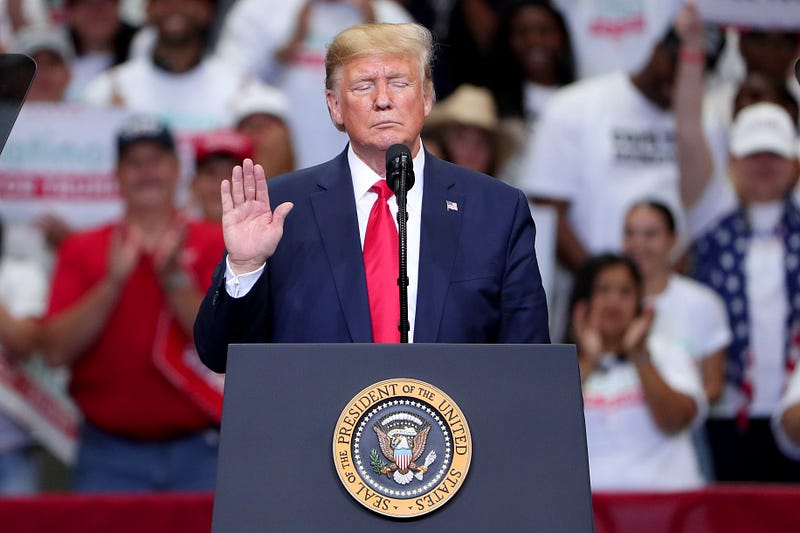
President Trump lies.
Trump lies so frequently and so freely that he seems to lack any regard for, or even a conception of, the very idea of truth and falsity.
I know he lies. You know he lies. I suspect even Fox Business host Stuart Varney—who contended in an August interview with GOP presidential candidate Joe Walsh that Trump never lies—knows he lies.
The depth and breadth of his lies, though, are what make his impeachable actions so mind-boggling.
Trump’s ask from Ukraine was not an American foreign policy goal. Neither was it for a large Ukrainian delegation to stay a month at one of his failing properties. Rather, Trump’s misadventure was an attempt to get Ukrainian politicians to provide the American public with evidence of wrongdoing.
It’s a surprising request from someone who lies far more readily than he laughs.
Specifically, Trump wants evidentiary support for at least two claims: that former Vice President Joe Biden corruptly abused his position to enrich his son Hunter Biden, and that the cybersecurity company Crowdstrike hid servers belonging to the Democratic National Committee in Ukraine.
These stories are not true. Hunter Biden’s position on the board of a Ukraine energy company offered an appearance of impropriety but there is no evidence of any wrongdoing on either his part or his father’s. The Crowdstrike story, which is one element in a larger conspiracy that incorrectly exonerates Russia for interference in the 2016 election, has been widely debunked by the intelligence community as well as current and former members of Trump’s own administration.
Trump could have simply made up a story of whole cloth that incriminated Biden or exculpated Russia. He also could have stated the falsehoods that Biden is corrupt and Crowdstrike hid the DNC servers in Ukraine and left it at that.
Instead he shot himself in the foot trying to provide the public with evidence that those statements were true.
To be clear, Trump is not trying to find good evidence—that is, evidence that would persuade a rational person that those claims are true. Rather, he wants what might best be termed “token evidence,” which is the minimal evidence it would take for his supporters and right-wing media to cohere into political conviction.
It’s possible that Trump believes his own stories. When text messages between Trump loyalist and Fox News host Sean Hannity and imprisoned former Trump 2016 campaign chair Paul Manafort were released, it was striking to see that even talking privately, Hannity seemed sincerely to believe exactly what he says on TV every night.
Hannity texted Manafort in August 2017:
Now we have criminalized political differences. HRC NOTHING? And NOTHING IS getting done for the great people of this country. I am truly frightened the constitution is being shredded, (no 4th Amendment protections) no equal justice under the law. I am truly frightened for the future of this country we love. God help us and the world if we don’t get all this straightened out. …
To be honest. The left may win and get me fired at some point. But I don’t give a shit. I’ll get 2 Dixie cups and talk to myself. Paul I started as a dishwasher and construction worker. I’m 55. I’m pretty wealthy and I don’t care. I made more this year than my mom, dad and all their brothers and sisters and my grandparents made combined in their lifetimes. They fought for my ability to have a better life. What I supposed to now say, “I’m playing golf?” I suck at golf. The beach? I’m bored in 5 minutes. You life story, and mine, are the reasons this country was created. I would be embarrassed at myself as a son and grandson of people far greater than me not to try my best to fight hard to end corruption in this country.
It’s always hard to know what, exactly, Trump believes about anything. Some have taken his quest to get information on the DNC server from Ukraine as evidence that he believes the DNC server is there.
It’s certainly possible; Trump has been known to fall for conspiracy theories. It’s also possible Trump is asking in hopes that Ukraine will either manufacture evidence or simply find something that looks sort of sinister. Then he’ll have his token evidence.
Trump is apparently sensitive about his inability to offer even token evidence in these cases. In his recent rallies, Trump has bemoaned that the press has been calling his accusations against Joe and Hunter Biden “unsubstantiated.” In a rally in Minneapolis on October 10, he said:
[Reporters] say, “in totally unsubstantiated charges” every time they talk about [Joe Biden]. “President Trump has said his son walked away with a fortune. Now you know that’s a totally unsubstantiated charge.” Really? It’s not unsubstantiated, it’s fact. … It’s not unsubstantiated, you crooked son of a guns. It’s 100 percent true. … The Bidens got rich and that is substantiated while America got robbed.
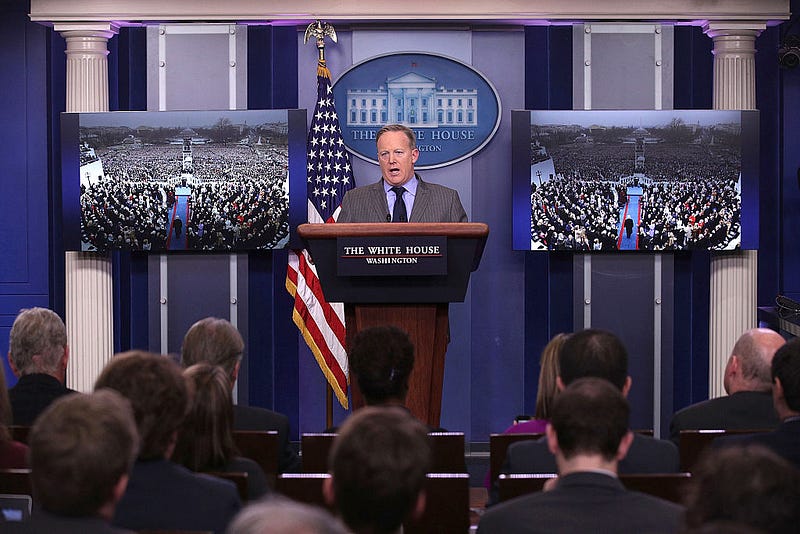
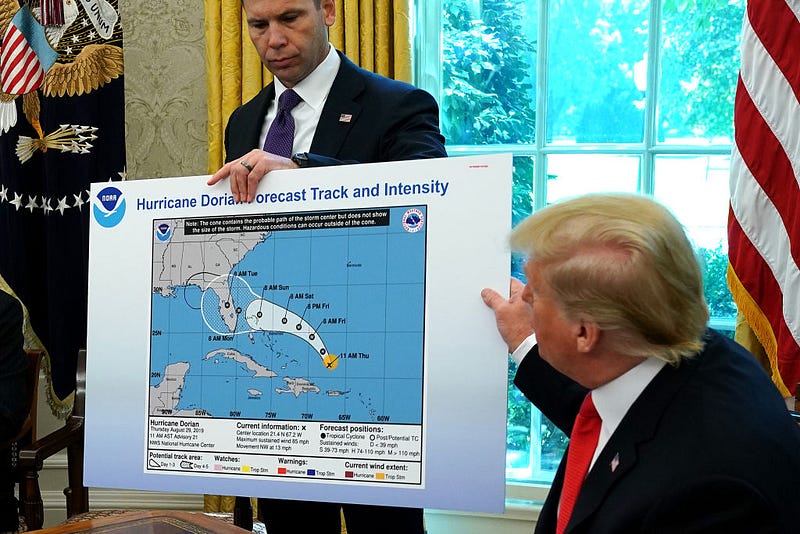
Trump’s desire to offer evidence is not new. He has offered trumped-up token evidence for his lies many times. For example, he offered visual token evidence of the crowd size at his inauguration and a hurricane supposedly forecast to hit Alabama.
Travis View, a conspiracy theory researcher (whose work has appeared in Arc Digital) and host of the podcast QAnon Anonymous, told me “most conspiracy theories generally have a tiny element of truth, even if the conspiracy itself is ultimately fact-free.”
View observed that the Pizzagate conspiracy theory, which posited a Hillary Clinton-led cabal of elite pedophiles who trafficked children, did not turn out to be true—but the central contention of Pizzagate did in fact slightly resemble the case of Jeffrey Epstein.
When any of us receive new information that is surprising and conflicts with our current set of beliefs, we decide which of our previous beliefs to hold and which to discard.
Take Senator Lindsey Graham’s (R-S.C.) sudden turn toward Trumpism in 2017, which surprised many across the political spectrum. This was a new fact that conflicted with a previous set of beliefs—that is, that Graham stood with his friend, then-Senator John McCain, as a principled Republican bulwark against Trump.
Explanations for Graham’s turn have been: he’s being blackmailed (discarding the belief that Graham is one of the vast majority of U.S. politicians whose political acts are motivated by some combination of ideology, pleasing voters, and pleasing donors); he’s cynically trying to get re-elected (discarding the belief that Graham is somewhat more principled than other politicians); or that he’s sincere (discarding the belief that he’s less partisan than others).
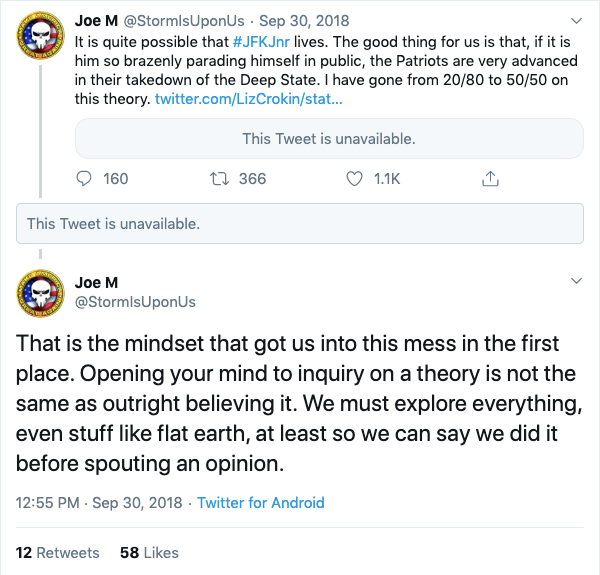
Trump-friendly conspiracy theorists do not, in fact, swallow anything. They argue among themselves and disagree about the persuasiveness of evidence. For example, QAnon conspiracy theorists disagree among themselves whether John F. Kennedy, Jr. is still alive, arguing over whether the evidence for his continued existence (he died in a 1999 plane crash) is convincing.
Conspiracists, too, absorb surprising new information by figuring out how it meshes with their current beliefs. Where conspiracy theorists go wrong is deciding which beliefs should be maintained and which should be discarded. View notes that one of the beliefs to which conspiracy theorists are most likely to cling above all others is “the rejection of the mainstream narrative.”
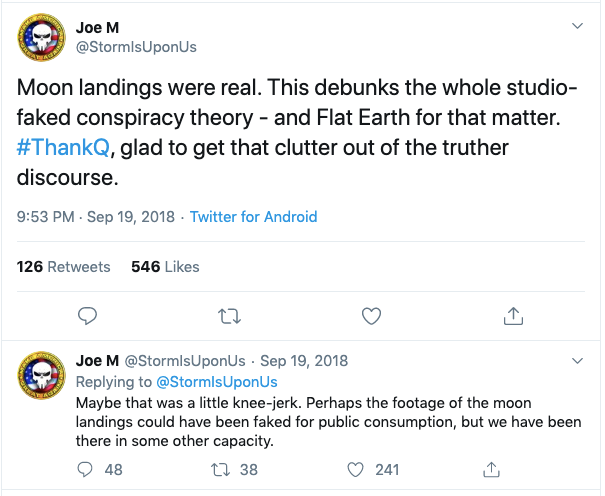
You can see a prominent QAnon Twitter presence weighing evidence in the following:
In a conspiracy from another era, the Salem witch trials featured vigorous contemporaneous intellectual debates over what counted as evidence of witchcraft.
It was not that people in 1692 argued that witches do not exist. The existence of witches was not a belief anyone was ready to discard at that point. Rather, there were long and heartfelt debates over what should count as legal evidence of witchcraft. Should testimony of the accusers that they saw an apparition of a defendant be used to convict? What if the accusers’ afflictions stopped when touched by the defendant?
The Salem witch trials, the paradigm case of an obviously false and deadly conspiracy, were not simply impulsive and thoughtless acts by unreflective people. They were conducted by highly educated judges who grounded their theories in, among other things, British legal philosophy and the scientific works of René Descartes.
Trump fundamentally gets what his conspiracy-minded supporters need. They may or may not forgive him if he shot someone in the middle of Fifth Avenue. However, despite a reservoir of trust they may have for him more generally, they cannot swallow just any story.
And that’s how a liar risked his presidency to give his supporters not the truth, but a tiny kernel of truth, out of which the stories might be spun to maintain his future in power.