Why Toxic, Patriarchal Men Become Enraged When They’re Ghosted
Getting cut off deprives them of control and because they see you as a possession, they can’t handle it.
I vividly remember listening to my dad lecture me on how my mom was entirely at fault in the divorce. Dad drove because he liked being in control. The periodic flashes of oncoming traffic illuminated his face in a way that was both ominous and threatening.
“Your mother’s family was highly dysfunctional,” he explained using the same lawyer voice that he employed during a trial’s closing arguments. With his right hand, he made theatrical gestures. He snapped out his index finger like an exposed blade.
His body language and his tone of voice projected calm rationality, but the atmosphere was thick with threat.
His left hand caressed the wheel, and I understood, if provoked, that he had the power to drive us straight into oncoming traffic.
He offered a succession of points without allowing me any opportunity to retort. When he finished, he turned and looked at me in triumph as if only a fool or a lunatic could fail to see his logic.
“But,” I said haltingly, “almost everyone in your family has gotten divorced at least once. Anyone can see that the one marriage that has endured is hardly a happy one. Perhaps we should at least consider that there might be a toxic element on your side of the family.”
The moment I said this, both of his hands shifted over to strangle the steering wheel. He hunched his shoulders and stared defiantly ahead. I caught a glimpse of the expression I’d come to know as “the stranger’s face.”
Though my daddy loved me, I knew that the stranger didn’t. This had always been the dynamic of our relationship, but I was in my 20s for this talk, and the thought of a physical altercation no longer terrified me as it once did. Still, I didn’t push the point at that moment.
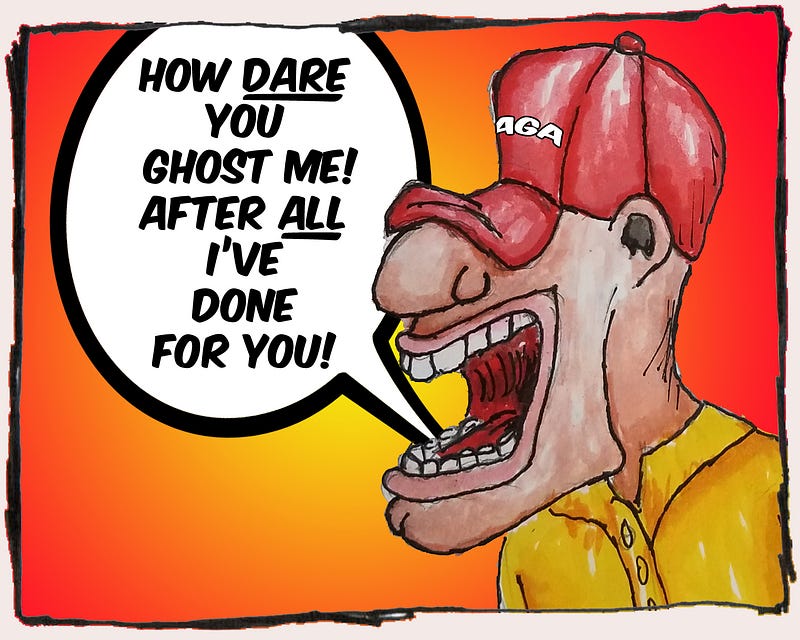
Our relationship didn’t end in a fiery crash out on the highway. It didn’t end in any kind of physical altercation. Instead, I eventually cut off contact. I haven’t talked to him in twenty years. He’s never met his grandchildren. He rages about how this is “unfair” and how the fact that I ghosted him indicates that I am the “toxic” one.
To this day, he refuses to even engage the possibility that he might be at fault. I can’t make him change, but I also don’t have to be an accessory to his self-delusion.
Forced moderation is another form of abuse
Our society has not cultivated a reasonable approach to navigating conflict. We make bad assumptions, and we too often surrender to the abuses and failures of existing power dynamics.
When my daughter got spit on in Spanish class, the school’s response was to force her to sit down to “talk it out” with her attacker. I called them and told them this was not acceptable. In the end, the boy was permanently removed from her classroom, but that wouldn’t have happened without my insistence.
It’s valuable to examine and dismantle the thought process that, unchecked, would have made the transgression against my daughter worse instead of better.
There’s an absurd, moderate belief system at work that insists, in any conflict, we must assume that both parties bear an equivalent amount of blame.
This assumption is wrong.
One-size-fits-all approaches to complex situations are like broken clocks. Sometimes there is an alignment between the philosophy and the conflict, so you achieve a positive result. However, the existence of the occasional success should not prohibit us from recognizing all the times the approach fails.
Too often, our assumptions about intrapersonal conflict are oversimplified to the point of being useless. Unfortunately, the traditional approach greatly favors individuals who are indifferent about the harm they cause.
Don’t let them try to label you as toxic
When you discover you’re in an abusive relationship, your first response should be to distance yourself from the abuser. We should all be able to agree on that. However, I find it stunning how many people feel compelled to put qualifications on this concept.
“Well, if you’ve been in a relationship with somebody for a long time, they have a right to an explanation.”
That’s an irresponsible argument to voice. The first, second, and third thing you have to do is establish your safety. You have no obligation to sit in a vehicle with an emotionally unhinged person who threatens to crash the car. However, our society too often apologizes for abusers while disregarding the plight of survivors.
Even therapists are sometimes inclined to disparage the idea of ghosting an abuser. In the same way that our society disregards the prevalence of racism, I believe we’ve become blind to the extent to which our toxic ideology poisons our relationships.
Patriarchal systems lack accountability for men in positions of power. They will abuse you again and again, and until our system changes, your only choice is to endure it or leave.
Remember, this is a society that refuses to do anything to stop mass shootings. Why is it so hard to believe that our staunchly defended traditional values prevent us from cultivating healthy and enduring human connections?
You can’t talk it out with some people
When I write on this subject, I find that both men and women, but particularly men, often have a strong, emotional response. Emotional responses do not represent respectful discourse.
Instead, an emotional reaction is more often used as a strategy to intimidate and silence the opposition. It’s bad when you encounter such a reaction in the form of an online comment. It’s intolerable when you have to endure it during a face-to-face interaction. Your only response is to stand firm and demand to be treated with respect.
That’s not easy when you perceive an imminent threat to your life.
You have to prepare yourself for these battles because they happen all the time in our society. It’s unacceptable that the consensus is that rational people should retreat.
Factual discussion points should never be “off limits”
It’s rarely the case that somebody thanks you for presenting a fact that proves they’re the party at fault in a conflict.
What’s more likely to happen is that when you state a fact that proves your opponent wrong, they’ll become enraged and possibly violent.
We see this behavior at work in our society all the time. The Capitol attack on January 6th which resulted in the murder of a police officer is an example.
Unfortunately, the patriarchal influence is so strong that our society has come to assume it represents an act of aggression to belabor a fact. Abusive people feel “deeply held beliefs” that are completely disconnected from reality are entitled to a greater show of respect than the verifiable truth.
Innocent people are blamed when they fail to relent in the face of unchecked aggression.
The correct response would be for our society to understand the violence of emotionally unhinged people isn’t justified because they’re triggered by their refusal to accept reality.
Using “shared blame” to escape accountability
In the example with my dad, I understand that exploring the dysfunction in his family was an emotionally charged topic. However, that doesn’t mean that the concept must be buried in history forever.
I had no obligation to go along with his narrative that my mom was the source of all his problems just because it made him uncomfortable to examine his failings.
The irony in this situation is that my dad had used the camouflage of the shared blame philosophy to effectively employ a “one-person-at-fault” narrative. This is too often the consequence of the current approach.
Our lazy mechanism that begins with a flawed but reasonable-sounding universal assumption is often manipulated to place all the blame on the innocent party. There is no “shared blame” if a patriarch feels he has total immunity.
An unsustainable system that relies on selective perception
We need to work towards a system that provides emotionally unhinged people with the help they need. We won’t get there by enabling them through a code of silence that pressures us to ignore unprovoked transgressions against the innocent.
Instead, our path lies in refusing to permit abusive people to spread misrepresentations or blatantly false narratives.
If people threaten you with their volume or their body language when you’re in their presence, you have to leave. You have to get as far away from them as possible. A person who cannot control his/her emotions is a threat. We cannot allow ourselves to be intimidated into disregarding facts for the sake of an unjust peace.
Ghosting toxic people is a matter of self-preservation
You can get killed from one punch. An unhinged driver can cause a head-on collision by turning the steering wheel an inch to the left. The danger is real, and our attitude of tolerance towards unhinged, toxic, and emotionally immature individuals subjects us to an unacceptable level of danger.
Ultimately, we’re stuck in this scenario because it’s easier to make innocent people suffer than it is to hold guilty people accountable. I’m tired of seeing innocent women forced to endure the consequences of our society’s failure to stand up to emotionally immature men.
A boy who spits on my daughter is never allowed the privilege of being in her presence ever again. I don’t believe in “accidents.” I don’t believe in “I just lost control.”
The violence has to stop. It says a lot about our culture that the concept of ghosting is derided while the very real issue of domestic violence is largely denied and ignored.