
Why did Thoth, God of the Moon and Writing Welcome Seti I to the Afterlife?
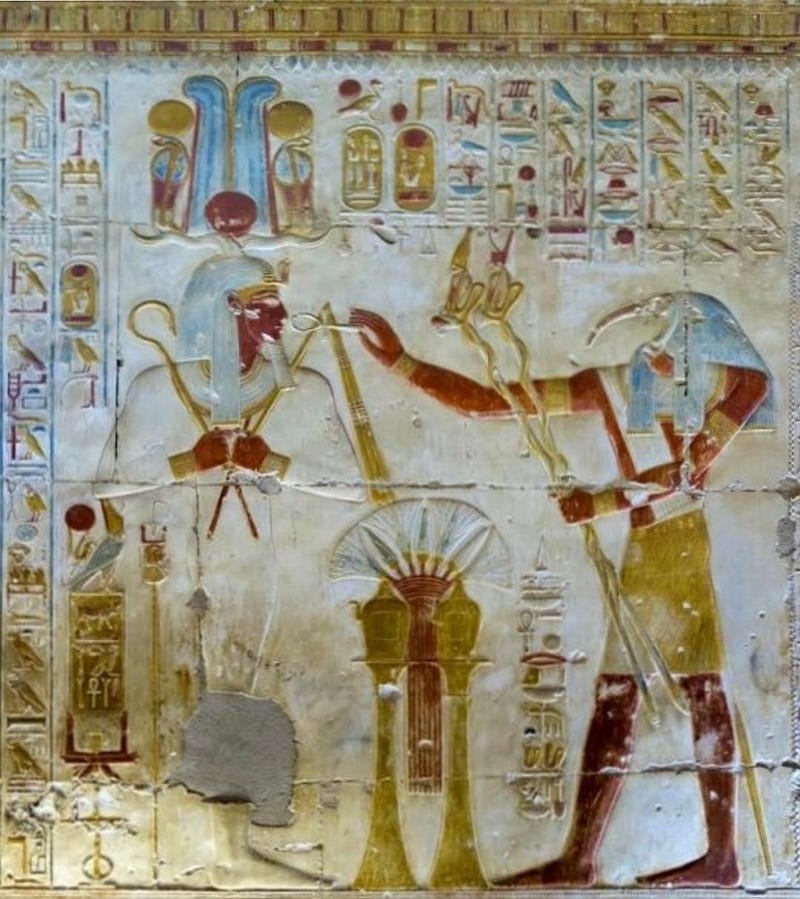
The God breathed life to the pharaoh by placing an ankh close to his nose
Ancient Egyptians believed that our life on earth is just a part of our eternal journey. Everything we do has consequences therefore one should lead a balanced life free from excess.
The unity of the mind, body, soul and spirit was of utmost importance. Ancient Egyptians believed that inner peace and clairvoyance could be achieved by developing the five basic senses.
According to them, one should be prepare for the afterlife and be guided through it. We will show why Seti was deemed so honourable the Moon God became his guide.
Thoth, the inventor of writing and the wisest man in ancient Egypt created a hieroglyph symbol that represented the word life.
The ankh became the symbol of life itself and was made as an object often carried by ancient Egyptian Gods. The population used to possess at least one in their houses.
It was very important to nourish the mind, rejoice and show gratitude every single day.
“Soul to heaven, body to earth” (Book of The Dead) was the mantra in Ancient Egypt.
When Akhenaten rose to power, he introduced the first monotheist religion which brought chaos and social disorder in the society. Seti who succeeded him re-establish the strength of the old gods by building temples honouring them.
Even before Seti became pharaoh, the Gods already knew he was going to be a wise ruler thus keeping a special place for him in the afterlife.
When Seti was a child, his father Ramses I brought him to Abydon to pay his respect to Osiris, God of the Underworld. His wife Isis and son Horus the Sky God welcomed Ramses I while Osiris focused on Seti.
He told him: “My chosen son of my body, lord of two lands. My heart is happy and content because you have acted. You are my son and protector. As long as the sun exists, your name will exist. As long as the sky exists the deed will exist”.
Ramses I raised Seti to respect his elders and be religious. When he became pharaoh, Egyptians were happy that spiritual order had been restored as Seti built temples to honour Osiris, Isis, Horus and Amun-Ra. He also encouraged the population to pray every single day.
Thoth who recorded the verdict on the deceased in the hall of Ma’at, decided to personally give the breath of life to Seti when his time on earth came to an end.
During the ceremony, Thoth was dressed as a priest and held the wands of Upper and Lower Egypt to evoke the unity Seti brought to the society. The latter was dressed as Osiris.
Thoth hailed Seti as the pharaoh who brought back order and harmony in the society and raised who was to become one of the most important ruler ancient Egypt has ever seen: Ramses II.
To conclude, this event shows that our good deeds will be rewarded in the afterlife and having an ankh may be used as a reminder to always stay on the right path.
I write towards what I want to know
Join my ever-growing list of followers on Medium to enjoy a singular reading experience
Visit https://linktr.ee/CharlotteZ to connect with me on social media


