
Harnessing the Power of Intuition in Art
Exploring the uniqueness of Kandinsky’s expressionist painting
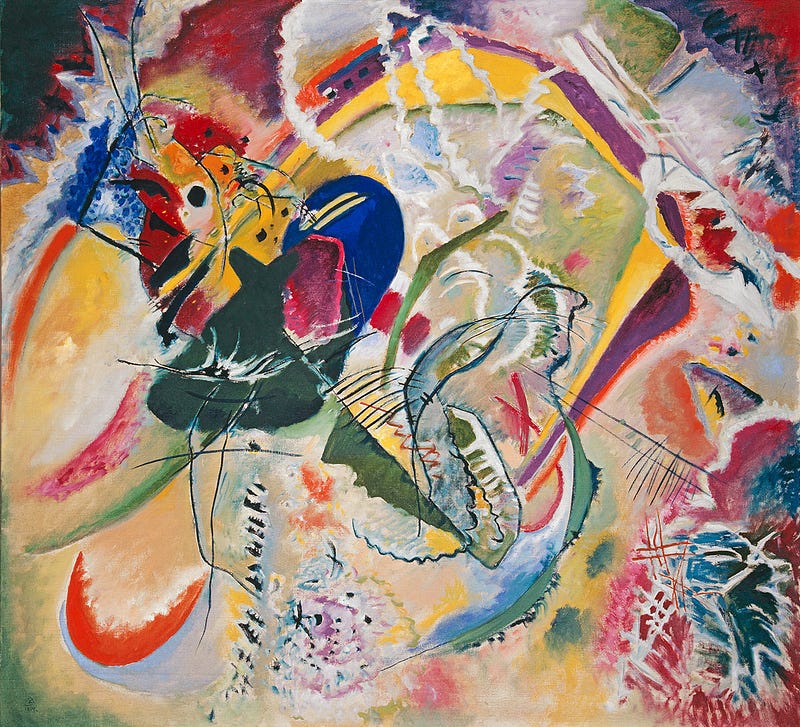
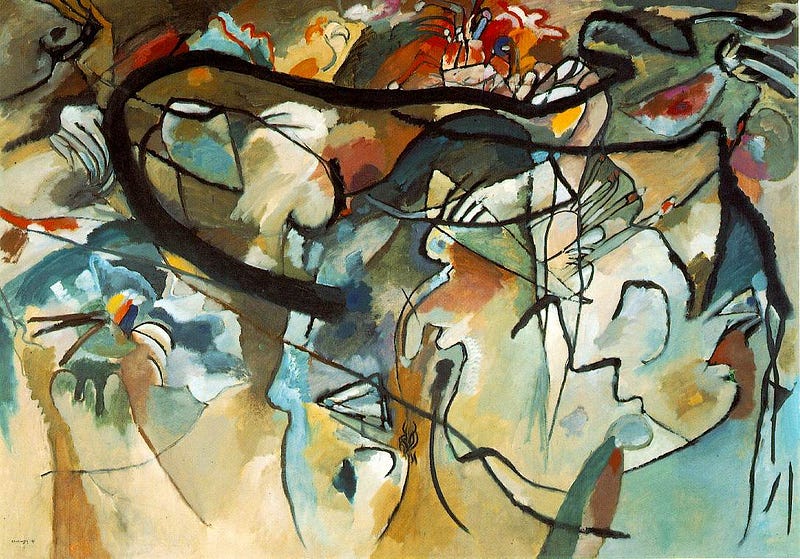
This painting Improvisation 35, was made by the Russian artist Wassily Kandinsky in 1914. It was part of a long series of paintings in which he used intuition as his guiding principle.
He described his process as “a largely unconscious, spontaneous expression of inner character, non-material nature.”
The composition is a bursting riot of colour. Forms rush, oscillate, tremble, collide, staccato, float, recede, stretch out, open, and even dance with a freshness of energy. There are no barriers here, no repetition, just the interplay of free colour and form.
As for its meaning, trying to “read” a painting like this can make it seem inscrutable. Instead, you have to find your way by feeling.
What makes this “non-material” image particularly fascinating — along with the era of art history it dates from — is the preoccupation shared by Kandinsky along with many other artists about the true essence of reality and the extent to which modern science could authentically describe it.
For Kandinsky, it was harnessing the intuitive potential of human creativity that held the key. And perhaps more than any other painter of the time, he felt the need to develop a complete theoretical system to explain why.
Altered States
Like many of Kandinsky’s paintings from around this time, Improvisation 35 seeks to reveal itself from within, seeming to suggest altered states, dreams and half-forgotten memories. The colour palette is intentionally intense and musical — you might say symphonic.
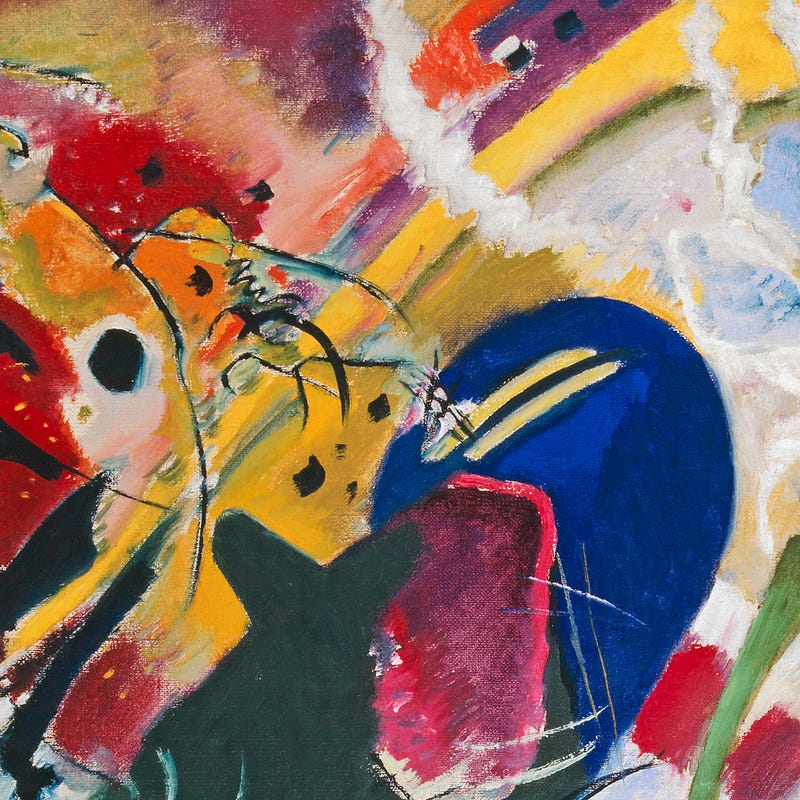
In his writings, he associated yellow tones of paint with warmth and blue tones with coolness, positing that yellows appear to advance towards the observer, radiating outward from the canvas, while blues seem to retreat, diminishing into the picture and their own infinite depth.
For Kandinsky, Blue was a heavenly colour, whilst yellow was the colour of the earth.
It is perhaps easier to reflect on a painting like this if we remember that Kandinsky stated that he experienced colours not so much in their physical appearance but rather as forms of energy.
“Colour directly influences the soul,” he wrote in his text Concerning the Spiritual in Art (1911).
He also associated different colours with dynamic emotional states, perhaps akin to the timbre of a musical note, i.e. as brassy, soft, piercing or smooth.
The term synesthesia is appropriate: when a person hears colours or tastes shapes. Kandinsky was fascinated by the topic, noting the case of a doctor in Dresden who reported that one of his patients always saw the colour blue when eating a certain sauce.
The phenomenon of different senses overlapping has intrigued thinkers throughout history, with mention in ancient Greek philosophy, the works of 17th-century physicist Isaac Newton, and the 19th-century Symbolist poetry of Charles Baudelaire.
Kandinsky saw the experience of sensory crossover as less a psychological trait and more a universal truth, writing:
“The sound of colours is so definite that it would be hard to find anyone who would express bright yellow with bass notes or dark lake [a deep blue colour] with treble.”
Spiritual Penetration
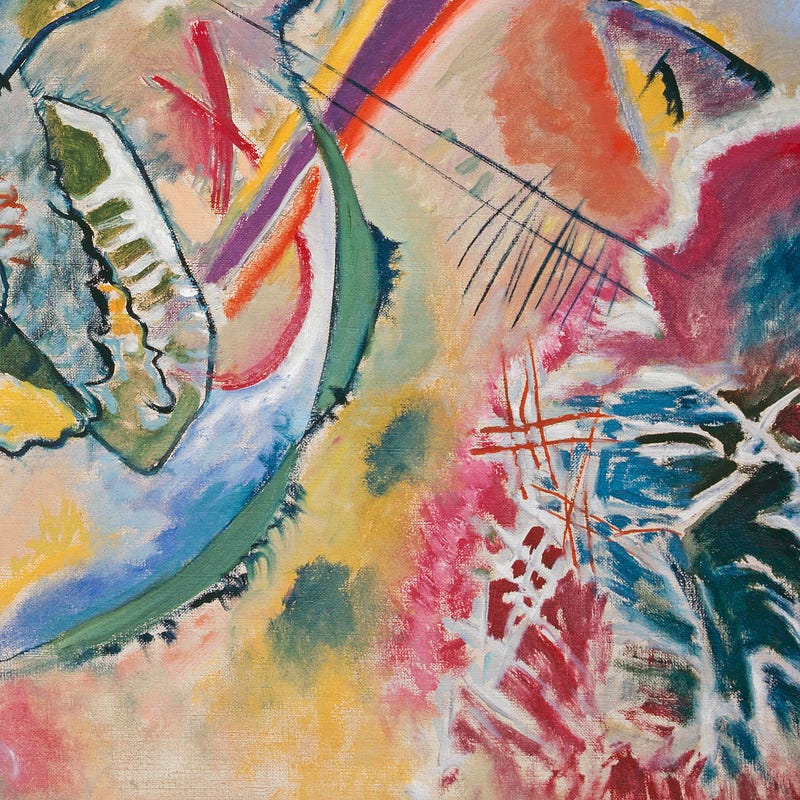
The thought that colours, music and emotions might share a common, deeper reality fitted with Kandinsky’s worldview that saw the material world as merely a set of surface appearances.
The power of art, as he saw it, lay in its ability to peel back the outer skin.
Painting could be a portal into this other world, a suggestive and lyrical initiator of the spiritual inclination that lies within all of humankind. Colour especially could instigate a spiritual penetration into the unified whole that lay beneath:
“Colour is the keyboard, the eyes are the hammers, the soul is the piano with many strings. The artist is the hand that plays, touching one key or another purposively, to cause vibrations in the soul.”
The Artist’s Influences
Kandinsky’s background informed many of his artistic choices. He was born in Russia in 1866, surrounded by Russian folklore and Orthodox traditions. Then, during a touring exhibition in St. Petersburg in 1896, he saw one of Monet’s “Haystacks” paintings.
It was a decisive moment for the Russian: with its coarse brush marks and emphasis on colour harmonies, Kandinsky saw what painting might become.
So at the age of 30, he moved to Munich in Germany and committed himself to becoming an artist — after a successful career as a lawyer.
Another early influence was the art of Henri Matisse and the group of artists known as Les Fauves (translated as “Wild Beasts”), whose members also included André Derain and Maurice de Vlaminck. Working in brief conjunction around 1904–07, these expressionistic painters found artistic liberation in the experimental use of pure colour and improvised perspective.
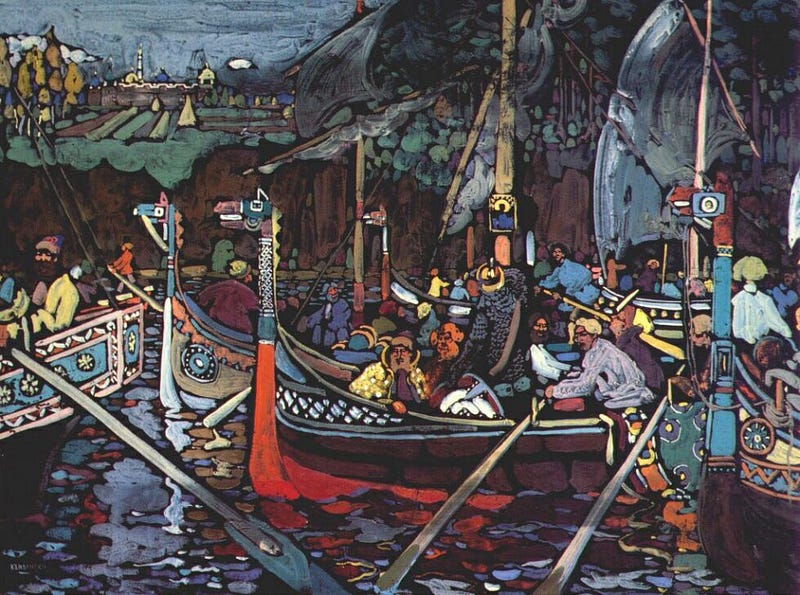
These influences would push Kandinsky at first towards a “naive” style of painting that represented old folk stories, like the painting Volga Song (1906) above.
Yet it would take several other influences to bring Kandinsky to full abstraction. When in Paris, he encountered the philosophies of Henri Bergson. Bergson had found great fame after the publication of his fourth book, Creative Evolution (1907) in which he emphasised creativity and freedom, and the essential role of intuition in understanding true reality.
And in Munich, he attended the lectures of the Austrian reformist and occultist Rudolf Steiner, a prominent advocate of Theosophy.
Kandinsky undoubtedly responded to Theosophy’s combination of Eastern and Western spirituality and its discourse on the interconnectedness of all life. As a movement, it posited a hidden, universal wisdom underlying all religious and philosophical traditions, and it sought to uncover and share that wisdom with the world.
Total Artwork
Spurred on by these philosophies of the immaterial, Kandinsky’s art took a critical turn into abstraction — a deliberate refutation of society’s emphasis on material progress and scientific advancement. He discovered a different means of expression: from this point on, it was the inner spiritual life that mattered.
In the lightness of the brushstrokes and the ephemerality of Improvisation 35, Kandinsky was aiming at an image that might stimulate the spirit of the viewer. He deliberately avoided concrete forms, anything that might suggest the permanence of something like a landscape or a man-made structure. Nothing is rooted. There’s no ground to be fixed to.
For Kandinsky his work was, “The expression of mystery by means of mystery […] Is that not the conscious or unconscious purpose of the compulsive urge to create? […] this is the language of art.”
Improvisation 35 became one of the last free-form improvisations he made. With the advent of the First World War, Kandinsky’s series seemed to arrive at a denouement.
From this point, the fluidity and liberal invention of those crucial pre-war years would evolve into more deliberate geometrical shapes and graphical clarity. Kandinsky returned to Russia, and then spent a productive decade back in Germany teaching at the Bauhaus.
What didn’t end was his desire for a union of all the arts, nor his promotion of the ideal artwork, captured in the notion of a Gesamtkunstwerk (“total artwork”) that he admired so much in the music and staging of Richard Wagner’s operas.
As Kandinsky taught, all artists — be they painters, composers or writers — were disposed towards the same aspiration, to penetrate beneath the surface of appearances and juxtapose the intuitive powers of creativity with the deeper mysteries of reality.

My most recent book is Great Paintings That Tell Stories, an exploration of some of the most iconic artworks in history.
Would you like to get…
A free guide to the Essential Styles in Western Art History, plus updates and exclusive news about me and my writing? Download for free here.
Join me…
On Instagram for more great paintings on the go!