Why These Six Red Dots Are a Big Problem For Physics
Together they may be powerful enough to break the universe
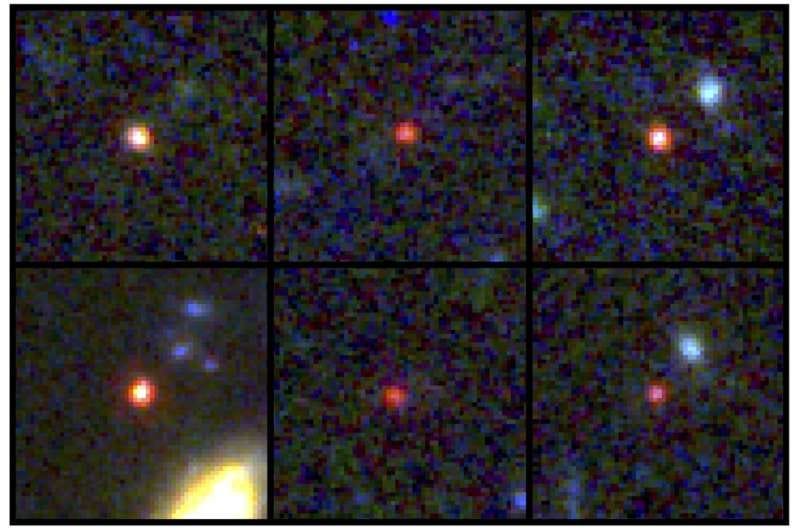
They don’t, if we’re honest, look like anything much at all. Each is no more than a dot, glowing red against a noisy black background. At first glance, indeed, your eye would probably skip right over them, drawn instead to brighter, more impressive splashes of light.
Yet these six dots, captured in one of the deepest views ever observed by the James Webb Space Telescope, are remarkable. For one thing, astronomers believe they are galaxies seen six hundred million years after the Big Bang, making them some of the oldest objects ever sighted. For another, they appear to be extraordinarily large: far larger than our understanding of physics should allow.
That last point could have deep implications for astronomy. If the dots turn out to be as large as they look, then they threaten to blow a gaping hole in cosmological theory; forcing us to rethink the story of how the modern universe came to be. In doing so, they could change the way we think of dark matter and dark energy, of the big bang and the early universe, and ultimately open the door to a radically new understanding of the cosmos. No wonder one of the researchers that found the dots labelled them “universe breakers”.
This, of course, is a big ask; especially of six faint dots seen in a photograph. Yet these dots also represent our first view of an era that had previously been confined to modelling and simulation. Telescopes, until the James Webb come along, had found it impossible to peer back so far, leaving the period when the first galaxies came together shrouded in darkness.
Astronomers attempted to fill that darkness with models, especially with one known as Lambda-CDM. This model, when input into a computer and correctly configured, can simulate the evolution of the universe from the Big Bang until the modern day (or, if you like, well into the future). It has proven remarkably successful, creating simulated universes that look fairly similar to one we actually live in.
That had given astronomers a great deal of faith in it, especially as it predicted amounts of dark matter and dark energy that seemed in agreement with other observations. Yet it also predicts how the cosmos should have looked early on, when the first galaxies came together. Importantly, it places limits on how fast those galaxies should have grown.
These six dots, however, appear to show galaxies far larger than Lambda-CDM allows. Either the model is wrong, therefore, or these dots are not what they appear to be. Both options are possible, of course, but for now the focus is on the latter. The observations are early, based on limited data. They may be mistaken. They may, indeed, not even be galaxies at all.
To find out more, astronomers will need more data. The James Webb is sure to spend more time examining each of these six dots in detail. Researchers are especially keen to measure the spectra of light coming from them; data that should show what they are made of. That should help settle the question of what they are and how old they are.
Should they turn out to be as old and as big as they appear, then Lambda-CDM is in trouble. With it, so too is our understanding of how the modern universe came to be. The James Webb is already shaking modern cosmology. A few more red dots may be enough to overthrow it completely.