avatarChristopher P Jones

Free AI web copilot to create summaries, insights and extended knowledge, download it at here

3807

Abstract

esize:fit:800/1*efTSToPS8g_h8Hez-6lfgA.jpeg"><figcaption>Detail of ‘<i>Mary and Child Surrounded by Seraphim and Cherubim’, part of the </i>Melun Diptych (1452–1458) by Jean Fouquet. Oil on panel. 94.5 × 85.5 cm. Royal Museum of Fine Arts Antwerp, Belgium. Image source <a href="https://en.wikipedia.org/wiki/File:Fouquet_Madonna.jpg">Wikimedia Commons</a></figcaption></figure><p id="a069">Meanwhile, the Christ Child points to his mother’s womb, which is further emphasised by the role of the fabric that wraps around her waist and the ornate belt that extends from it. The satin sheen of the material also accentuates a sort of treasure within.</p><p id="52f9">So what’s going on here?</p><h1 id="8265">Resemblances</h1><p id="3c63">To better understand the painting, it’s helpful to remember that devotional images of Mary breastfeeding, known as <i>Madonna Lactans</i> or <i>Virgo Lactans</i>, had been around since the Middle Ages. Through the 15th century, they grew in popularity whilst Mary as the ideal mother figure gained devotional momentum.</p><figure id="f28c"><img src="https://cdn-images-1.readmedium.com/v2/resize:fit:800/1*5EpFMcxBwCyu0zjivyi9sw.jpeg"><figcaption><i>Mary and Child Surrounded by Seraphim and Cherubim, part of the </i>Melun Diptych (1452–1458) by Jean Fouquet. Oil on panel. 94.5 × 85.5 cm. Royal Museum of Fine Arts Antwerp, Belgium. Image source <a href="https://en.wikipedia.org/wiki/File:Fouquet_Madonna.jpg">Wikimedia Commons</a></figcaption></figure><p id="53c5">Indeed, poems and songs also paid tribute to Mary’s breasts, which linked the act of breastfeeding to a sign of good mothering and nurturing.</p><p id="17c0">This can perhaps explain why the breast is so ample and — so to speak — architecturally perfect.</p><p id="6ee7">The broader painting begins to raise eyebrows if we also consider that the features of the Virgin are thought to resemble a mistress of King Charles VII of France — in whose court the artist Fouquet worked.</p><p id="0010">Her name was Agnès Sorel and as the king’s favourite, she gave birth to three of his children, all of them girls. At court, she is said to have generated scandal through her fashion, which included uncommonly low-cut dresses.</p><p id="d8e9">The circumstances of her death are disputed, with some suggestion that she died of mercury poisoning shortly after giving birth to another of the king’s offspring — perhaps at the hands of a rival.</p><p id="d6d1">Despite being a controversial figure, could this painting really be a portrait of the king’s mistress in the guise of the Virgin Mary?</p><h1 id="e2ab">Blasphemous?</h1><p id="3a65">If this audacity might strike you as a touch sacrilegious, then you wouldn’t be alone.</p><p id="20bf">The Dutch historian Johan Huizinga, wrote about the painting in 1919, making the judgement that “There is a flavour of blasphemous boldness about the whole.”</p><p id="1aa1">An explanation for the peculiar style of this painting may also come from the fact that the artist behind the work absorbed several different artistic traditions in the image.</p><p id="ab71">The artist Jean Fouquet was born in Tours in the Loire Valley, around 1420. He trained in Paris as a manuscript illuminator and a miniaturist before setting off for Italy where he immersed himself in the images from the Italian Renaissance.</p><p id="ad60">It’s possible to see influences from both Northern and Southern European painting in this work. From the Flemish tradition, he incorporated the intricate folds of fabric and detailed textures, reflections and glossy surfaces. Meanwhile, the way the Virgin is shown from her knees upwards, with somewhat perfected features, was very much part of the Italian tradition.</p><h1 id="f873">More to the Story</h1><p id="04b9">The <i>Mary and Child</i

Options

painting was actually made as part of a pair. Designed as the right-hand panel of a diptych, it was originally painted to sit alongside a double portrait showing the painting’s commissioning patron.</p><figure id="14ba"><img src="https://cdn-images-1.readmedium.com/v2/resize:fit:800/1*YQ8XdbAY4hIljbV0x-LUsw.jpeg"><figcaption></figcaption></figure><figure id="7498"><img src="https://cdn-images-1.readmedium.com/v2/resize:fit:800/1*5EpFMcxBwCyu0zjivyi9sw.jpeg"><figcaption>Left and right panels of the Melun Diptych (1452–1458) by Jean Fouquet. Left: Étienne Chevalier and Saint Stephen. Oil on panel. 95.9 × 85 cm. Gemäldegalerie, Berlin, Germany. Image source <a href="https://commons.wikimedia.org/wiki/File:Jean_Fouquet_006.jpg">Wikimedia Commons</a> Right: <i>Mary and Child Surrounded by Seraphim and Cherubim. </i>Oil on panel. 94.5 × 85.5 cm. Royal Museum of Fine Arts Antwerp, Belgium. Image source <a href="https://en.wikipedia.org/wiki/File:Fouquet_Madonna.jpg">Wikimedia Commons</a></figcaption></figure><p id="f219">This partner painting shows two figures: the kneeling man in red is Étienne Chevalier, the treasurer to King Charles VII, and also the executor of Agnès Sorel’s will. In other words, a man closely connected with both the king and his mistress. Beside him is his patron saint, St. Stephen. He has his hand around Chevalier’s shoulder, while in his left hand he holds a holy book and piece of rock — a reference to his martyrdom by stoning.</p><p id="56c3">The two men’s worship towards the Madonna and Child is clear. Chevalier is thought to have commissioned the diptych, ostensibly to commemorate his own wife, Catherine Budé, who died in 1452. The painting’s construction is thought to have begun in the year that Chevalier lost his wife and it was over her tomb that the diptych was hung in Notre Dame, Melun, for the next 300 years.</p><p id="4055">Yet long-standing tradition and visual evidence tell us that the puzzling Madonna painting wasn’t modelled on Budé. Historians have concluded that it was Agnès Sorel who was commemorated.</p><p id="b1a3">Sorel, the king’s favourite, died in 1450 and this work is thought to be a tribute to her, painted in the guise of the Virgin Mary and given her place on the throne that she would never occupy in real life, along with the son she would never provide.</p><p id="4db3">Dressed as an opulent 15th-century monarch, with pale skin fashionable for the era — noblewomen often wore white make-up made of white lead and vinegar — the “disguised portrait” should be read as a homage to Sorel’s power and influence. By blending her features with those of the Virgin Mary, the portrait also makes a claim on Sorel’s religious virtue.</p><p id="06e1">As such, this is a complex image that works on many levels, expressing Chevalier’s devotion not only to the Virgin Mary, but also to Sorel’s memory — and hence to her coterie at court and, most importantly, to the king himself.</p><figure id="8281"><img src="https://cdn-images-1.readmedium.com/v2/resize:fit:800/1*igQbKCOI4qGLg6JzYP7H9w.png"><figcaption></figcaption></figure><p id="7c83">If you liked this, you may also be interested in my book <a href="https://www.chrisjoneswrites.co.uk/great-paintings-explained/"><i>Great Paintings Explained</i></a>, which delves into the stories of some of the most compelling paintings in art.</p><h1 id="e394">Would you like to get…</h1><p id="d810">A free guide to the <i>Essential Styles in Western Art History</i>, plus updates and exclusive news about me and my writing? <a href="https://www.chrisjoneswrites.co.uk/sign-up-art/">Download for free here</a>.</p><h1 id="4cd3">Join me…</h1><p id="9f4c">On <a href="https://www.instagram.com/greatpaintingsexplained/">Instagram</a> for more great paintings on the go!</p></article></body>

Why There’s More to this Extraordinary Painting Than Meets the Eye

A bizarre painting explained
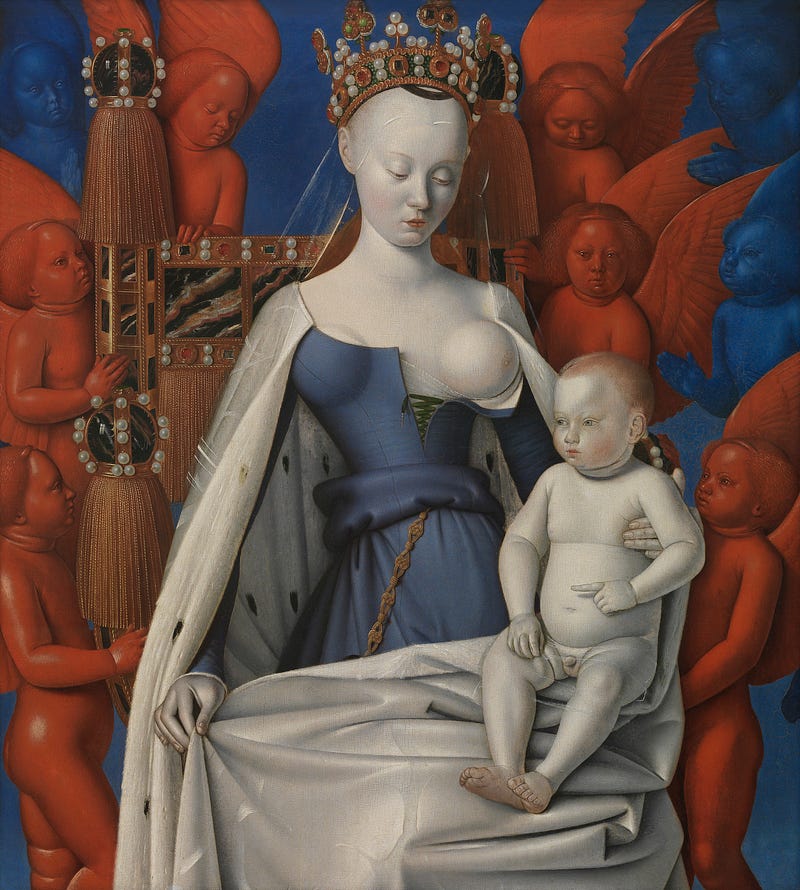
Mary and Child Surrounded by Seraphim and Cherubim, part of the Melun Diptych (1452-1458) by Jean Fouquet. Oil on panel. 94.5 × 85.5 cm. Royal Museum of Fine Arts Antwerp, Belgium. Image source Wikimedia Commons

It can take a few moments of looking to fully acclimatise to this striking image.

Made by the French artist Jean Fouquet in about 1458, it shows an enthroned Madonna holding the baby Christ on her lap.

The Virgin Mary’s appearance is particularly puzzling, being so pale, sleek and otherworldly, as if carved from stone. Her artificially rotund nursing breast is also hard to ignore.

Historians have long deliberated over how to “read” this unusual painting, which is more or less unique in the history of art — and their conclusions are surprising.

Regal Mary

The Virgin’s face is grey-white and streamlined, with finely plucked eyebrows and barely a hairline to speak of. She wears a cloak lined with ermine fur and a jewelled crown on her head — as opposed to the more familiar halo. In other words, Mary is dressed like a queen.

In the history of art, depictions of Mary tend to sit between two extremes.

In late-medieval devotional paintings, the “Madonna of Humility” became popular, with Mary shown seated humbly on the ground or on a low cushion. (If you’re wondering why we call Mary “Madonna” then you might be interested to learn that it comes from the Italian ma donna or “my lady”.)

Alternatively, from as early as the 11th century, a tradition emerged with the Madonna on a gilded throne known as the “throne of wisdom” (sedes sapientiae).

As time passed, the veneration of Mary as the “Queen of Heaven” became more pronounced. Paintings in this tradition tended to be larger than the earlier devotional images. The effect was to turn Mary into a more aristocratic figure, an idealised regal queen on a grand scale, often surrounded by saints, perhaps even the result of a divine vision.
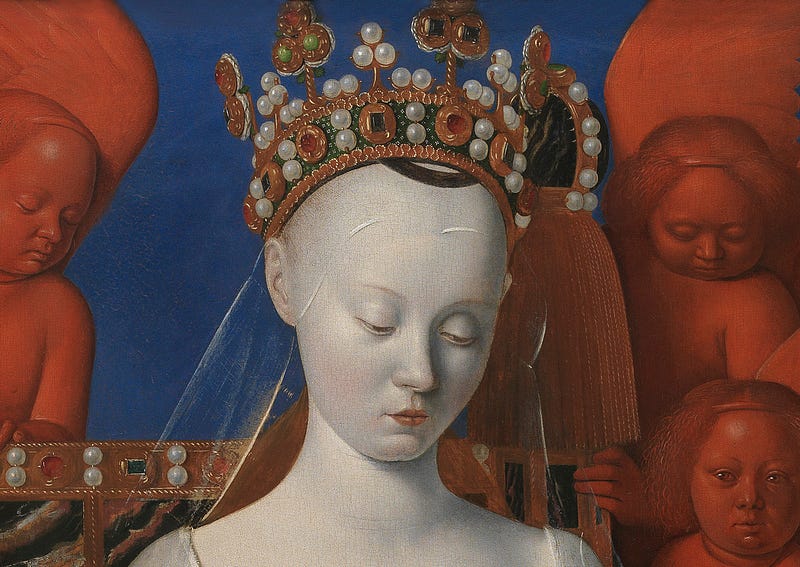
Detail of ‘Mary and Child Surrounded by Seraphim and Cherubim’, part of the Melun Diptych (1452–1458) by Jean Fouquet. Oil on panel. 94.5 × 85.5 cm. Royal Museum of Fine Arts Antwerp, Belgium. Image source Wikimedia Commons

This painting undoubtedly shows the Virgin Mary in full-blown monarchal splendour. She is sitting on a golden throne, with marble, pearl and gemstone inlays and a series of crown-topped decorative tassels.

To add to the uncommonly stylised manner, a series of red and blue cherubim and seraphim — cherubs and angels — cluster around the throne, each of them casting their gaze in different directions. Red and blue have for centuries been Mary’s colours: red was closely associated with royalty, whilst blue was the colour of heaven.

Mary herself has her eyes fixed on the Christ Child, typical of the theme. The unorthodox element of this painting is the slender, voguish figure of the Virgin, her uncommon fairness and the bulbous breast revealed from her thick-waisted dress.
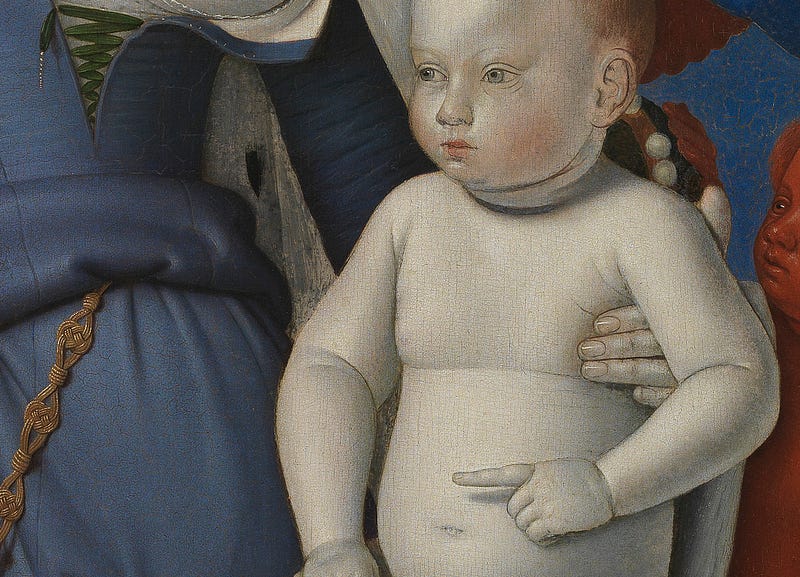
Detail of ‘Mary and Child Surrounded by Seraphim and Cherubim’, part of the Melun Diptych (1452–1458) by Jean Fouquet. Oil on panel. 94.5 × 85.5 cm. Royal Museum of Fine Arts Antwerp, Belgium. Image source Wikimedia Commons

Meanwhile, the Christ Child points to his mother’s womb, which is further emphasised by the role of the fabric that wraps around her waist and the ornate belt that extends from it. The satin sheen of the material also accentuates a sort of treasure within.

So what’s going on here?

Resemblances

To better understand the painting, it’s helpful to remember that devotional images of Mary breastfeeding, known as Madonna Lactans or Virgo Lactans, had been around since the Middle Ages. Through the 15th century, they grew in popularity whilst Mary as the ideal mother figure gained devotional momentum.

Mary and Child Surrounded by Seraphim and Cherubim, part of the Melun Diptych (1452–1458) by Jean Fouquet. Oil on panel. 94.5 × 85.5 cm. Royal Museum of Fine Arts Antwerp, Belgium. Image source Wikimedia Commons

Indeed, poems and songs also paid tribute to Mary’s breasts, which linked the act of breastfeeding to a sign of good mothering and nurturing.

This can perhaps explain why the breast is so ample and — so to speak — architecturally perfect.

The broader painting begins to raise eyebrows if we also consider that the features of the Virgin are thought to resemble a mistress of King Charles VII of France — in whose court the artist Fouquet worked.

Her name was Agnès Sorel and as the king’s favourite, she gave birth to three of his children, all of them girls. At court, she is said to have generated scandal through her fashion, which included uncommonly low-cut dresses.

The circumstances of her death are disputed, with some suggestion that she died of mercury poisoning shortly after giving birth to another of the king’s offspring — perhaps at the hands of a rival.

Despite being a controversial figure, could this painting really be a portrait of the king’s mistress in the guise of the Virgin Mary?

Blasphemous?

If this audacity might strike you as a touch sacrilegious, then you wouldn’t be alone.

The Dutch historian Johan Huizinga, wrote about the painting in 1919, making the judgement that “There is a flavour of blasphemous boldness about the whole.”

An explanation for the peculiar style of this painting may also come from the fact that the artist behind the work absorbed several different artistic traditions in the image.

The artist Jean Fouquet was born in Tours in the Loire Valley, around 1420. He trained in Paris as a manuscript illuminator and a miniaturist before setting off for Italy where he immersed himself in the images from the Italian Renaissance.

It’s possible to see influences from both Northern and Southern European painting in this work. From the Flemish tradition, he incorporated the intricate folds of fabric and detailed textures, reflections and glossy surfaces. Meanwhile, the way the Virgin is shown from her knees upwards, with somewhat perfected features, was very much part of the Italian tradition.

More to the Story

The Mary and Child painting was actually made as part of a pair. Designed as the right-hand panel of a diptych, it was originally painted to sit alongside a double portrait showing the painting’s commissioning patron.
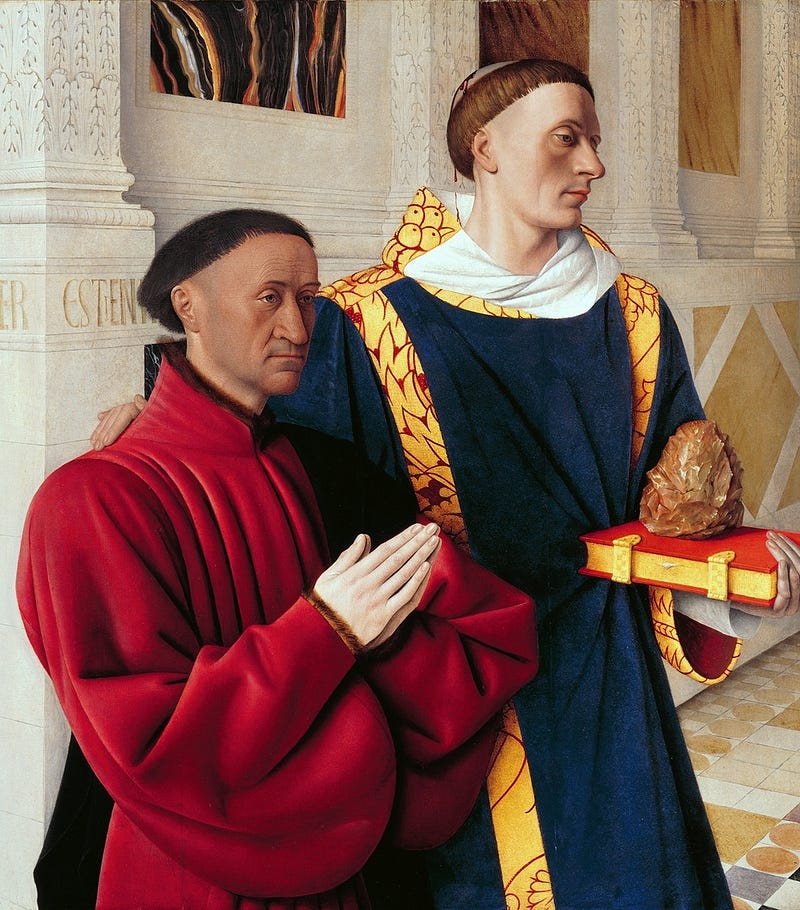
Left and right panels of the Melun Diptych (1452–1458) by Jean Fouquet. Left: Étienne Chevalier and Saint Stephen. Oil on panel. 95.9 × 85 cm. Gemäldegalerie, Berlin, Germany. Image source Wikimedia Commons Right: Mary and Child Surrounded by Seraphim and Cherubim. Oil on panel. 94.5 × 85.5 cm. Royal Museum of Fine Arts Antwerp, Belgium. Image source Wikimedia Commons

This partner painting shows two figures: the kneeling man in red is Étienne Chevalier, the treasurer to King Charles VII, and also the executor of Agnès Sorel’s will. In other words, a man closely connected with both the king and his mistress. Beside him is his patron saint, St. Stephen. He has his hand around Chevalier’s shoulder, while in his left hand he holds a holy book and piece of rock — a reference to his martyrdom by stoning.

The two men’s worship towards the Madonna and Child is clear. Chevalier is thought to have commissioned the diptych, ostensibly to commemorate his own wife, Catherine Budé, who died in 1452. The painting’s construction is thought to have begun in the year that Chevalier lost his wife and it was over her tomb that the diptych was hung in Notre Dame, Melun, for the next 300 years.

Yet long-standing tradition and visual evidence tell us that the puzzling Madonna painting wasn’t modelled on Budé. Historians have concluded that it was Agnès Sorel who was commemorated.

Sorel, the king’s favourite, died in 1450 and this work is thought to be a tribute to her, painted in the guise of the Virgin Mary and given her place on the throne that she would never occupy in real life, along with the son she would never provide.

Dressed as an opulent 15th-century monarch, with pale skin fashionable for the era — noblewomen often wore white make-up made of white lead and vinegar — the “disguised portrait” should be read as a homage to Sorel’s power and influence. By blending her features with those of the Virgin Mary, the portrait also makes a claim on Sorel’s religious virtue.

As such, this is a complex image that works on many levels, expressing Chevalier’s devotion not only to the Virgin Mary, but also to Sorel’s memory — and hence to her coterie at court and, most importantly, to the king himself.

If you liked this, you may also be interested in my book Great Paintings Explained, which delves into the stories of some of the most compelling paintings in art.

Would you like to get…

A free guide to the Essential Styles in Western Art History, plus updates and exclusive news about me and my writing? Download for free here.

Join me…

On Instagram for more great paintings on the go!

Art
Art History
History
Inspiration
Culture
Recommended from ReadMedium