
Why Theism and Atheism are both Laughable
Who said a mammal gets to understand everything?
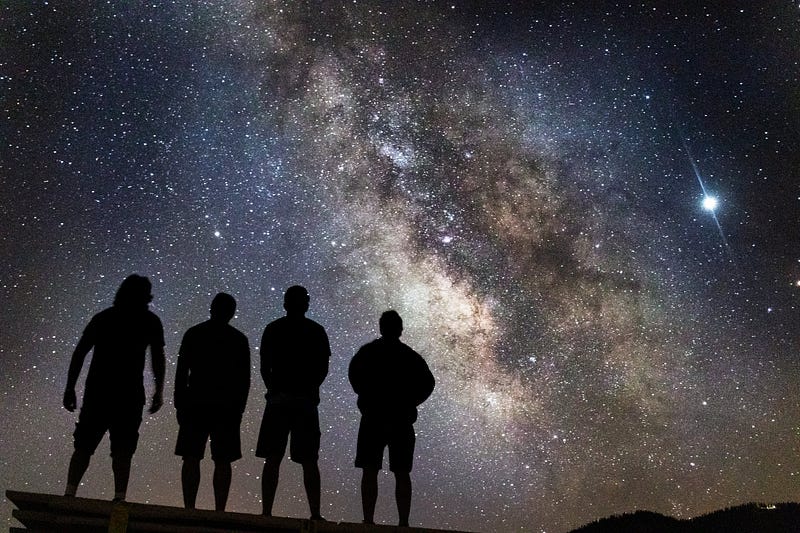
A modest proposal for religious and secular folks feeling trapped within their tribal identities: if theism is the belief that someone created the universe and atheism is the implication that something but not someone did so, consider that both explanations are preposterous.
Theism is Ludicrous
Theism isn’t just mistaken, but ludicrous. That wasn’t always the case, since theism used to make sense when the universe seemed to extend no farther than our solar system and when everything apparently revolved around our planet at the very time our species happened to dominate it. Of course, that was most of the time when we were around to gather what evidence we could before the spectacular advances in science and technology in just the last few centuries. For thousands of years, the going intuition was that people are crucial to everything else that exists.
Moreover, we knew that we create things such as our tools, clothes, and houses. No stretch of imagination was needed to infer that everything we’re aware of must also have been created by something similar to us, namely by someone rather than by a thing, strictly speaking. The correctness of theism used to be obvious and by running against that intuition or by denying the validity of the local gods, atheism seemed farfetched.
How matters have changed! Astronomers discovered that the universe of matter and energy is far, far larger and older literally than the human brain is capable of intuiting, and Darwinian biologists showed how organic designs evolve mindlessly from the interaction between genes and harsh environments. Any life-centric cosmology or theory of everything that lingers after those two revelations must be handed the dunce cap that used to belong to atheism.
True, an omnipotent person would have the power to create something larger and older than we can comprehend. But the point isn’t that theism is conceptually impossible or empirically disproven. No, what I’m saying is that the belief that a person could be fundamental to everything we now know exists is absurd in the sense of being grossly counterintuitive. That’s because what’s common today is the flood of scientific explanations which show how complex forms arise from simpler ones. The notion that God would create the world just for us to lord over it is likewise laughable once we discover how old the planet is and how random and thus seemingly natural is its position in the universe.
Theism is anachronistic and not in a cool way like a retro subculture. Fashion, movies, and music can go in and out of style, because their value is mostly up to us. If we were only playing a game or telling a fictional story, then of course we could entertain the belief that one person or a team of individuals created everything that scientists explain as being natural. But if we mean to be taken seriously as offering an earnest, sane, rational, and informed statement about the ultimate fact of the matter, and we say in 2019 that “God created the universe,” we have in point of fact disgraced ourselves.
Atheism is Preposterous
Alas, the opposing viewpoint is equally preposterous. To show how that’s so, we need to translate atheism into its positive form. Technically, “atheism” means only the denial of theism. But assuming someone isn’t responsible for creating all of nature and we intend to supersede theism with an alternative, nontheistic cosmology and all-encompassing philosophy, rather than withholding our belief on such ultimate questions in the agnostic manner, we’re led to say, at a minimum, that something rather than someone is the ultimate cause of everything else.
Moreover, to avoid offering only a vacuous explanation, the elementary thing in question must be scientifically or at least rationally posited. We can’t just dream up an arbitrary X and assign it all the powers needed to create the rest of the universe, minus the power of being a deity, since that wouldn’t result in a genuine explanation with any advantage over theism.
Thus, some contenders for the atheist’s ultimate foundation are the strings of string theory or the quantum vacuum or the Big Bang singularity. However, as soon as the scientist or secular philosopher posits some such First Cause, ensuring that the element is natural and rationally understood, we have a problem. That element can’t account for itself, which is to say the secularist will presuppose some conditions or prior entities or regularities that would have to be rationally accounted for, and so the ultimate explanation will be pushed back further and further.
The rational investigator thus tends to falsify the appeal to any one natural thing as the ultimate element. The notion of a first natural thing is oxymoronic. So the atheistic alternative to a theistic theory of everything presupposes there’s no complete ultimate explanation, after all, but only an infinite series of limited causes and effects, each of which can be modeled and given a limited explanation.
The reason for this is that the atheist who hopes to have an advantage over theism is committed to methodological naturalism, to the view that we ought to assume that everything we encounter is natural and capable of being rationally explained. And here we arrive at the source of the atheist’s problem: that methodical commitment or secular faith in reason works by objectifying and thus limiting the thing we’re trying to explain.
A classic example of this is the mathematician Georg Cantor’s analysis of the concept of infinity. You might have thought infinity is necessarily unlimited, but it turns out, after rational investigation, that there are orders of infinity: higher infinities contain lower ones, which means we can think of infinity as comparable to a finite thing after all.
How, then, is atheism preposterous? Well, if the atheist is committed to offering an ultimate, complete explanation of how the universe came to be, she’ll undermine that explanation by seeing to its rationality. In short, she deprives herself of a final answer. But if atheism is supposed to differ from agnosticism, the atheist can’t just maintain that we can never know what likely created the universe, given that a god didn’t do so. Sure, the atheist can say we’re currently in the dark about such a far-flung question, but she can’t affirm that in principle we can never know how all things came to be.
Atheism as a rival to theism is preposterous, therefore, because the atheist’s naturalistic alternative to theism is likewise at odds with our intuitions. We want to know what the ultimate reason is for the universe’s coming to be, and by its nature, the best nontheistic explanation can point only to an infinite series of particular things, none of which explains everything, including why the series should be infinite. Should the atheist land on one of those particulars and insist, on the contrary, that it accounts for absolutely everything, she too will have disgraced herself.
This is what happened to the physicist Lawrence Krauss who argued in A Universe from Nothing, that the quantum vacuum, in which particles fluctuate into and out of existence as a result of Heisenberg’s Uncertainty Principle, counts as the proverbial nothing that ultimately gave rise to everything.
David Albert in a New York Times review pointed out that Krauss presupposed the various rational paraphernalia he needed to show the naturalness of the quantum vacuum, including, for example, the tools, as it were, of the laws of quantum field theory. The fluctuating vacuum isn’t absolute nothingness in the philosophical sense, but a natural thing that calls for a rational explanation in turn. Why is there a quantum vacuum? Why one kind of vacuum rather than some other kind we can imagine? As an atheistic explanation of everything, Krauss’s was absurd in that its scientific rationality undercut its finality, as any such explanation would have to do.
So Krauss showed us inadvertently that the series of physical particulars must extend beyond the vacuum of quantum fluctuations, because the methodological naturalist insists on the naturalness of whatever she encounters, which means her work will never be complete, contrary to our intuition that the explanations should come to a nonarbitrary end.
A Call for Humility
What lesson should we draw from this shared counterintuitiveness? We should transcend theism and atheism and adopt something closer to the agnostic’s position. Of course we should deny that a deity created nature, since theism is ludicrous in 2019. We should also be skeptical of the alleged finality or completeness of any rational explanation of the universe.
This isn’t to say we should arbitrarily give up on ultimate explanations. Instead, we should come to terms with the prior preposterousness of the conceit that we navel-gazing mammals are entitled to understand everything that occurs in the 100 billion galaxies in all of space and time.
Reason evolved to enable us to survive long enough to reproduce on the African savanna, not to fathom and to humanize the inhuman vastness of the cosmos. Clearly, we’ve exapted reason for scientific purposes, extending the reach of rational procedures to make sense of much that lies far beyond the initial, Paleolithic subjects of our inquiries. But no scientific explanation should be considered a mirror that captures the essence of what’s explained. Science is more pragmatic than that. We explain things to make use of them, which means some of the criteria for judging the truth of a scientific model require that the model be useful to the scientific enterprise. For example, the model should be fruitful, conservative rather than radical, and have broad scope. Thus, even scientific reason hasn’t lost its evolutionary practicality.
What’s ridiculous, then, isn’t just the human-centered or incoherent content of our ultimate explanations, but our audacity in proposing them in the first place. It’s not as though the humility needed to doubt theism and atheistic naturalism should be hard to come by, since we ought to be terrified as soon as we recognize that our true role in the world can’t be anything like our self-serving intuitions suggest. We ought to be humbled by the realization that perhaps the most we can say by way of offering an ultimate account is that we’re human creatures thrown up in the beginning by something inhuman.


