
Why The Yen is Losing Value
Earning a salary denominated in yen is getting increasingly painful. Here’s my analysis of the causes, and potential outcomes.
For most of the last decade, the yen has hovered around 105 to 110 yen to the dollar, but in just two months, the yen has lost almost 20% of its value against the dollar, and shows no signs of stopping. Meanwhile, the Bank of Japan has doubled down on its commitment to cap interest rates, implying that the yen may have much farther to fall as U.S. interest rates continue to rise in comparison.
What Interest Rates Have To Do With Exchange Rates
The strength of a currency depends on many factors, but chief among them are interest rates, and inflation rates. Trade balances also play an important role, but I’d like to focus on the first two for now.
Assuming similar rates of inflation, savers and investors will generally park their money in the currency that offers the highest interest rate. For large financial institutions, and wealthy investors, this typically means holding government bonds. Therefore, when the United States is offering upwards of 3.2% interest on 10 year bonds, compared to Japan’s offering of less than 0.25%, money flows out of Japanese yen and into U.S. Dollars.
In a free market, rates rise and fall naturally depending on the supply and demand of credit, and the credit worthiness of the lenders and borrowers — the primary borrowers in this case, being the United States Government, and the Japanese Government, respectively.
Unfortunately, Governments aren’t very keen on allowing rates to find a natural equilibrium, because it’s always in their near-term advantage to manipulate them, especially to the down side. So, that’s precisely what they do. I mean, just imagine if you could manipulate the interest rate on your credit card debt! How about 0% interest? Better yet, how about negative rates? For the borrower, this is a great thing indeed. And, this is exactly what most of the developed world has been doing for the last decade, enabling governments to borrow and spend far beyond their means and stimulate their economies, albeit at the expense of savers and salaried workers.
Governments manipulate interest rates by manipulating the supply and demand of government bonds in the open market. You see, interest rates rise when there are not enough buyers for government debt, and fall when there are too many buyers. So, to artificially keep rates low, governments work in tandem with their respective central banks, having the central bank buy as many government bonds as are necessary to keep a cap on yields — replacing the demand that would normally be there (or be absent, in the case of yields that are too low) from individual investors, and financial institutions.
If you want to understand exchange rates, you must pay attention to bond markets, and interest rates.
The Japanese Bond Market Is In Chaos
Which brings us to the Japanese bond market. A quick look at a chart of the 10 Year Japanese Treasury Bond says it all:
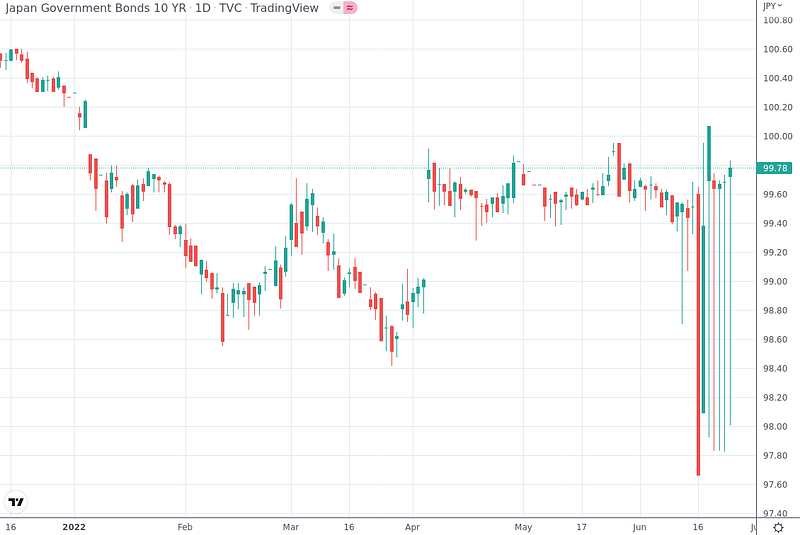
The extremely long wicks on the candles from the 16th of June onward indicate extreme volatility — massive selling by bond holders, and massive buying by the Bank of Japan to keep rates from rising.
This is a clear sign that the market wants to take rates higher to compensate for rising inflation, and the opportunity cost associated with holding yen. So long as the status quo holds — Japan insisting on capping rates in the face of inflation, whilst the rest of the world raises rates — the relative strength of the yen will continue to decline. At this rate, exchange rates of 150 yen to the dollar, or even higher, are seemingly inevitable.
Relative Inflation Rates and Real Yields
The astute reader will quickly note one oddity here, and that is real rates: The current inflation rate in Japan is 2.5%, meaning Japanese Government Bonds yield a -2.25% real return adjusted for inflation, whereas the current inflation rate in the U.S. is much higher at 8.6% as of May of 2022, with the 10 year treasury yielding only 3.2%, for a much lower -5.4% real return. From this perspective, the yen should actually be strengthening in relation to the U.S. Dollar, but it appears that either the market believes inflation will be higher, or currently is higher, than the reported 2.5% in Japan, or it simply doesn’t care about price increases in the domestic U.S. market— only the value of the U.S. Dollar in international transactions, and the nominal yield associated with it.
Possible Resolutions
Given the circumstances, these are the possible scenarios, in rough order of probability, that I see as likely playing out for the yen:
- We enter a deflationary global recession, which brings interest rates down in the U.S. and tightens the spread between Japanese Government Bonds and U.S. Treasuries, and bringing exchange rates back down in favor of the yen.
- We continue to see stagflation, possibly including a stagflationary recession, in which rates cannot be lowered substantially, and the yen continues to lose value or retains its current level relative to the U.S. Dollar.
- The Bank of Japan abandons their aggressive yield curve control policy, yielding to the market and allowing rates to rise, restoring the exchange rate and strengthening the yen.
- The Bank of Japan doubles down on their aggressive yield curve control policy and intervenes in the Foreign Exchange Market by buying yen with their foreign cash reserves in a costly and ultimately vein attempt to strengthen the Yen. This kind of intervention is typically a desperate measure employed by countries on the brink of currency collapse. It’s extremely costly, and only temporary in effect, as a country can quickly eat through the entirety of its foreign exchange reserves with this sort of direct intervention, begetting no lasting effect and leaving its currency and financial position in an even weaker long-term state.
It is important to note that trade balances may improve due to a cheaper yen, which could act in favor of the yen, but a weaker currency can also hurt an economy like Japan which is equally dependent on imports — a recent case study on this point being that of Turkey and the Lira.
The situation for the yen may get much worse before it gets better, and it may be indicative of the Bank of Japan’s long-term desire to stoke inflation that they are happy to allow the yen to continue falling for some time. Whether rates revert to previous levels, or an exchange rate of 200 yen / dollar ultimately becomes the new norm in the decade to come, only time will tell. All we can do as earners and savers of Japanese yen is to diversify our earnings and savings, to the best of our ability — by investing in assets and income streams denominated in currencies other than the yen, or which do not derive their value from the yen.


