avatarComrade Morlock

Summary

The article argues that the white elite prefers to engage in discussions about race rather than class to maintain their wealth and power, as they stand to lose in a class war but could potentially "win" a race war due to demographic and wealth distribution disparities.

Abstract

The article "Why the White Elite Wants to Talk about Race instead of Class" presents a critical perspective on the motivations behind the white elite's focus on race issues over class issues. It suggests that rich white individuals are aware that they hold a significant advantage in a hypothetical race war due to their majority status and concentration of wealth. The author points out that even with the inclusion of Asian, Indigenous, and Hispanic Americans on the side of people of color, the wealth and power dynamics would still favor the white elite. In contrast, a class war would unite the poor and working class across racial lines against the wealthy, posing a real threat to the elite's status. Historical data and current wealth gap trends are cited to illustrate the growing economic inequality and the potential for class solidarity to challenge the established power structures. The article implies that the elite's emphasis on race is a strategic distraction from the more pressing issue of economic disparity.

Opinions

  • The white elite's focus on race is seen as a tactic to protect their wealth, akin to how kings would proclaim humility to maintain their power.
  • In a race war, the numerical and financial advantage of the white elite would ensure their victory, whereas in a class war, their wealth would not guarantee victory.
  • The article suggests that in a class war, the military would side with the poor, making it impossible for the rich to maintain their dominance.
  • The wealth gap is highlighted as a growing issue, with the top 1% in the United States receiving a significantly larger share of income compared to Western Europe.
  • The author criticizes the white elite for their willingness to acknowledge white privilege as a superficial gesture that does not threaten their economic interests.
  • The article implies that discussions about race are used to divide the working class and prevent them from uniting against the economic elite.

Why the White Elite Wants to Talk about Race instead of Class

JasonPToews, CC BY-SA 4.0

Rich white people know they would win a race war and lose a class war. They spout vapid phrases about their white privilege as easily as kings proclaimed that they were sinners who were humble before God. They will say anything that protects their bank accounts.

In a race war, rich whites win easily. The US racial divide in 2019 was 76.3% white and 13.4% black, so even if Asian and Indigenous Americans joined black Americans, the war would be three white people against every person of color. If Hispanic whites fought on the side of people of color, the odds would improve to 60.1% non-Hispanic white against 39.9% everyone else, but since the very rich have most of the wealth and are disproportionately white, they would easily win that version of a race war too.

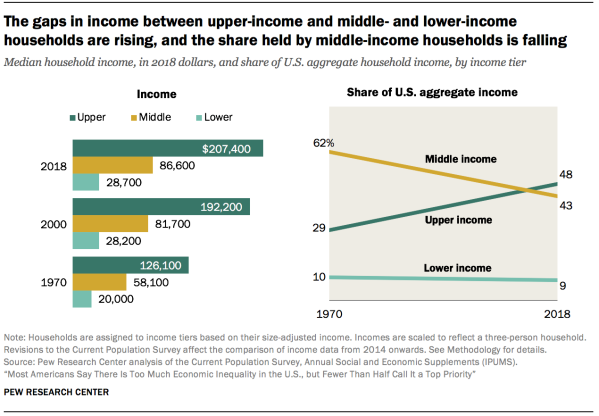
But in a class war, all of the rich lose, no matter what color they are. The constantly expanding wealth gap is between the 20% and the 80%:

From 1971 to 2019, the share of adults in the upper-income tier increased from 14% to 20%. Meanwhile, the share in the lower-income tier increased from 25% to 29%.

One of the richest men of the Gilded Age, Jay Gould, is supposed to have said, “I can hire one-half of the working class to kill the other half.” That’s true in a race war, but not in a class war—in every successful revolution of the poor against the rich, the army joins the side of the poor. The rich can’t win when they have all the money and no one to serve them.
Bonus fact #1:

In 1980, the United States and Western Europe shared a similar wealth gap, with the top 1% receiving 10% of the income in both places. Since then, they have deviated significantly, according to the 2018 World Inequity Report. By 2016, Western Europe’s top 1% got about 12% percent of the income, compared to 20% in the United States. In the United States, the income share held by the bottom 50% tumbled to 13% in 2016 from more than 20% in 1980.

Bonus fact #2:

In 2018, the richest 10% held 70% of total household wealth, up from 60% in 1989. The share funneled to the top 1%’ jumped to 32% last year from 23% in 1989.

Related: Why the Black Elite Wants to Talk about Race instead of Class

Racism
Race
Class
Class Warfare
Robin Diangelo
Recommended from ReadMedium