Why The USSR Senselessly Drove Whales To The Brink Of Extinction
Whaling for the sake of whaling
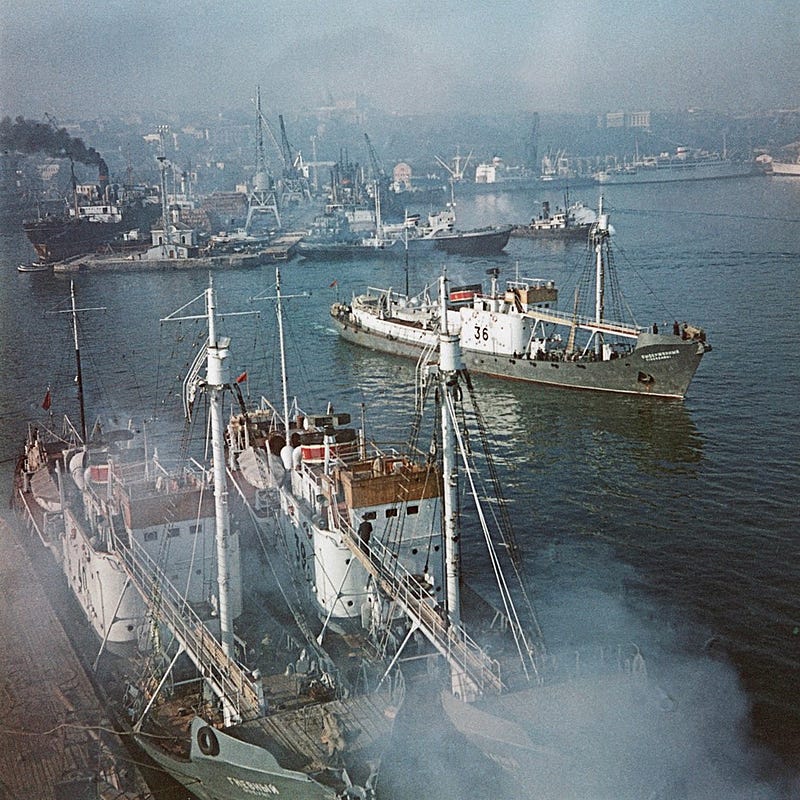
Whaling has long been a part of Russian culture. Russians have participated in whaling activities for centuries, tapping into the fertile whaling grounds in the far northern waters of the planet. However, in the 20th century, when the rest of the world started winding down their whaling economies, the Soviet Union doubled down. Instead of pulling back, the USSR started sending whaling ships all over the world in hopes of bagging more and more of the aquatic mammals.
Over the course of the 20th century, the USSR would go on to slaughter hundreds of thousands of whales, many of them threatened or endangered. During the 1960s and 1970s, treaties and quotas were put into place to try and prevent the overhunting of whales. Instead of complying, the Soviets continued to bring in their hauls while presenting the governing bodies with doctored books and records that vastly undercounted their kills. The USSR hid their crimes from the international community and continued to wipe out pods of whales even when evidence started to grow that such activities were putting the natural whale populations at risk of extinction.
So why were the Soviets so intent on whaling? Were they gaining serious benefits from the wholesale slaughter of whales? It was all derived from the centrally planned economy, which favored numbers for the sake of numbers.
Quotas, Quotas, Quotas
After World War II, the Soviet Union looked around the world and began reorganizing its peacetime economy. The Soviet Union long adhered to a centrally planned economy. Economists would meet and set quotas for various economic activities. Each region and industry was tasked with meeting certain goals. Every quarter, these quotas were evaluated and underperformers were punished, stripped of valuable stipends and sometimes relocated to different industries or even entirely different regions. No one wanted to miss quota and risk losing their house and being shipped to Siberia.
Nothing escaped the Central Planning Committees gaze and that included whaling. Despite the fact that crude oil and synthetic lubricants had long replaced whale oil as a viable material, the Soviet Union decided to set high quotas for their whaling fleets. Numbers were doled out, and whaling captains were tasked with bagging a certain number of whales in order to meet quota.
The great tragedy of this system is that it led to the deaths of countless whales for very little gain. The USSR was not benefiting from the large number of whales being killed. Instead, they compared themselves to other cultural whaling societies, such as Norway and Japan, and said that they could match or beat them. Many of these quotas had nothing to do with industrial or domestic demand and instead had everything to do with projecting power and prestige to nearby nations.
Soviet aquaculture scientist Alfred Berzin wrote in his memoirs in 2008 that Soviet whalers were told to kill whales just so that they could say that they had killed them.
They were motivated by an obligation to satisfy obscure line items in the five-year plans that drove the Soviet economy, which had been set with little regard for the Soviet Union’s actual demand for whale products. — Fee.org
Whaling was a part of the Russian economy, and thus, whaling needed strict quotas to appease the Central Planning Committee. Whalers went out of their way to ensure they met the quota, fearing reprisals or a loss of income if they did not perform. So thousands of whales died each year so that Soviet whalers could extract small amounts of usable blubber and leave the corpses to rot in the sea in order to meet the requirements of an arbitrary piece of paper prepared in Moscow.
Gross Output
One of the reasons Soviet whalers began hunting endangered whales was because of their size. Many of the Soviet quotas were based on the concept of “gross output.” The viability or quality of the materials didn’t matter much, just the output. That meant that whalers were rewarded for hauling in massive whales, even if they did not produce many viable materials. This saw Soviet whaling ships sailing far and wide looking for blue whales and pygmy blue whales because of their size, not because of their value.
At the start of the 20th century, many whale populations had recovered from the last great whaling surge in the 18th and 19th centuries, only to be knocked down again by indiscriminate whaling by the Soviet Union. The USSR would kill roughly 500,000 whales during the 20th century. The USSR was so destructive because they hunted all whales. The larger, the better. They did not follow or adhere to new whaling guidelines crafted to protect vulnerable fisheries and whale populations. All that mattered was the gross output.
Whaling captains would bag massive blue whales and then record an equally massive number in their log which would appease their land based superiors.
In responsible whaling cultures, whalers evaluate whales based on their potential for blubber, meat, or bones. Sperm whales, for example, were heavily targeted because they produced a usable amount of oil. But the Soviet whalers were not doing this. When asked years later about their actions on the high seas, many Soviet whalers shrugged and said that whaling was good way to make a living and that no one could skirt the Soviet system when they were living in it. As long as they were getting paid and not rocking the boat (no pun intended), they were content to kill as many whales as needed.
International Pressure
The slaughter of tens of thousands of illegal whales does not easily go unnoticed. During the 1970s, environmentalist groups began targeting Soviet whalers in a bid to uncover their volume. These groups harassed Soviet whalers and reported their illegal activities to world governing bodies. The USSR denied any wrongdoing and never produced accurate logs or figures about their whaling activities. It was not until after the fall of the USSR that Soviet whalers came forward, and Soviet planning documents were made public.
The system didn’t change because it was designed to be unchangeable. Going back to Alfred Bezin again:
For seventy Soviet years the industry of lies was created, shaped, and perfected in the country. Lies were encouraged and cultivated, and people were forced to lie. Lies in art, lies in movies, on TV, on the radio, and in newspapers.
Lying was a part of the culture. Speaking up got you sent to the gulag. Everyone was just trying to keep their heads down and survive. The decision to slaughter thousands of whales was not engineered by the whalers themselves but by party commissars in stuffy Moscow offices looking for a way to boost the output of their communist system arbitrarily.
By 1980, the Soviet focus on “gross output” and their refusal to follow the rules led nearly every large whale species to be teetering on the brink of extinction. Phillip Clapham, the former head of NOAA, said that illegal Soviet whaling in the 20th century accounted for the “largest removal of biomass in world history.”
The End
Due to international pressure and the fact that arbitrary whaling quotas were not benefiting the Soviet Union in any tangible way, whaling eventually came to an end. The 1980s saw most commercial whaling operations be declared illegal. Whalers were banned from large swaths of ocean in a bid to protect the remaining populations. In 1987, the USSR ended its commercial whaling operations for good. Today, Russia does not pursue any serious commercial whaling.
Despite the end of the practice, it only took 50 years for the Soviet Union to wreak havoc on local whale populations. They did a massive amount of damage in a startingly short amount of time.
Despite the shocking numbers, Norway and Japan actually killed more whales in the 20th century than the USSR. But Norway and Japan were targeting legal whales while the USSR was largely targeting illegal and endangered whales to meet their quotas.
Sources