
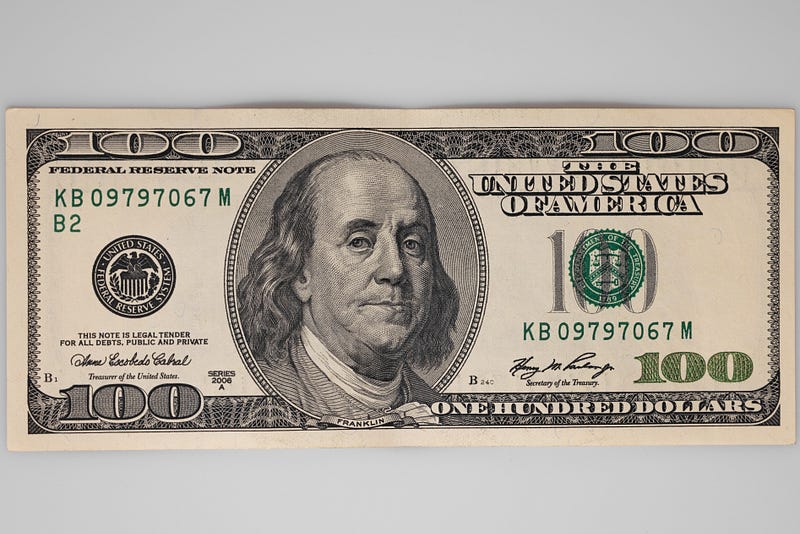
Why The U.S. Dollar’s Reserve Currency Status Is Safe
The cases against the Chinese yuan and Bitcoin
The U.S.’ dollars (USD) reserve currency status seems as safe today as it’s ever been over the past decade or so — inflation is down, the U.S. economy is strong, and the most important reason: competitor currencies look less attractive by the day.
It’s great being the country that issues a reserve currency. It means that other countries, central banks, global companies, and investors use your currency to transact, raise capital, and save (as a store of value).
The net effect is that demand for USD and USD denominated assets are significantly boosted by reserve currency status — if the reserve currency is the world’s de facto store of value then sovereign bonds issued by the owner of that reserve currency become the world’s de facto risk free asset. This allows for a lot more dollars to be printed before being hit with significant inflation as well as a lot more USD debt (a.k.a. U.S. Treasuries) to be issued before being hit with higher yields. A major reason that our economy is still looking good after a decade plus of super easy monetary policy and significant money printing is precisely because of the U.S. dollar’s reserve currency status.
In 2021 and 2022 when inflation fears started hitting the U.S., everyone started wondering if reserve currency status was at risk. And if it was, then who would be next in line to inherit the all-important mantle? More traditional pundits thought that the Chinese yuan could be ready for prime time. While others frothing over Bitcoin’s rapid price rise thought that its ascent equated to a permanent impairment in the dollar’s value.
Hindsight 20–20, both were clearly wrong. Let’s take the yuan first. For a while it looked like China had handled both COVID as well as the economic consequences of COVID better than the U.S. had. A quick 180 later, China is now mired in a real estate slump, terrible job market, and looks to be entering deflation. Given high debt levels both within its government and banking system, deflation is going to be a real doozy — deflation raises the real cost of debt (the money you pay back is worth more than the money you initially borrowed) and puts tremendous pressure on borrowers.
Couple these macroeconomic issues with questions around China’s increasingly dictatorial leadership style and the possibility that it might try to make war and you can see why foreign investors and banks are leery of holding too much yuan.
An added wrinkle is that China’s wealthy also see the writing on the wall. The best days of China’s economy are behind it (at least for the foreseeable future) — looking forward they see only deflation, asset price declines, and anti-corruption purges. Thus, there’s huge demand from China’s rich, especially those whose riches were ill-begotten, to get it the heck out of the country. Such a mad dash for the exits is obviously terrible for the economy and asset prices and could easily turn a downturn into a depression.
A prerequisite of reserve currencies is extreme liquidity — people need to be able to access their money whenever they want it and be able to do whatever they want with it. If China’s rich could do that, they would take all their yuan and peace out. That would be unacceptable to the Chinese government (who obviously don’t want a depression). Thus, unless there is a political regime change the Chinese yuan will never be a viable reserve currency — capital controls are too important to the Chinese Communist Party.
What about Bitcoin? Don’t make me laugh. The pipe dream was fun while it lasted — but there’s just way too much volatility and shadiness in and around the crypto ecosystem. Bitcoin is a gamble not a store of value. Same with Ether. The irony is that in order for Bitcoin to have a chance of becoming a reserve currency, it needs to be regulated (so that holders are more protected from failures and scams). But that regulation would cancel out the one thing that makes Bitcoin so magical to its supporters — the fact that it’s unregulated and independent of governments and banks. It’s both sad and funny that the safest and stablest cryptocurrencies are the ones that back themselves with … drumroll … the U.S. dollar.
So for better or worse, the U.S. dollar has lucked itself into locking in its plum position as the world’s reserve currency for the foreseeable future. American politicians and policy makers — please don’t mess it up.


