
LAW
Why The Supreme Court Embraces Originalism, A Racist Legal Theory
We must evolve beyond the interpretations of White men
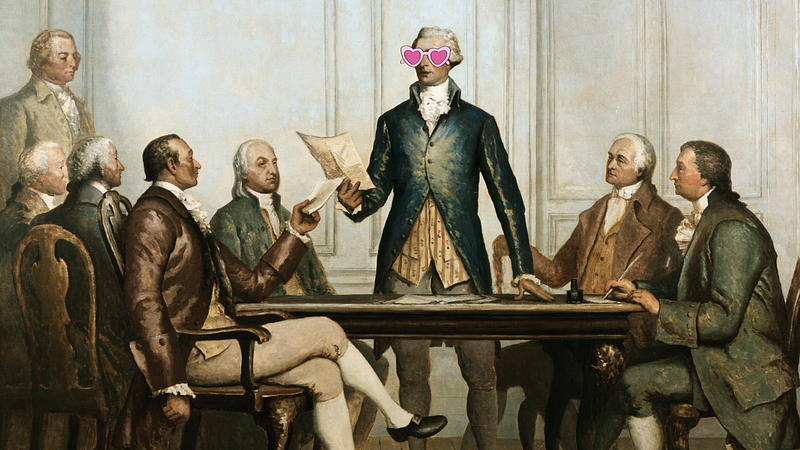
If you see the world through rose-colored glasses, you're likely to believe that the world is inherently just, which is a problem when you're sitting on the highest judicial body in America, the Supreme Court. Since 1789, when Congress established the court, justices have been tasked with interpreting the law. Unlike the legislative branch, which has the power to create new laws, Supreme Court justices may only interpret whether parties in cases brought before them are behaving consistently with the law. Their decisions, in turn, have a wide-sweeping impact on the lives of Americans.
Originalism, a legal theory that at least five sitting Supreme Court justices endorse, refers to the notion that "judges must interpret the Constitution as it was understood when ratified." While this statement sounds race-neutral on the surface, originalism is racist since when the founding fathers ratified the Constitution, only White, landowning men were considered citizens. If we choose to see the world through their rose-colored glasses, then we would not consider Black people or women of any race as citizens, and thus, any effort to safeguard their rights will be dismissed. For instance, last summer, conservatives on the Supreme Court overturned Roe v. Wade, leaving states to individually decide whether women's reproductive rights would be respected by state law.
Originalist judges express a belief that we should interpret the U.S. Constitution according to the legal opinions of 18th century white men. — Baynard Woods
In contrast, many liberal legal scholars believe in "living constitutionalism." In short, people elect representatives in both houses of Congress, empowering them to pass laws. Thus, the interpretation of the Constitution should be rooted not only in the whims of the founding fathers but also in alignment with America's dynamic culture. For instance, in January of 1865, less than a hundred years after the nation's founding, Congress passed the Thirteenth Amendment, legally abolishing the chattel slavery system. Clearly, the country had fundamentally changed from the nation founded by a group of enslavers and wealthy bureaucrats. It's puzzling that anyone would want us to be limited to the founders' racist interpretations when the nation has, over time, extended rights to Black people and women. Originalism is an obsession with and deification of the founding fathers, who were mere mortals.
An originalist interpretation of the Constitution confines us.
Before the Civil War, in 1857, Chief Justice Roger B. Taney, the Supreme Court justice who read a majority opinion in Dred Scott v. Sandford, claimed "enslaved people were not citizens of the United States" and thus not legally eligible to petition the court. Using an originalist-style argument, Taney argued that since the majority of the Constitution's authors considered Black enslaved people as property and not people, they could not petition the court. Including Black people as citizens would run contrary to the founders' intent, so choosing to interpret the law from an originalist perspective, consistent with the founders' ideological framework, perpetuates the inequalities that existed in the 1700s.
While originalism has existed since the nation's founding, Calvin TerBeek, a University of Chicago Ph.D. candidate, noted that "originalism arose out of the backlash to Brown v. Board of Education," the 1954 landmark Supreme Court decision that prohibited public school segregation. Conservatives argued that those who drafted the 14th Amendment, which granted "equal protection" to citizens regardless of race, never foresaw the possibility of racially integrated schools. Barry Goldwater, a former Senator who is a hero amongst conservatives, noted that "the 14th Amendment's framers had no intent of creating integrated schools." This idea is dangerous since it attempts to confine people living in the modern era to the ideologies endorsed hundreds of years ago. It doesn't allow the country to evolve as a multiracial, multicultural democracy, to become something grander than the White, landowning founders envisioned.
According to Baynard Woods, the author of Inheritance: An Autobiography of Whiteness, "The conservative supermajority" on the Supreme Court" has weaponized this harmful judicial philosophy to embrace a racist, patriarchal narrowing of political rights." For instance, while some argued that the originalist perspective would lead Supreme Court justices to uphold affirmative action since the drafters of the 14th Amendment "did not require states to be blind to race," their "originalist analysis" then "posited that governmental benefits fell outside the scope of the Fourteenth Amendment." While others suggested the use of race-based affirmative action policies violated the 14th Amendment’s equal protection clause. Legal scholars have since criticized conservatives on the court, like Clarence Thomas, for cherry-picking originalism. The court's decision to ban race-based affirmative action policies this summer, once again, exposes the hypocrisy of conservatives, who only want to apply originalism when it limits the rights and benefits citizens receive.
Originalism attempts to confine the interpretation of the law in the modern era to the largely misguided views of the founding fathers, many of whom enslaved Black people and diminished women's rights. And the irony isn't lost on us that conservatives only embrace originalism when it meets their modus operandi. If the founding fathers were anti-racists instead of bigots, conservatives wouldn't be originalists. They would instead endorse the idea of a living constitution.
🌹Learn more about the author here.