Why the New Silk Roads Matter for Our Future?
Some Comments on a Book

As America becomes incapacitated by the irregularities and fraud of its 2020 Presidential Election, the world continues to move on to its pre-ordained future relentlessly disregarding the impact of who might be the next United States (US) President. In truth, whoever is the next US President would not have any significant impact on the inevitable future of the world even as we are profoundly interconnected.
The US and much of the Western World are no longer key actors and drivers of the winds of change sweeping across the globe at the turn of the 21st century. Peter Frankopan’s book “The New Silk Roads” (Bloombury, 2015) is about the change phenomenon which has transformed the traditional Silk Road with newer and stronger networks of relationships throughout the entire length and breadth of newer Silk Roads.
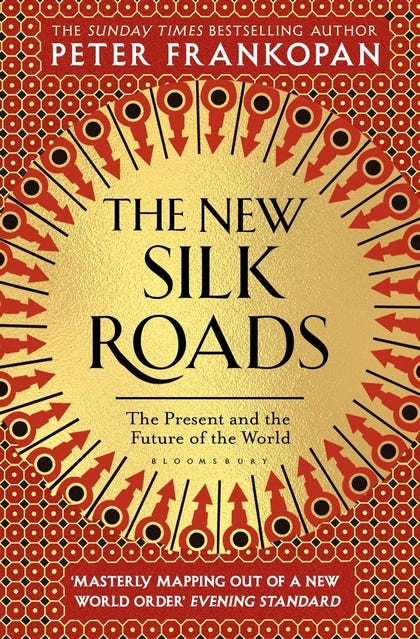
Peter’s book is about change, and he reminded readers of the permanently continuous change grounded in the past. He sees the waning influence of the US and the West, the decline of America and Western Europe as a pivotal region of global political economics. He focused on China, the origin and destination of the genesis Silk Road which was a network of trade routes connecting ancient China and her neighbours in the Middle East, the Mediterranean, Europe, and beyond towards the Atlantic Ocean. The Silk Road was catalytic and central to the development of political, economic, scientific, and cultural interactions between these regions from during the late Roman Empire, in the 2nd century BCE, to the 18th century.
“We are living through a transformation and a shift that is epochal in its scale and character, similar to what happened in the decades that followed the crossing of the Atlantic by Columbus and those who followed him.”
The world today is in a light-speed transition. The rise of China’s political, economic, and social influence from the end of the 20th century was hastened by the decline of the US and its Western allies, as well as Russia. Russia and the Middle East however continue to remain important levers of global politics through the economics of energy and minerals.
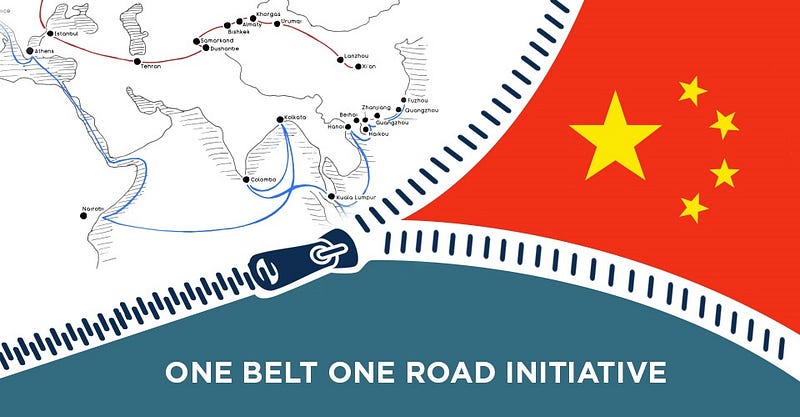
Peter systematically described a China far removed from any Western influence in its 5,000 years history, its politics, philosophies, and worldviews. He is fascinated with China’s Belt and Road Initiative (formerly known as One Belt One Road or OBOR) announced in 2013 by Chinese President Xi Jinping, as a global infrastructure development strategy to invest in nearly 70 countries and international organizations based on the spiritual principles of Peace and Co-operation, Openness and Inclusiveness, Mutual Benefits and Win-Win results.
Since the launch of Belt and Road, President Xi Jinping (and other Chinese leaders) has spoken frequently on China’s desire to “boost mutual understanding, mutual respect, and mutual trust” and promote “peace and development”.
It is the Chinese approach to establish trade connections and political ties between China and nations across Asia, the Middle East, Africa, and beyond. Critics have argued that it is in fact a Chinese strategy to seize economic and political control of more and more nations across the world. There has been no evidence of such Chinese overt or covert domination or political colonization.
‘The Belt and Road is all-encompassing and can include anything and everything; but then again, that was the case too with the Silk Roads of the past as well — where events that took place in one part of the world were sometimes directly linked to consequences in another.’
‘The new Silk Roads are an integral part not only of China’s economic and foreign policy, they are an integral part of how China sees the world — and how it is preparing for the future.’
Peter noted that much of the new Silk Roads is about how China’s “Belt and Road” have come to ring the world. “Over 80 countries are now part of the initiative,” he pointed out, encompassing more than 63% of the world’s population and 29% of its global economic output. [Author: As of March 2020, 138 countries have joined the Belt and Road Initiative (BRI) by signing a Memorandum of Understanding (MoU).]
Peter’s book is full of details from his research travels. For example, a “dry port” at Khorgos, on the China-Kazakhstan, acts as a giant dispatch centre for goods shipped in from coasts well over 1,000 miles away, Azerbaijan pumps gas to south-eastern Europe, Iran provides a third of India’s oil, Afghanistan is building a pipeline into Pakistan and India, while a spanking new seaport sits on the Caspian shores of Turkmenistan which is the world’s largest port below sea level. And then some.
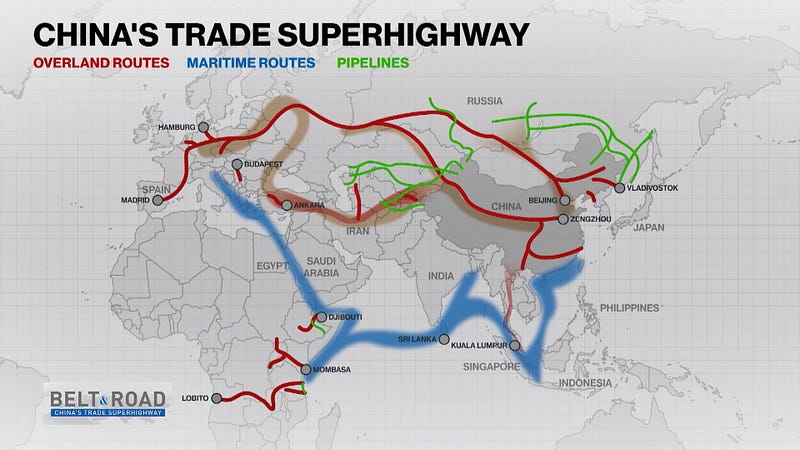
The One Belt One Road initiative has also created and facilitated cross-border cooperation. For example, a Eurasian Economic Union embraces Belarus, Russia, Armenia, Kyrgyzstan, and Kazakhstan, and has engaged in trade talks with Iran. The “Bright Road initiative of Kazakhstan, the Two Corridors, One Economic Circle initiative of Vietnam, the Middle Corridor initiative of Turkey, the Development Road initiative of Mongolia” — are visible impact results of China’s One Belt One Road, the biggest connective global grandfather project of all.
In Africa, Peter discovers that China has been building new highways and railway lines throughout the country and beyond its borders, forging direct links with the lucrative markets of Europe and the rich resource-producing African nations. In Djibouti, for example, China is building a military base. Strategically located on the Horn of Africa, it is a natural convergent hub for highways that might one day radiate across the continent. The U.S. has a military base there, while France and even Japan have troops there. Nearby, Russia has been working in neighboring Somaliland to establish a military presence and is now set on “helping the breakaway republic establish its independence from Somalia and be internationally recognised as a sovereign state.” Peter sees the unstoppable currents of re-alignment in active real-time movement to radically change the order of the African political and economic eco-system landscape.
Peter’s broad sweep of history, led by his deep knowledge of the original Silk Road, directed our attention mostly on Russia, Iran, and China (and other adjacent countries) to provide an updated picture of the current new Silk Roads through the major international relations, economic, financial and realpolitical events over the turn of the 21st century.
Napoleon Bonaparte once said, “China is a sleeping dragon. Let her sleep, for when she wakes, she will move the world.” Peter’s new Silk Roads show us the chosen routes of the awakened Chinese dragon even as her emergence also signals the dawn of a new global order and the waning of Western pre-eminence and influence.
Read the book as we prepare to be ready for the inevitable change already upon us.
Please enjoy my recent Articles.
You can also subscribe to my stories and social media posts via your email.
Enjoy more interesting Articles by signing up to Medium here: https://thefuturistoracle.medium.com/membership