Why The Mandalorian Feels Like Star Wars — and the Sequel Trilogy Doesn’t
(Note: Some spoilers through Season 2, episode 6)
When George Lucas filmed a battle on Geonosis for his prequel trilogy, he took inspiration from Saving Private Ryan. When he and Dave Filoni created a new battle on Geonosis for Star Wars: The Clone Wars, they quoted the same source. It was not a singular occurrence. Indeed, The Clone Wars frequently riffed on various war movies, B-movies, and other genre fare. A Godzilla-like monster ravaged Coruscant. A crucial arc borrowed the premise of The Fugitive, with episode titles riffing on Hitchcock films. Another adventure copied liberally from The Seven Samurai.
That last one was also stolen by The Mandalorian, in its first season’s fourth episode. With The Clone Wars’ Dave Filoni acting as an executive producer and occasional writer/director, it’s no surprise that the two spin-offs share some DNA. But this particular bit of DNA explains why The Mandalorian and The Clone Wars succeed, while Disney’s sequel trilogy ran into so many creative difficulties. In short, the TV shows borrow from the same sources as George Lucas.
Star Wars, for all its acclaim, is not the most original franchise ever created. George Lucas wore his inspirations on his sleeve, from samurai films to Flash Gordon. And the diverse number of precedents gave him plenty of chances to mix and match his favorite tropes. When Disney developed its own Star Wars films, this lesson was lost.
The Disney Star Wars films, especially the two by J.J. Abrams, rely heavily on nostalgia, and not for Akira Kurosawa. Instead, they are devoted to remixing only the original Star Wars trilogy, mostly just the first film. If the source material was longer, this wouldn’t have been a problem, because Abrams would have had plenty of tropes to choose from to create an original story. Instead, he essentially remade A New Hope. There weren’t any other cards available in such a small pool of references. The Force Awakens and The Rise of Skywalker are copies of a copy, with an increasingly corrupted understanding of their genre’s traditional appeal.
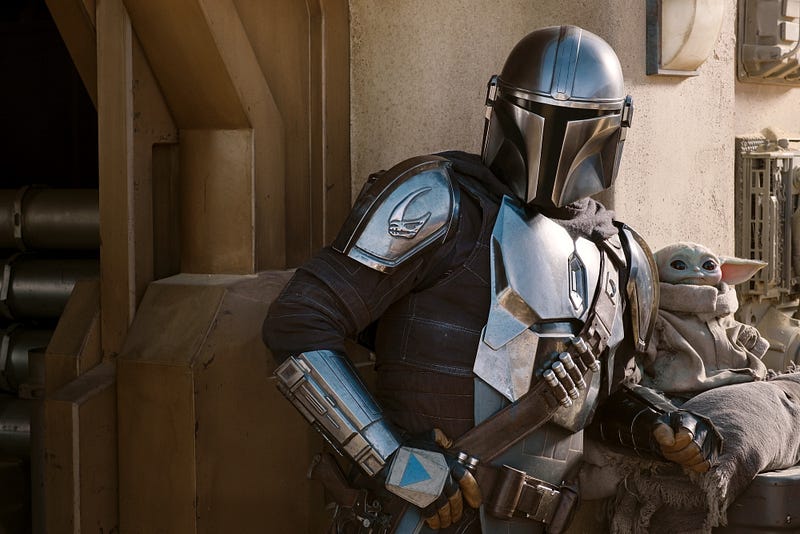
The Mandalorian is different, going back to those original references. It homages John Ford as much as Harrison Ford, and that makes it feel authentically Star Wars, because Star Wars already was a series of homages. Nowhere in the original trilogy is there a man with no name or a lone wolf and cub. But these are very much the kinds of influences the franchise already had, so integrating them now makes for a continuation of George Lucas’ universe, rather than a repetition of it.
Even when the show does reference other Star Wars movies, it does so with a more restrained mentality. It repurposes the mythos for its own ends as it needs it, and nothing more. The Mandalorian might visit the Mos Eisley Cantina, but only for scenes that had to be set at a cantina somewhere. That crossover even allows for some worldbuilding. The place has emptied out since its film appearance, hinting at the hard times Werner Herzog’s character claimed the galaxy was now facing.
Jawas and Tusken Raiders are toys in the sandbox, available for play, but they are not assigned any greater value than what they can add to the story. It can be Sand People one week and frog people the next; this universe has a lot of aliens, so it makes sense we get an assortment. And if anyone watching the show has not seen the movies, they might not know which creatures are callbacks and which debuted last Friday morning.
Recent guest stars Ahsoka and Bo-Katan have extensive history from the animated shows, but if you didn’t know that going into their episodes, you wouldn’t be at a disadvantage. There are no in-jokes or unnecessary callbacks, nor does music dramatically swell as their faces or names are revealed. Both get exciting introductions, but they’re the kind of introductions a cool new original character might also get. When Bo-Katan drops Ahsoka’s name, her delivery is casual and the circumstances behind it are logical. When Ahsoka refuses to train Grogu, animation fans know she’s thinking of Anakin, but her comments stand on their own. It’s probably hard to find a Mandalorian viewer who’s never watched even the movies, but if you did find one, they could follow the story just fine.
Of course, the one exception here would be Boba Fett’s introduction in the Season 2 premiere, which did swell the music for a dramatic reveal. His later appearance comes at an oddly climactic moment if you don’t know who he is, but is still otherwise fully explained, at least by the show’s usual standards. That lone reveal remains the exception rather than the rule, which is a radical break from the Disney films.
Even Rogue One had some nonsensical cameos by cantina patrons, pausing the story for a hit of nostalgia. Like the Dark Side, it was the quick and easy path, but, also like the Dark Side, it was seductive. The films performed at peak financial expectations, but diminishing returns were seemingly setting in. Solo underwhelmed and The Rise of Skywalker might have only been a hit because of an ideal release date. The series made a dismal first impression in China, where audiences watched the sequels without the benefit of nostalgia and promptly rejected them. (And the Chinese love plenty of American blockbusters, from Marvel to Fast & Furious, so cultural differences probably weren’t the issue.) Critics and fans disagreed about why the films were failing, but by the trilogy’s end, few disputed the basic assessment.
Disney might hope the films’ reputations will improve with time, which appears to be happening with the prequels. But those films were always controversial in a different way than the sequels are. It helps that a generation that was raised on them is coming of age, and that The Clone Wars retroactively improved their setting. But love them or hate them, the prequels didn’t rely on nostalgia. They swung for the fences, with a ton of interesting, provocative ideas. Even when those ideas were misguided or the execution was atrocious, it’s still a singular vision unlike anything before or after it. For that reason, a revival probably won’t strike twice. Young fans likely won’t latch onto the sequels as their own version of Star Wars, because there’s little to distinguish them from what came before.
They might latch onto The Mandalorian, though, because The Mandalorian doesn’t just imitate Star Wars. It simply is Star Wars. It accomplishes this by drawing inspiration from the same sources as the original movies, instead of drawing inspiration from those movies themselves. And it merely continues past stories where they are relevant, rather than gratuitously paying homage to them at its own narrative’s expense. By not copying the original trilogy, it has summoned its spirit far more than any Death Star knockoff ever could.
You seem awesome! Join my newsletter, and together, we can rule the galaxy as culture-savvy geeks!