
Why the Left and Right Are Both Wrong About Inequality
The fix is simpler than we’re led to believe

Would you believe me if I told you that we could significantly reduce wealth inequality in the US by addressing one simple issue? That change doesn’t involve taxing the rich at 90%, raising the minimum wage or building a nordic-style welfare state.
It doesn’t involve cutting welfare spending, school vouchers or investing in job development programs.
That’s not to say that there aren’t legitimate discussions to be had about those proposals, but none of them deal with the major obstacle facing America’s poor.
That obstacle is our approach to criminal justice. It is, I will argue, the most important factor in solving the inequality problem because it holds back poor communities in ways that other factors do not.
It does this through the twin policy failures of the tough-on-crime movement, and the war on drugs — both of which have given us our current problem of mass incarceration.
To show why this is true we have to take a hard look at America’s inequality problem from a bird’s eye view.
Inequality in America: Extent and Causes
The United States is currently ranked fourth among OECD nations in relative poverty. Relative poverty is a metric that measures the percentage of people living below half of the median income for a particular nation.
The typical explanation for this is either the comparably small size America’s welfare state and/or its supposed lack of economic regulation. Both of these explanations are unsatisfying because the data does not show a consistent correlation between either of them and inequality across the board.
For instance, if the United States was an inequality outlier because it lacked business regulation, we should expect to see it rank comparatively high in economic freedom. However, according to Economic Freedom Index, the U.S. ranks 17th in economic freedom, coming in below countries such as Australia, New Zealand, Switzerland, United Kingdom, Denmark, and even Canada.
A specific example of how economic freedom doesn’t seem to correlate with inequality is to look at the minimum wage. It is often assumed that a higher minimum wage is essential in reducing inequality. Yet some of the countries who do best in terms of income equality have no national minimum wage at all. For instance Sweden, Denmark, Norway, Switzerland and Iceland.
The freedom with inequality association is also at odds with global economic trends, especially in the developing world. The current trends show that as economies are liberalizing, millions of people are being lifted out of poverty. In fact, according to ourworldindata.org global poverty has decreased by half since 1990.
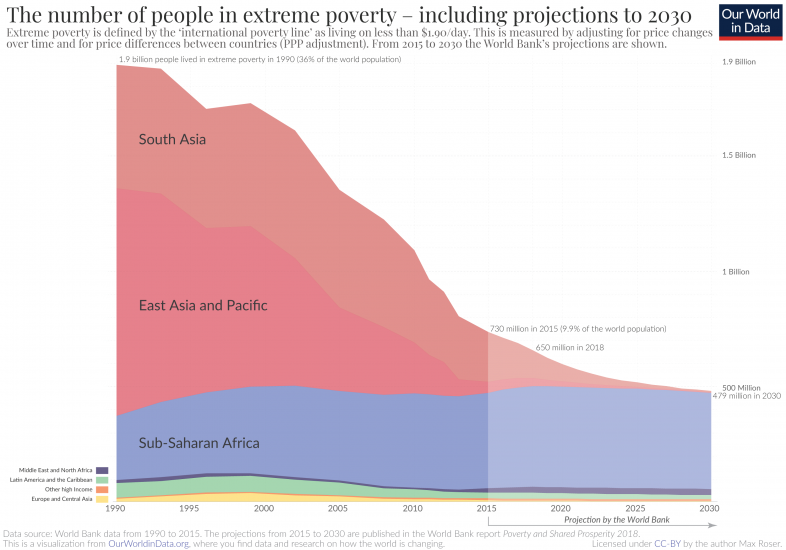
It may seem counter-intuitive, but economic freedom tends to lessen poverty in absolute terms slowly over time.
Furthermore, the evidence doesn’t point to a lack of mobility potential in the American economy. According to data from the Treasury department over half of American taxpayers were able to better their lot — including those at the bottom of the economic ladder — in recent decades.
The report on Income Mobility in the U.S. from 1996–2005 states that “there was considerable income mobility of individuals in the U.S. economy during the 1996 through 2005 period as over half of taxpayers moved to a different income quintile over this period.” The report goes on to state that “roughly half of taxpayers who began in the bottom income quintile in 1996 moved up to a higher income group by 2005.”
This may seem at odds with many news stories which claim that Americans have only struggled to maintain their income level and purchasing power since the 1970s. As economist Thomas Sowell points out in an article entitled, Using Statistics To Lie About Inequality, this is due to statistical manipulation that fails to differentiate between “households” and the economic well-being of individuals. Household sizes have decreased in the last 40 years. The income of the individuals in those households has not.
There does seem to be a positive correlation, however, and likely a causal relationship between government social spending, and the reduction of inequality. This has been shown in a recent study, and even acknowledged by the libertarian Cato Institute. The United States has taken a more minimalist approach to social spending compared to other wealthy nations, and it should be acknowledged that that is likely a cause of its high level of inequality — at least in part.
However, social spending doesn’t tell the whole story. When looking at absolute poverty, rather than relative poverty, the case for high social spending levels is not as strong.
While the U.S. has high levels of relative poverty (around 17%) levels of absolute poverty are much lower (closer to 13%). According to a paper published in the Journal of Economic Perspectives, the United States was found to have lower rates of absolute poverty than the UK, Sweden, and Finland.
Although the picture there is complex. When looking at absolute rates of child poverty, the U.S. jumps up to #2, behind the U.K. The U.K., in fact, was found to be the leader in absolute poverty among wealthy nations by all metrics. However, the UK is more generous with social spending than the U.S.
Further complicating the economic picture are America’s high levels of immigration from impoverished nations. In fact, America leads the world in opening its arms to the world’s poor. As a result, it does appear that the U.S. imports a certain amount of global poverty. Identifying the importation, or “compositional effect” (as economists will sometimes refer to it) is not to say that immigration has a negative effect on the living standards of Americans in general. To the contrary, immigration has been shown to generally improve economic conditions, especially over the long term.
According to a paper published by Professors Steven Raphael and Eugene Smolensky of UC Berkely, this compositional effect is relatively modest. The reason for its modesty, they found, is that immigrants who arrive poor tend to escape their poverty in a relatively short time. This again shows that the inequality problem is not one of general social mobility.
However, there may be a more specific problem of social mobility caused by specific obstacles. That is where the criminal justice factor comes in.
Incarceration’s Effect on Poverty
According to the Center for Community Change, if not for the rise in incarceration that has occurred in recent decades, “the number of people in poverty would fall by as much as 20 percent.”
They found that “the U.S. economy more than doubled in the three decades prior to the Great Recession, but the poverty rate remained largely unchanged. At the same time, incarceration rates increased rapidly by 342%, from 111 to 491 for every 100,000 citizens.”
In a paper entitled The Relationship Between Poverty and Mass Incarceration, How Mass Incarceration Contributes to Poverty in the United States, the Center cites the following factors that link poverty and the rise in imprisonment that has occurred in the past four decades:
- Removes primary earners and drains assets of low-income families
- Limits access to public benefits
- Disrupts the social and economic fabric of neighborhoods
- Imposes barriers to employment
- Results in reduced lifetime and intergenerational earnings
This point has been made again, and again by criminologists, and sociologists in places such as the Journal of Crime and Delinquency , The New York Times, the Population Reference Bureau, and in many other studies and articles which a basic internet search on the topic will show.
The problem mainly comes down to excessively harsh prison sentences that lock people up for too long, and keep them in prison past the age when they are most likely to commit more crimes (there is ample evidence that criminal activity decreases with age — particularly after 40).
But there is another element to the equation that both contributes to the incarceration problem, and also causes economic problems on its own. That is the War on Drugs. Pushing drugs underground in poor communities has been shown to disincentivize social mobility.
For instance, if you happen to be 18 years old, living in a poor household in the inner city, and you can make a ton of money selling drugs, working your way up at Wal-Mart or McDonalds while you go to school at night is not going to make a lot of sense. This is a point that John McWhorter, contributing editor for The Atlantic, has made for years in various articles, such as this one in The New Republic. He spells it out in detail in the speech below he gave several years ago at the Cato Institute.
This effect is not particular to the United States. The NGO, Health Poverty Action has examined the effects on the drug war globally and found them be devastating for poor communities in developing nations like Brazil. The reasons seem to overlap with the explanation that McWhorter gives for its effect on poverty in the U.S. Martin Drewery, CEO of HPA, explains it this way:
There is a self-perpetuating cycle of poverty. People get involved in drugs to afford the basic essentials of life because of a lack of other options. Then they get arrested and their life chances are even more severely damaged. So there are whole families where this cycle has been passed down from one generation to the next. One girl in São Paolo told us how she had to start selling drugs because her mother had been arrested, and she needed to provide for her younger sisters. She was 12 years old. Sixty-four percent of the women in prison in Brazil are there for drug-related offenses
Source: How the Drug War Eats the Poor, JS Rafaelli — Vice
Taking Drewery and McWhorter’s advice to heart, there could be many ways to change drug policy in the U.S., ranging from complete legalization to partial decriminalization. But any approach that leaves more families and breadwinners intact will increase social mobility and reduce inequality.
What about controlling crime
In his best-selling book, David and Goliath: Underdogs, Misfits, and the Art of Battling Giants, Malcom Gladwell looks at several areas of society where our assumptions about power and advantage are wrong.
He shows that in many areas of society, the results of factors we think of as advantages can be plotted along an inverted U-curve. That is, the factor in question is an advantage, until it reaches a point where it becomes the opposite. This is the case in the effect of imprisonment on crime levels in a community. Putting more criminals behind bars for longer reduces crime; that is, until it doesn’t.
He cites the work of Criminologist Todd Clear, who along with his colleague Dina Rose studied the relationship between incarceration, and rates of crime in Tallahassee Florida. Their finding was that once more than 2% of a neighborhood goes to prison, crime rates will increase the following year.
Why would that be? Gladwell summarizes Clear’s hypothesis this way:
Prison has a direct effect on crime: it puts a bad person behind bars where he can’t victimize anyone else. But it also has an indirect effect on crime, in that it affects all the people with whom that criminal comes into contact. A very high number of the men who get sent to prison, for example, are fathers. (One-fourth of juveniles convicted of crimes have children.) And the effect on a child of having a father sent away to prison is devastating. Some criminals are lousy fathers: abusive, volatile, absent. But many are not. Their earnings — both from crime and legal jobs — help support their families. For a child, losing a father to prison is an undesirable difficulty. Having a parent incarcerated increases a child’s chances of juvenile delinquency between 300 and 400 percent; it increases the odds of a serious psychiatric disorder by 250 percent.
If Gladwell’s hypothesis is correct, then by dealing with the mass incarceration issue we should expect to not only see a reduction in poverty and inequality, but also a reduction in violent crime.
Conclusion
Hopefully, I have shown that the primary driver of poverty and inequality has little to do with America’s economic system.
There is, however, one factor which has consistently and conclusively shown to be a driver of both inequality as well as absolute poverty. That factor happens to be one of the areas in which America is a strong outlier.
The U.S. currently locks up more of its citizens per capita than any other country in the world according to worldpopulationrevew.com. And as Malcom Gladwell argues, criminologists have found that over-incarceration increases crime.
That means that by rethinking the policies that lead to mass incarceration, we can not only significantly reduce poverty but we can potentially reduce violent crime as well.
By aiming for two birds with one stone, we have a solution that is supported by a wealth of data, strategic and humane.
Surely, that would make for the best place to start.


